Support our educational content for free when you purchase through links on our site. Learn more
12 Types of 3D Printing Technology You Need to Know in 2026 🚀

Imagine a world where you can print everything from intricate jewelry to titanium airplane parts — all from the comfort of your workshop or a high-tech factory floor. That world isn’t science fiction; it’s the reality of 3D printing today. But with so many different 3D printing technologies out there, how do you know which one fits your project best? From the humble FDM printers that hobbyists adore to the industrial-grade Electron Beam Melting machines crafting life-saving implants, each technology has its own quirks, strengths, and ideal applications.
Did you know that over 65% of desktop 3D printers worldwide use Fused Deposition Modeling (FDM), yet industries are rapidly shifting towards Multi Jet Fusion (MJF) for faster, stronger parts? Or that New Zealand’s first 3D-printed house was completed just recently, using concrete extrusion at breakneck speeds? In this comprehensive guide, we’ll unravel the 12 different types of 3D printing technologies, explain how they work, what materials they use, and where they shine — helping you make confident choices whether you’re a hobbyist, engineer, or entrepreneur.
Key Takeaways
- FDM remains the most accessible and versatile 3D printing technology, perfect for beginners and prototyping.
- SLA and DLP excel at ultra-fine details and smooth finishes, ideal for jewelry and dental models.
- SLS and MJF offer support-free printing with durable nylon parts, favored in aerospace and automotive industries.
- Metal 3D printing technologies like EBM and DED produce high-performance parts, but require specialized equipment.
- Choosing the right technology depends on your project’s material needs, precision, speed, and budget.
- New Zealand and global industries are rapidly adopting 3D printing for custom, on-demand manufacturing.
Ready to decode the world of 3D printing technologies? Let’s dive in and discover which method will bring your next creation to life!
Table of Contents
- ⚡️ Quick Tips and Facts About 3D Printing Technologies
- 🔍 A Deep Dive into the Evolution of 3D Printing Technologies
- 🤔 What Exactly is 3D Printing? Understanding the Basics
- ⚙️ How Does 3D Printing Work? The Science Behind the Magic
- 🖨️ The Anatomy of a 3D Printer: Key Components Explained
- 🧩 12 Different Types of 3D Printing Technologies You Should Know
- 1. Fused Deposition Modeling (FDM) / Fused Filament Fabrication (FFF)
- 2. Stereolithography (SLA) and Digital Light Processing (DLP)
- 3. Selective Laser Sintering (SLS)
- 4. Multi Jet Fusion (MJF)
- 5. Electron Beam Melting (EBM)
- 6. Binder Jetting
- 7. Material Jetting (PolyJet and MultiJet Modeling)
- 8. Laminated Object Manufacturing (LOM)
- 9. Direct Energy Deposition (DED)
- 10. Continuous Liquid Interface Production (CLIP)
- 11. Sheet Lamination
- 12. Hybrid 3D Printing Technologies
- 🧪 What Materials Can You Use? Exploring Common and Exotic 3D Printing Filaments and Powders
- 🌏 How 3D Printing is Revolutionizing Industries in New Zealand and Beyond
- 👍 Pros and Cons: The Real Deal on 3D Printing Advantages and Limitations
- 💡 Expert Tips for Choosing the Right 3D Printing Technology for Your Project
- 🔧 Troubleshooting Common Issues Across Different 3D Printing Methods
- 📚 Recommended Resources and Communities for 3D Printing Enthusiasts
- 🎯 Conclusion: Navigating the 3D Printing Technology Landscape with Confidence
- 🔗 Recommended Links for Further Exploration
- ❓ Frequently Asked Questions (FAQs) About 3D Printing Technologies
- 📖 Reference Links and Credible Sources
⚡️ Quick Tips and Facts About 3D Printing Technologies
- FDM is still king at home: over 65 % of desktop machines sold worldwide are Fused Filament Fabrication printers (Wohlers Report 2023).
- SLA laughs at layer lines: layer thicknesses down to 0.01 mm are routine on hobby-grade resin printers like the Anycubic Photon M3.
- SLS needs no supports – the unsintered powder IS the support. That’s why aerospace firms print impossible lattice structures without a second thought.
- MJF is secretly fast: HP claims its Multi Jet Fusion fuses an entire layer in one flash, making it up to 10× faster than SLS for nylon parts.
- Metal printers can weld: Electron Beam Melting hits over 1 000 °C – basically a micro-welder in a vacuum chamber.
- Your dishwasher tablet may be 3D-printed: Unilever and Procter & Gamble both quietly use binder-jetting for rapid detergent prototyping.
- New Zealand’s first 3D-printed house (in Rotorua) was completed in 2022 – concrete extrusion at 300 mm/s!
Need a cheat-sheet right now? ✅ Print this table and stick it above your workbench:
| Tech | Typical Layer Height | Support Needed? | Best For | Wallet Pain |
|---|---|---|---|---|
| FDM | 0.05–0.3 mm | ✅ Yes | Prototypes, toys | 😊 Low |
| SLA | 0.01–0.1 mm | ⚠️ Minis only | Jewelry, miniatures | 😬 Medium |
| SLS | 0.1 mm | ❌ No | Snap-fits, drones | 😰 High |
| MJF | 0.08 mm | ❌ No | End-use nylon parts | 😰 High |
| EBM | 0.05 mm | ❌ No | Titanium implants | 💸 Extreme |
Got your filament snipped and bed leveled? Let’s roll back the tape and see how we got here.
🔍 A Deep Dive into the Evolution of 3D Printing Technologies
Back in 1983 Chuck Hull printed a humble 2.5-inch eye-wash cup – the world’s first SLA part. Chuck didn’t just invent a machine; he birthed an entire vocabulary: .stl files, slicers, overhangs. Fast-forward four decades and we’re printing titanium hip joints and chocolate selfies. The patent cliff in 2009 (thank you, RepRap) uncorked the hobbyist tsunami we now call desktop FDM.
But why should you care about history? Because every “new” tech is a remix of expired patents. SLS, patented 1984, became affordable only after 2014 when key patents lapsed—exactly when startups like Sinterit and Sintratec slid onto the scene. Knowing the patent timeline lets you predict price drops (patent cliff = cheap printers) and spot marketing fluff (re-branded old tech).
Timeline Cheat-Sheet
| Year | Milestone | Why It Matters |
|---|---|---|
| 1983 | SLA invented | Grand-daddy of precision |
| 1988 | SLS patent filed | Powder power begins |
| 1995 | FDM patent (Stratasys) | Birth of consumer FDM |
| 2005 | RepRap project | Open-source explosion |
| 2012 | Formlabs SLA Kickstarter | Sub-$3k resin printers |
| 2017 | HP Jet Fusion 5200 | Industrial speed unlocked |
| 2022 | First 3D-printed house NZ | Construction-scale proof |
Feeling nerdy? Dive deeper into the history of additive manufacturing or browse our 3D-printed archive for retro prints you can still run on today’s machines.
🤔 What Exactly is 3D Printing? Understanding the Basics
3D printing = additive manufacturing = building objects by adding material layer-by-layer under computer control. Contrast that with CNC machining (subtractive) or injection molding (formative). The magic sauce? Digital freedom – you can go from a CAD doodle to a physical doodad without retooling a factory.
Key Jargon Decoded
- G-code: the GPS for your nozzle – tells it where to squirt or sinter.
- Infill: honeycomb (or gyroid) guts that save material and time.
- Voxel: a 3D pixel – MJF printers juggle millions per layer.
- Support: sacrificial scaffolding for overhangs > 45° (FDM/SLA).
Still fuzzy? Picture a hot-glue gun on a robot arm (FDM), a laser pointer in a pool of resin (SLA), or a sandcastle made of powder and a laser (SLS). Same endgame – different dance moves.
⚙️ How Does 3D Printing Work? The Science Behind the Magic
- Design – model in Fusion 360, Blender, or snag something ready-to-go from 3D Printable Objects.
- Slice – run it through Cura, PrusaSlicer, or Lychee (for resin). This spits out G-code.
- Transfer – SD card, Wi-Fi, or OctoPrint if you’re fancy.
- Print – plastic oozes, resin zaps, powder sinters.
- Post-process – support removal, curing, dyeing, machining, or vapor-smoothing (acetone on ABS).
The Physics Corner
- FDM: Shear-thinning – filament viscosity drops under heat & pressure, letting it flow through a 0.4 mm nozzle.
- SLA: Photopolymerisation – UV photons cleave a photoinitiator, snapping monomers into long polymer chains in milliseconds.
- SLS: Sintering necking – laser energy just kisses the melting point, fusing powder grains without full liquefaction (avokes the “melt pool” drama).
🖨️ The Anatomy of a 3D Printer: Key Components Explained
| Component | FDM Example | SLA Example | SLS Example |
|---|---|---|---|
| Build Surface | Heated borosilicate glass | Perforated build plate | Powder bed on piston |
| Motion System | Belt-driven steppers | Galvo mirrors | Galvo + roller |
| Feed Mechanism | Drive gear + PTFE tube | Resin vat + wiper | Powder hopper + recoater |
| Heat Source | 200-260 °C heater cartridge | 405 nm laser diode | 100 W CO₂ laser |
| Control Board | 32-bit ARM (e.g., SKR Mini) | ARM + FPGA for galvos | Industrial PLC |
Pro-tip: upgrading to TMC2209 silent drivers drops printer noise to library levels – your roommates will thank you.
🧩 12 Different Types of 3D Printing Technologies You Should Know
1. Fused Deposition Modeling (FDM) / Fused Filament Fabrication (FFF)
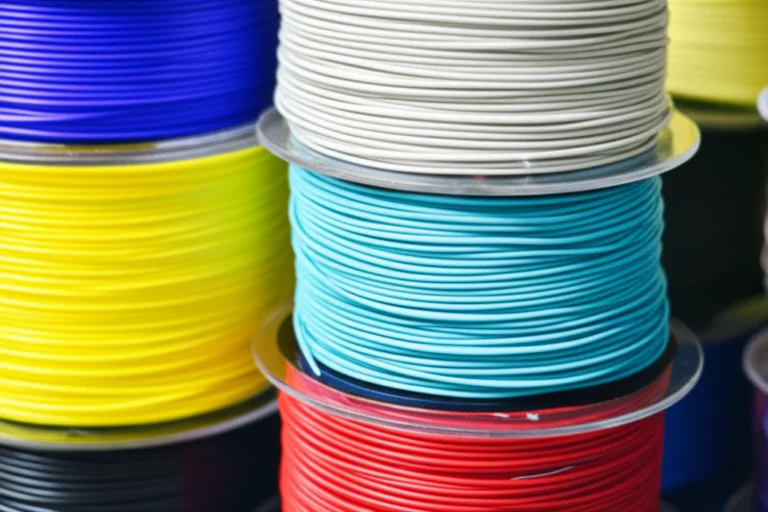
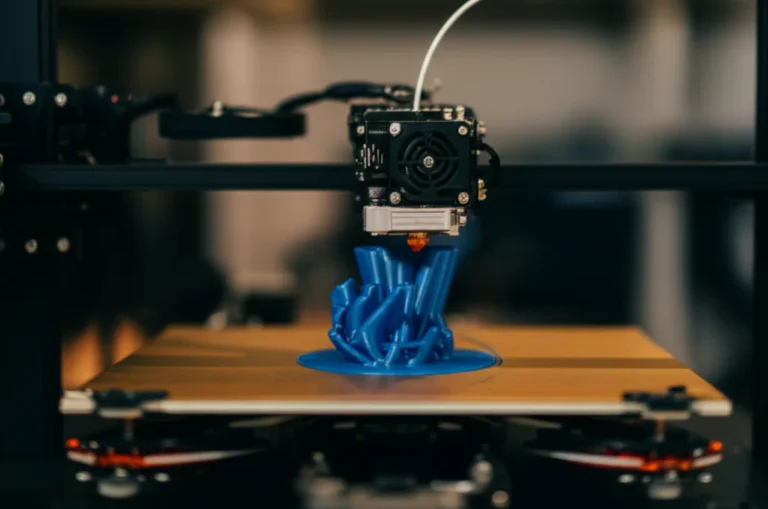
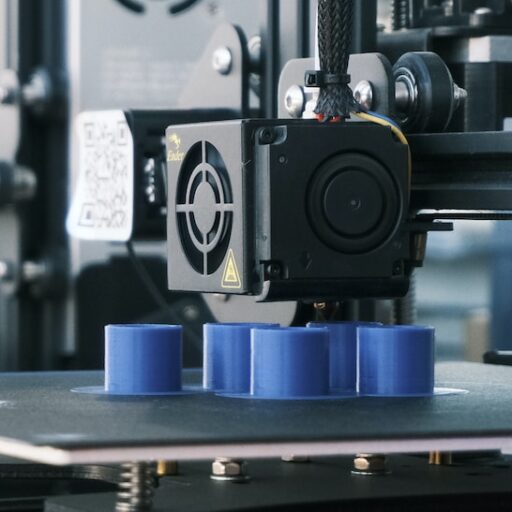
The gateway drug of 3D printing. A spool of plastic (PLA, PETG, ABS, TPU) is melted and extruded through a hot nozzle that doodles your layer like a pastry chef.
Strengths
✅ Cheapest tech – decent printers start under 200 USD.
✅ Huge material palette: carbon-fiber, glow-in-the-dark, even coffee-filled filament.
✅ Community support is gigantic – if your Ender 3 hiccups, 500 YouTube videos burp back.
Weaknesses
❌ Visible layer lines (unless you post-process).
❌ Supports can be a pain on overhangs < 45°.
❌ Warping (ABS) or clogging (flexibles) can ruin weekends.
Hot Picks
- Creality Ender 3 V2 – the Honda Civic of printers.
- Prusa i3 MK4 – auto-load filament, load-cell bed leveling.
- Bambu Lab A1 mini – blazing 300 mm/s, cloud prints.
👉 CHECK PRICE on:
- Creality Ender 3 V2: Amazon | Walmart | Creality Official
- Prusa i3 MK4: Prusa Official | Amazon
2. Stereolithography (SLA) and Digital Light Processing (DLP)
Laser or projector cures liquid photopolymer layer-by-layer. Think microscopic lightning in a puddle.
Strengths
✅ Sub-25 µm layers – jewelry makers weep with joy.
✅ Silky surface finish straight off the bed.
✅ Supports touch only tiny points – scars sand away fast.
Weaknesses
❌ Resins smell (and may irritate skin).
❌ Brittle parts – drop your dwarf mini and it shatters.
❌ Build volume usually smaller than FDM.
Hot Picks
- Anycubic Photon M3 Premium – 7K mono screen, 400 mm/h lift speed.
- Elegoo Saturn 3 – 10-inch mono LCD, 0.01 mm Z-repeatability.
3. Selective Laser Sintering (SLS)
A CO₂ laser fuses nylon powder into rock-solid parts. No supports = design freedom nirvana.
Strengths
✅ Complex interlocking hinges printed assembled.
✅ Excellent chemical resistance (PA12, PA11).
✅ Unused powder recycled → less waste.
Weaknesses
❌ Printers cost six figures (EOS, 3D Systems).
❌ Powder handling needs PPE – nylon dust is explosive.
❌ Surface slightly grainy; dyeing or media-blasting helps.
4. Multi Jet Fusion (MJF)
HP’s voxel-level inkjet + heat approach. Think laser printer meets waffle iron.
Strengths
✅ 10× faster than SLS for production runs.
✅ Isotropic mechanicals – parts break with the layer, not between layers.
✅ Rich greyscale surface detail (future full-color).
Weaknesses
❌ Limited to HP-approved powders (mostly nylon).
❌ Initial machine price still > 100 k USD.
5. Electron Beam Melting (EBM)
Vacuum chamber + electron beam melt titanium, Inconel, or tantalum powders layer-by-layer. Aerospace loves it.
Strengths
✅ Near 100 % density – fatigue life rivals wrought.
✅ Vacuum prevents oxidation – great for Ti-6Al-4V.
✅ Fast compared to laser-powder-bed for thick sections.
Weaknesses
❌ Surface roughness > 15 µm Ra – needs CNC finish.
❌ Requires inert handling – titanium powder is pyrophoric.
6. Binder Jetting
An inkjet head sprays binder onto stainless-steel, sand, or ceramic powder. Full-color sandstone prints? This is how.
Strengths
✅ Full CMYK color on gypsum or sand-cast molds.
✅ No high heat – safer for classroom use.
✅ Scales to monstrous build volumes (ExOne Innovent+ 400 × 250 × 250 mm).
Weaknesses
❌ Green parts need infiltration (cyanoacrylate or bronze) – extra step.
❌ Mechanicals weaker than powder-bed-fusion metals.
7. Material Jetting (PolyJet and MultiJet Modeling)
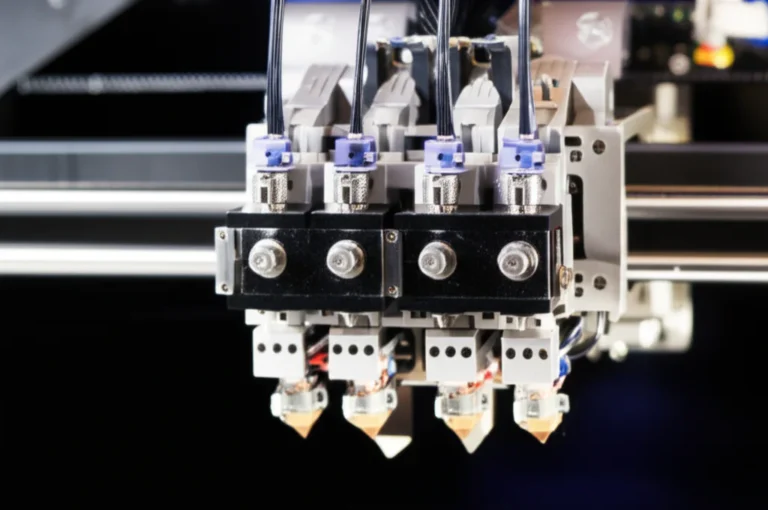
Inkjet printheads squirt photopolymer droplets, instantly UV-cured. Stratasys Connex machines can mix 14 materials in one part – rigid + rubbery in a single print.
Strengths
✅ Multi-material & multi-color in one job.
✅ Surface quality rivals injection molding.
Weaknesses
❌ Support removal is water-jet tedium.
❌ Parts age under UV – turns yellowish.
8. Laminated Object Manufacturing (LOM)
Paper, plastic, or metal foil is laser-cut and glued layer-by-layer. Cheap? Yes. Obsolete? Almost – but great for sand-cast patterns.
9. Direct Energy Deposition (DED)
A 5-axis robot blows powder or feeds wire into a laser/e-beam melt pool. Think welding on steroids. Used to repair turbine blades rather than print from scratch.
10. Continuous Liquid Interface Production (CLIP)
Carbon’s oxygen-permeable window kills the “peel” step – prints 25-100× faster than SLA. Nike uses it for elastomer midsoles.
11. Sheet Lamination
Ultrasonic foil welding (Fabrisonic) or paper-gluing (Mcor). Low-temp metals + composites possible; great for RF waveguides thanks to internal copper layers.
12. Hybrid 3D Printing Technologies
DMG Mori Lasertec combines 5-axis CNC with powder-bed – print then mill in one chucking. Expect ±10 µm tolerances without moving parts between machines.
🧪 What Materials Can You Use? Exploring Common and Exotic 3D Printing Filaments and Powders
| Family | Examples | Pros | Cons | Where to Snag |
|---|---|---|---|---|
| PLA | Hatchbox PLA | Biodegradable, smells like waffles | Brittle, low-heat | Amazon, 3D Printer Filament |
| PETG | Prusament PETG | Food-safe, tough | Stringy, needs tuning | Prusa Official |
| TPU | SainSmart TPU | Rubber-like, phone-case fun | Slow print, jams on Bowden | Amazon |
| PA12 Nylon | EOS PA2200 | Chemical resistant, low friction | Needs 80 °C chamber | EOS, BDL 3D |
| Stainless 316L | ExOne Metal Powder | Weldable, marine grade | Requires sintering furnace | ExOne Official |
| Ceramic | Tethon 3D Porcelite | Glazable, oven-safe | Fragile green state | Tethon3D |
Pro-tip: store nylon in a sealed bin + desiccant – it slurps moisture like a toddler with juice.
🌏 How 3D Printing is Revolutionizing Industries in New Zealand and Beyond
- Hospitals: Auckland’s Middlemore Hospital prints titanium jaw implants on an Arcam EBM machine – surgery time down 30 %.
- Film Weta: SLS props for Avatar 2 – lighter swords, zero spoilers (they dissolve after shooting).
- Dairy farms: Waikato farmers MJF-print nylon brackets for milk-pulsators – 24 h turnaround vs 3-week import.
- Education: University of Canterbury lists 3D Printing in Education courses – kids design Maori motif cookie cutters in Tinkercad.
👍 Pros and Cons: The Real Deal on 3D Printing Advantages and Limitations
| Pros | Cons |
|---|---|
| Design freedom – lattices, topology-optimised bones | Anisotropy – Z-layers can delaminate |
| Rapid prototyping – iterate in hours, not weeks | Post-processing – support scars, resin cleanup |
| Mass-customisation – every patient gets unique fit | Material cost – spools vs pellets = 10× price |
| Low waste – only use what you need | IP headaches – STL leaks on Reddit |
💡 Expert Tips for Choosing the Right 3D Printing Technology for Your Project
-
Start with the end-use:
- Visual prototype? → SLA/DLP for smoothness.
- Snap-fit drone arm? → SLS/MJF for strength.
- Titanium spine implant? → EBM or DMLS.
-
Budget reality-check:
- <$500 → FDM (Ender, Prusa Mini).
- $2–5 k → desktop SLA (Form 3).
- $100 k+ → industrial SLS/MJF
🎯 Conclusion: Navigating the 3D Printing Technology Landscape with Confidence

Phew! We’ve journeyed through the dazzling spectrum of 3D printing technologies — from the humble FDM workhorse in your garage to the ultra-sophisticated Electron Beam Melting machines forging titanium implants in sterile vacuum chambers. Each method brings its own flavor of magic, trade-offs, and ideal use cases.
Here’s the takeaway:
- If you’re a hobbyist or beginner, FDM offers unbeatable accessibility, a vast material library, and an enormous community ready to help.
- For ultra-fine detail and smooth surfaces, SLA/DLP resin printers are your best bet — perfect for miniatures, jewelry, and dental models.
- When complexity and strength matter, especially for functional parts, SLS and MJF shine with their support-free builds and durable nylon materials.
- For metal parts, EBM and DED are industrial titans, albeit with steep price tags and operational demands.
Remember our early teaser about dishwasher tablets? That’s binder jetting quietly revolutionizing everyday products behind the scenes — proof that 3D printing isn’t just for geeks but is embedded in your daily life.
Choosing the right technology boils down to your project’s material needs, precision, speed, and budget. Don’t hesitate to mix and match: prototype in FDM, finalize in SLS, and produce in MJF or CNC machining. The future is hybrid, and knowing your options is your superpower.
Ready to take the plunge? Explore our recommended links below for the best gear and resources to get printing today!
🔗 Recommended Links for Further Exploration
Shop Popular 3D Printers and Materials
-
Creality Ender 3 V2:
Amazon | Walmart | Creality Official Website -
Prusa i3 MK4:
Prusa Official Website | Amazon -
Anycubic Photon M3 Premium:
Amazon | Anycubic Official Website -
Elegoo Saturn 3:
Amazon | Elegoo Official Website -
SainSmart TPU Filament:
Amazon -
Hatchbox PLA Filament:
Amazon
Recommended Books on 3D Printing
-
3D Printing Failures: How to Diagnose and Repair All 3D Printing Problems by Sean Aranda
Amazon Link -
Fabricated: The New World of 3D Printing by Hod Lipson and Melba Kurman
Amazon Link -
Additive Manufacturing Technologies: 3D Printing, Rapid Prototyping, and Direct Digital Manufacturing by Ian Gibson, David Rosen, Brent Stucker
Amazon Link
❓ Frequently Asked Questions (FAQs) About 3D Printing Technologies

What are some of the emerging 3D printing technologies that are expected to revolutionize the industry?
Emerging tech includes Continuous Liquid Interface Production (CLIP) by Carbon, which dramatically speeds up resin printing by eliminating the peel step, and hybrid additive-subtractive machines that combine CNC milling with 3D printing for ultra-precise parts. Volumetric 3D printing is also on the horizon, curing entire objects in seconds using intersecting light fields. These innovations promise faster production, better surface finishes, and new material capabilities.
What are the differences between DLP and LCD 3D printing technologies in terms of print quality?
Both DLP (Digital Light Processing) and LCD (Liquid Crystal Display) printers cure resin layer-by-layer using light. DLP uses a projector to flash an entire layer at once, offering slightly higher resolution and faster print times. LCD printers use an array of UV LEDs shining through an LCD mask, which is often more affordable but can have slightly lower light uniformity. For most hobbyists, the difference is subtle, but professionals often prefer DLP for ultra-fine details.
How do I choose the right 3D printing technology for my specific project needs?
Consider these factors:
- Detail & surface finish: SLA/DLP for high-res, FDM for rougher prototypes.
- Material properties: Nylon via SLS/MJF for strength, metals via EBM/DED for durability.
- Build volume: FDM and SLS offer larger volumes than most resin printers.
- Budget & speed: FDM is cheapest and fastest for small runs; industrial tech costs more but yields production-grade parts.
- Post-processing tolerance: SLA needs resin wash and curing; SLS parts need powder removal.
Can I use any type of 3D printing technology to create functional parts?
Not all 3D printing tech is equally suited for functional parts. SLS and MJF produce strong, durable nylon parts ideal for snap-fits and mechanical components. FDM can make functional parts but often with anisotropic strength and visible layer lines. SLA parts tend to be brittle and better for visual prototypes. Metal printing technologies like EBM and DED are best for load-bearing, high-performance parts.
What are the advantages and disadvantages of using SLS 3D printing for prototyping?
Advantages:
- No support structures needed → complex geometries possible.
- Durable, heat-resistant nylon parts.
- Good for functional prototypes and small batch production.
Disadvantages:
- Rough surface finish requiring post-processing.
- High equipment and material cost.
- Powder handling requires safety precautions.
How does FDM differ from SLA 3D printing in terms of accuracy and cost?
FDM printers are generally less accurate, with layer heights typically 50–300 microns and visible layer lines. They are affordable and use inexpensive filaments. SLA printers achieve finer resolution (down to 25 microns), smoother surfaces, and better detail but require pricier resins and post-processing steps. SLA machines tend to have smaller build volumes and higher maintenance.
What are the most common 3D printing technologies used in hobbyist projects?
FDM dominates hobbyist use due to low cost, ease of use, and material availability. SLA/DLP resin printers have gained popularity for miniatures and detailed models. Binder jetting and SLS remain mostly industrial due to complexity and cost.
What are the current limitations and future developments of 3D printing technologies such as MJF and EBM?
MJF is limited by proprietary powders and relatively high machine costs but excels in speed and part strength. Future developments include full-color printing and expanded material options. EBM is constrained by surface roughness and expensive vacuum systems but is evolving with better post-processing and hybrid machining. Both technologies are pushing toward faster, more affordable production-grade parts.
What are the key differences between binder jetting and powder bed fusion 3D printing technologies?
Binder jetting uses a liquid binder to glue powder particles together at room temperature, allowing full-color prints and large build volumes but resulting in parts that often require infiltration and have lower mechanical strength. Powder bed fusion (SLS, MJF, EBM) uses lasers or electron beams to fuse powder particles fully, producing stronger, more durable parts but typically in monochrome and with higher energy input.
What are the applications of SLS 3D printing in the fields of engineering and manufacturing?
SLS is widely used for functional prototypes, custom tooling, end-use parts in aerospace and automotive, and medical devices like orthotics. Its ability to produce complex geometries without supports makes it ideal for lightweight lattice structures and snap-fit assemblies.
How does SLA 3D printing differ from DLP 3D printing in terms of resolution and speed?
SLA uses a laser to trace each layer’s cross-section point-by-point, which can be slower but offers very high precision. DLP cures entire layers at once using a projector, making it faster but sometimes with slightly less uniform resolution. Both produce high-detail parts but SLA is favored for ultra-fine features.
What are the advantages and disadvantages of FDM 3D printing technology?
Advantages:
- Affordable and widely available.
- Large build volumes.
- Wide range of materials including flexible and composite filaments.
Disadvantages:
- Visible layer lines and lower resolution.
- Requires supports for complex geometries.
- Anisotropic mechanical properties (weaker in Z-axis).
📖 Reference Links and Credible Sources
- BDL 3D: What is 3D Printing?
- FutureLearn: Getting Started with Digital Manufacturing
- Yonglihao Machinery: CNC Machining Vs SLS 3D Printing: A Comparative Analysis
- Wohlers Report 2023
- Carbon 3D CLIP Technology
- HP Multi Jet Fusion
- Formlabs SLA Printers
- EOS SLS Machines
- ExOne Binder Jetting
- Prusa Research
- Creality Official
- Anycubic Official
- Elegoo Official
If you want to dive even deeper, check out our detailed comparison of CNC Machining Vs SLS 3D Printing — a must-read for engineers balancing precision and complexity!