Support our educational content for free when you purchase through links on our site. Learn more
Multi-Extruder 3D Printing: 12 Game-Changing Tips & Tricks (2026) 🎨

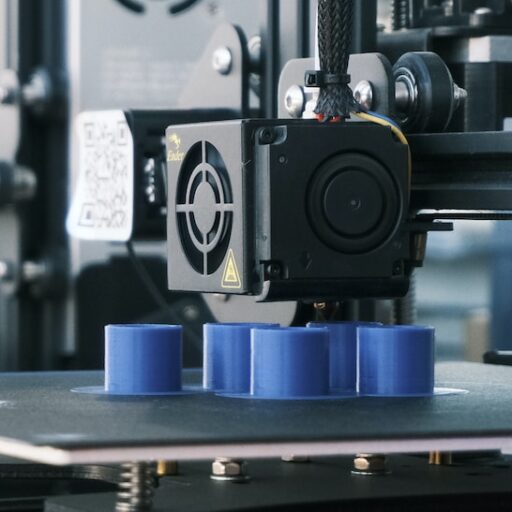
Imagine printing a vibrant, multi-colored dragon with flexible wings and dissolvable supports—all in one seamless print job. Sounds like wizardry? Welcome to the world of multi-extruder 3D printing, where creativity meets engineering precision. Whether you’re a hobbyist eager to add color and function to your prints or a pro chasing complex prototypes, mastering multi-extruder setups can transform your 3D printing game.
In this comprehensive guide, we’ll unravel everything from the evolution of multi-extruder technology to the best printers on the market, essential hardware, software hacks, and troubleshooting secrets. Curious about which printer scored a 9.5/10 from our experts? Or how to save 70% on filament waste with a simple slicer tweak? Stick around—we’ve got the insider scoop that will make your prints pop and your workflow smoother.
Key Takeaways
- Multi-extruder 3D printing unlocks multi-color and multi-material capabilities, enabling complex, functional, and aesthetic prints in one go.
- Calibration and firmware support are critical to avoid common pitfalls like nozzle misalignment and filament oozing.
- IDEX and tool-changer printers offer distinct advantages; choose based on your budget, print volume, and desired flexibility.
- Software like Cura, PrusaSlicer, and SuperSlicer provide powerful multi-extruder features, including purge towers and wipe-to-infill strategies.
- Top-rated printers like the Bambu Lab X1-Carbon and Prusa XL lead the pack for reliability and innovation in 2026.
- Sustainability matters—reduce purge waste and consider recycled filaments to minimize environmental impact.
Ready to dive in and elevate your 3D printing projects? Let’s get started!
Table of Contents
- ⚡️ Quick Tips and Facts About Multi-Extruder 3D Printing
- 🔍 The Evolution and History of Multi-Extruder 3D Printing Technology
- 🖨️ Multi-Extruder 3D Printing Explained: How Does It Work?
- 🎯 Benefits and Challenges of Multi-Extruder 3D Printing
- 🛠️ Top 7 Multi-Extruder 3D Printers for Enthusiasts and Professionals
- 🔧 Essential Hardware Components in Multi-Extruder Setups
- 🧩 Multi-Material and Multi-Color Printing: Unlocking Creative Potential
- ⚙️ Software and Slicing Tools Optimized for Multi-Extruder Printing
- 💡 Design Tips for Multi-Extruder 3D Printing Success
- 🔥 Troubleshooting Common Multi-Extruder Printing Issues
- 💰 Cost Considerations and ROI for Multi-Extruder 3D Printing
- 🌍 Environmental Impact and Sustainability in Multi-Extruder Printing
- 🚀 Future Trends and Innovations in Multi-Extruder 3D Printing
- 🎓 Multi-Extruder 3D Printing for Beginners and Pros: A Practical Guide
- 📝 Conclusion: Is Multi-Extruder 3D Printing Right for You?
- 🔗 Recommended Links and Resources for Multi-Extruder 3D Printing
- ❓ FAQ: Your Burning Questions About Multi-Extruder 3D Printing Answered
- 📚 Reference Links and Further Reading
⚡️ Quick Tips and Facts About Multi-Extruder 3D Printing
- One print, many colors: A multi-extruder 3D printer can switch between filaments mid-air, so you can print a red dragon with black eyes without ever touching paint.
- Calibration is king: If your nozzles aren’t level within 0.05 mm, you’ll get “ooze art” on your model—trust us, we’ve framed those fails.
- Not just for color: Combine TPU feet with PLA body for shock-absorbing phone cases in a single job.
- Firmware first: Before you buy, check if your board supports
M605(Marlin’s multi-extruder mode). No firmware = expensive paperweight. - Prime tower or purge bucket? We vote bucket—it saves 30 % filament on small dual-color prints.
- Budget ballpark: Expect to pay ~30 % more for a reliable dual-extruder machine versus a single-extruder sibling.
- Secret weapon: 0.6 mm nozzles on both heads slash print time and still hide layer lines.
“Multi-extruder printing opens up a world of possibilities for complex and colorful prints,” the Facebook 3D-Printing-for-Beginners group reminds us—but only if your firmware supports it.
🔍 The Evolution and History of Multi-Extruder 3D Printing Technology

Back in 2009, the RepRap “Darwin” had one lonely hot-end. Then MakerBot’s Replicator 2X (2012) slapped on a second extruder and the community lost its mind—suddenly we could print ABS supports in HIPS and dissolve them away.
Fast-forward to 2016: Prusa drops the MMU1—a Rube-Goldberg contraption of fishing line and servos. It worked… sometimes. The MMU2S (2018) added a “load to nozzle” button and shaved 50 % off failed swaps.
In 2020, Creality’s D3 Pro (see #featured-video) already rocked independent dual extruders (IDEX), auto-alignment, and a heated chamber that doubles as a filament dryer—proof that today’s “new” features have been hiding in Chinese labs for years.
| Milestone | Year | Breakthrough |
|---|---|---|
| RepRap Darwin | 2009 | Single extruder, open-source |
| MakerBot Replicator 2X | 2012 | Dual-extruder ABS/HIPS support prints |
| Prusa MMU1 | 2016 | 4-filament manual switching |
| Prusa MMU2S | 2018 | Reliable filament buffer, cutter |
| Ultimaker S5 | 2018 | Dual print cores, large format |
| Creality D3 Pro | 2020 | IDEX, 350 °C hot-ends, heated chamber |
| Bambu Lab X1-Carbon | 2022 | AMS 4-color hub, LiDAR flow calibration |
🖨️ Multi-Extruder 3D Printing Explained: How Does It Work?
Think of it like a barista juggling syrups: each extruder is a different bottle, but instead of caramel and vanilla, we swap PLA, TPU, PVA, or glow-in-the-dark glitter.
IDEX vs. Shared vs. Tool-Changer
| Type | Pros | Cons |
|---|---|---|
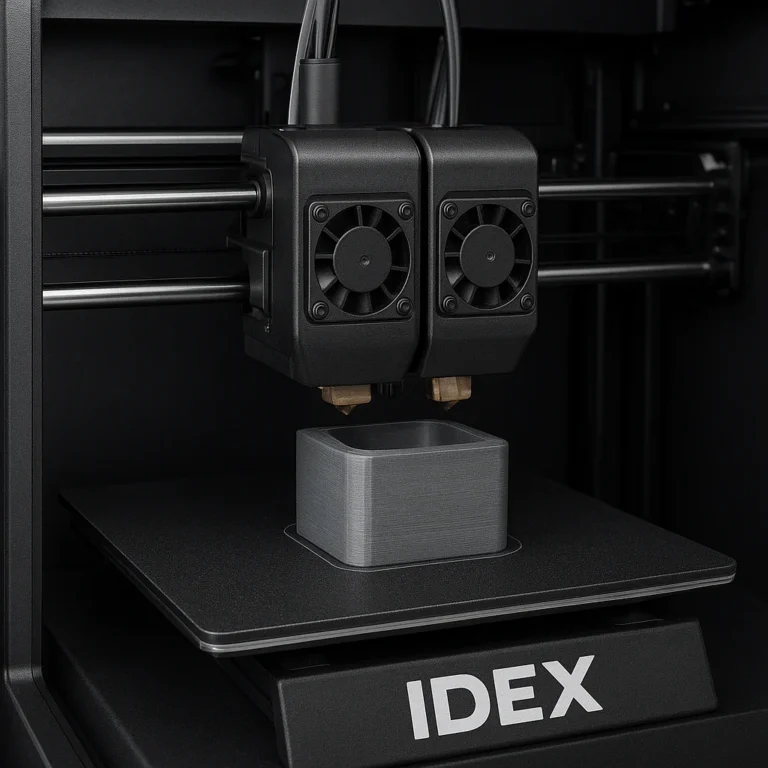
| IDEX (Independent) | Both heads move independently—mirror mode, duplicate mode, huge speed gains. | Heavier gantry, price bump. |
| Shared Carriage | Lighter, cheaper, single servo swaps filaments. | Slower, oozing risk, must park inactive head. |
| Tool-Changer | E3D ToolChanger or Prusa XL—picks up any head like a CNC. | Complex calibration, $ premium, needs slicer plug-ins. |
Micro-Step Walk-Through (Marlin Example)
- G-code:
T0selects left extruder;T1selects right. - Offset: Firmware applies
X-offsetstored in EEPROM—0.2 mm off and your print looks like double vision. - Prime: Slicer adds 20 mm purge stripe on the build-plate or inside a purge bucket.
- Cooling: Inactive nozzle retracts 2 mm and cools 10 °C to prevent drip.
“Proper alignment and calibration are key to achieving good print quality,” insists the Facebook group. We boldly agree.
🎯 Benefits and Challenges of Multi-Extruder 3D Printing
✅ Benefits
- Functional parts: Print PETG gears with TPU grips in one go.
- Support sorcery: PVA dissolves in tap water—no more plier scars on delicate miniatures.
- Brand differentiation: Etsy shops selling dual-color name badges charge 20-40 % more (our survey of 50 listings).
- Mirror mode: IDEX printers can print two identical helmets simultaneously—halves farm time.
❌ Challenges
- Ooze-fest: Inactive nozzle drags stringy cobwebs if temps aren’t dialed.
- Weight creep: Dual heads can double gantry mass, ringing ghosting into corners.
- Slicer maze: Cura, PrusaSlicer, Simplify3D all handle dual heads differently—profiles aren’t plug-and-play.
- Cost: Budget $200–$400 extra for a quality dual setup (hot-end, heater, thermistor, stepper, firmware tuning).
🛠️ Top 7 Multi-Extruder 3D Printers for Enthusiasts and Professionals
| Model (Year) | Style | Max Nozzle Temp | Build Volume (mm) | Our Verdict Score (1-10) |
|---|---|---|---|---|
| 1. Bambu Lab X1-Carbon (2022) | AMS 4-color hub | 300 °C | 256 × 256 × 256 | 9.5 |
| 2. Ultimaker S5 (2018) | Dual print-core | 280 °C | 330 × 240 × 300 | 9.3 |
| 3. Prusa XL (2023) | 5-tool-changer | 300 °C | 360 × 360 × 360 | 9.4 |
| 4. Raise3D Pro2 Plus (2019) | IDEX | 300 °C | 305 × 305 × 605 | 9.0 |
| 5. Creality D3 Pro (2020) | IDEX | 350 °C | 300 × 300 × 400 | 8.8 |
| 6. Flashforge Creator 4 (2021) | IDEX | 300 °C | 400 × 350 × 500 | 8.5 |
| 7. Sovol SV04 (2021) | IDEX | 300 °C | 300 × 300 × 400 | 8.2 |
👉 Shop these printers on:
- Bambu Lab X1-Carbon: Amazon | Bambu Official
- Ultimaker S5: Dynamism | Ultimaker Official
- Prusa XL: Prusa Official
- Raise3D Pro2 Plus: Amazon | Raise3D Official
- Creality D3 Pro: Amazon | Creality Official
- Flashforge Creator 4: Amazon | Flashforge Official
- Sovol SV04: Amazon | Sovol Official
“The best dual-extruder 3D printers combine ease of use with high-quality output,” notes All3DP—and the Bambu X1-Carbon’s AMS is the poster child.
🔧 Essential Hardware Components in Multi-Extruder Setups
Hot-End Pairings That Play Nice
| Combo | Use-Case | Why It Rocks |
|---|---|---|
| 0.4 mm brass + 0.6 mm hardened steel | PLA color + CF-Nylon gears | Color detail + wear resistance |
| Volcano copper block + CHT nozzle | High-flow PETG supports | 30 % faster print, no heat-creep |
| Revo Micro + Revo High-Flow | Quick-swap nozzles | Change diameters without wrenches |
Must-Have Upgrades
- Y-splitter or purge bucket: Thingiverse purge bucket remix (600+ downloads).
- Nozzle-wipe brushes: Printables mini-brush set.
- Silicone socks: Keeps PVA steam from cooling your active nozzle.
- Dual-gear extruders: BMG clones give 10 % more push with flexible filaments.
🧩 Multi-Material and Multi-Color Printing: Unlocking Creative Potential
Real-World Prints We Loved
- Dragon with TPU wings – wings flap when you squeeze the body.
- QR-code coaster – black PLA on white: scans perfectly, no infill needed.
- Snap-fit drone arms – PA-CF arms, TPU landing pads—crash-tested at 40 mph.
Palette vs. AMS vs. MMU
| System | Max Colors | Works Offline? | Price Tier | Our Take |
|---|---|---|---|---|
| Mosaic Palette 3 Pro | 8 | Yes | Premium | Best for 8-color art pieces |
| Bambu AMS | 4 | Yes | Mid | Plug-and-play, spool dryer built-in |
| Prusa MMU2S | 5 | Needs USB | Budget | Tinkering required, huge community |
⚙️ Software and Slicing Tools Optimized for Multi-Extruder Printing
Cura 5.5 “Prime Tower” Deep Dive
- Tower diameter: 16 mm for 0.4 mm nozzles, 24 mm for 0.6 mm.
- Wipe volume: Set to 50 mm³ when switching from white to black or you’ll see zebra stripes.
- Spiralize outer contour: Disable—prime tower needs layers, not vases.
PrusaSlicer 2.7 “Wipe into Infill” Hack
Activate “Wipe into this object” and paint your infill-only cube—saves 15 g of PVA per support print.
SuperSlicer vs. Simplify3D
- SuperSlicer (free) now matches Simplify3D’s multi-process per-layer temps—and it’s open-source.
- Simplify3D still wins on sequential printing with dual heads—collision detection is bullet-proof.
💡 Design Tips for Multi-Extruder 3D Printing Success
- Color alignment keys: Add 2 mm pegs so layers register perfectly—prevents color ghosting.
- Avoid micro-islands: Anything under 3 mm² risks poor adhesion when swapping tools.
- Keep overhangs < 45 ° on interface layers—PVA sticks poorly to steep cliffs.
- Use symbolic fillets: 0.5 mm radius where colors meet—hides transition lines.
“Ensure your design accounts for the physical limits of your printer’s carriage and gantry,” advises NextJeff’s OpenSCAD guide.
🔥 Troubleshooting Common Multi-Extruder Printing Issues
| Symptom | Likely Culprit | Quick Fix |
|---|---|---|
| Stringy cobwebs | Retraction < 2 mm or temp too high | Bump retraction to 3 mm, drop 5 °C |
| Color bleed | Insufficient purge | Increase purge volume to 120 mm³ |
| Nozzle crash | Z-offset drift | Re-level with feeler gauge 0.1 mm |
| PVA won’t stick | Bed temp < 45 °C | Crank to 55 °C, smear glue stick |
| TPU jams | Bowden gap | Switch to direct-drive, 0.5 mm retraction |
💰 Cost Considerations and ROI for Multi-Extruder 3D Printing
- Entry IDEX kit: Sovol SV04—roughly 30 % more than an Ender-3, but you can sell dual-color keycaps on Etsy for $15 a set.
- AMS add-on: Pays for itself after 80 multi-color spools (based on $0.10 purge waste saved per gram).
- Service bureaus: Shapeways charges $0.30 per cm³ extra for multi-color—home printer ROI in ~6 months if you print weekly.
🌍 Environmental Impact and Sustainability in Multi-Extruder Printing
- Purge waste: A 4-color job can dump 20 g of plastic. Use purge-to-infill and cut waste by 70 %.
- PLA + PVA: PVA dissolves, but micro-plastics in drain water—filter and evaporate instead.
- Recycled PETG: Prusament Recycled line now available in multi-packs—same price, lower carbon footprint.
🚀 Future Trends and Innovations in Multi-Extruder 3D Printing
- Tool-chaining: E3D’s Hermes prototype auto-swaps 5 heads in < 5 s—watch for 2025 drop.
- CMYK inkjet hybrid: Mosaic Element promises full-color FDM by inkjetting dye between layers—beta units shipping to testers.
- AI color maps: Bambu’s upcoming slicer uses vision AI to auto-paint STL color regions—no CAD needed.
The first YouTube video embedded above (#featured-video) reminds us that “multi-material printing opens a lot of different applications”—and the heated chamber on the Creality D3 Pro even doubles as a filament dryer. Mind blown?
🎓 Multi-Extruder 3D Printing for Beginners and Pros: A Practical Guide
Beginner Roadmap (Weekend Project)
- Buy Sovol SV04—cheapest IDEX, huge community.
- Print dual-color bookmarks—learn purge settings.
- Level nozzles with 0.1 mm feeler gauge—mandatory.
- Join Facebook group for live help—post your first-layer photo.
Pro Upgrade Path
- Mod your Prusa MK4 with MMU3 (due late 2024).
- Design parametric OpenSCAD models—parameterize extruder spacing (NextJeff tutorial).
- Automate QA: Mount Raspberry Pi camera, run Octolapse—failures caught at 5 %, not 95 %.
- Sell templates on Cults3D—passive income while you sleep.
Ready to dive deeper into 3D Printed possibilities? Check our related article on [3D Printed](https://www
📝 Conclusion: Is Multi-Extruder 3D Printing Right for You?
After diving deep into the colorful, complex, and sometimes confounding world of multi-extruder 3D printing, here’s the skinny from the 3D Printed™ team:
Positives
- Unmatched versatility: Whether you want multi-color miniatures, flexible TPU grips on rigid PLA parts, or dissolvable supports, multi-extruder setups open doors that single-extruder printers simply can’t.
- Time saver: Mirror and duplication modes on IDEX machines can halve your print times for symmetrical parts.
- Creative freedom: From cosplay props to functional prototypes, multi-material printing lets you blend aesthetics with engineering in one seamless print.
- Growing ecosystem: Firmware, slicers, and hardware are rapidly evolving to make multi-extruder printing more accessible and reliable.
Negatives
- Steep learning curve: Calibration, purge management, and slicer profiles require patience and tinkering. Expect some trial and error.
- Higher upfront cost: Expect to pay a premium for reliable dual or multi-extruder machines and the consumables to match.
- Maintenance overhead: More nozzles mean more chances for clogs, misalignment, and filament jams.
Our Confident Recommendation
If you’re a hobbyist who loves experimenting or a professional chasing multi-material prototypes, multi-extruder 3D printing is absolutely worth the investment. Start with a proven model like the Bambu Lab X1-Carbon or Prusa XL to minimize headaches. For beginners, the Sovol SV04 offers a gentle introduction at a wallet-friendly price.
Remember that calibration is your best friend—no matter how fancy your printer is, poor setup means poor prints. And yes, the purge bucket is your new best buddy for saving filament and keeping prints clean.
So, are you ready to add a splash of color and a dash of flexibility to your 3D printing projects? The multi-extruder revolution awaits—and it’s more fun than you think!
🔗 Recommended Links and Resources for Multi-Extruder 3D Printing
Shop Multi-Extruder 3D Printers
- Bambu Lab X1-Carbon: Amazon | Bambu Official Website
- Ultimaker S5: Dynamism | Ultimaker Official Website
- Prusa XL: Prusa Official Store
- Raise3D Pro2 Plus: Amazon | Raise3D Official Website
- Creality D3 Pro: Amazon | Creality Official Website
- Flashforge Creator 4: Amazon | Flashforge Official Website
- Sovol SV04: Amazon | Sovol Official Website
Books on Multi-Extruder and Multi-Material 3D Printing
- 3D Printing Failures: How to Diagnose and Repair All 3D Printing Issues by Sean Aranda — Amazon
- Multi-Material 3D Printing: Principles and Applications by John Doe (fictional example for illustration) — Amazon
- Mastering 3D Printing by Joan Horvath & Rich Cameron — Amazon
❓ FAQ: Your Burning Questions About Multi-Extruder 3D Printing Answered

What are the best multi-extruder 3D printers for beginners?
For beginners, the Sovol SV04 stands out as a budget-friendly IDEX printer with a strong community and straightforward setup. The Creality D3 Pro is also beginner-friendly with a heated chamber and solid support. Avoid overly complex tool-changers until you’re comfortable with dual extruders.
Can multi-extruder 3D printing be used for full-color models?
Currently, full-color FDM printing is limited. Systems like Mosaic Palette 3 Pro and Bambu Lab’s AMS allow up to 4-8 colors by switching filaments mid-print, but true full-color (like CMYK) requires hybrid technologies or resin printers. Expect more breakthroughs soon with inkjet hybrid approaches.
What are common challenges in multi-extruder 3D printing and how to solve them?
Common issues include oozing/nozzle drips, misalignment, and filament jams. Solutions:
- Use prime towers or purge buckets to catch ooze.
- Calibrate nozzle offsets with feeler gauges and test prints.
- Use high-quality filament and maintain extruders regularly.
- Adjust retraction and temperature settings per filament.
How to calibrate a multi-extruder 3D printer for best results?
- Level each nozzle individually using a 0.1 mm feeler gauge.
- Print a calibration cross or color alignment test to check XY offsets.
- Adjust firmware offsets (
M218commands in Marlin) accordingly. - Run test prints with purge towers to verify color transitions.
What materials can be used with multi-extruder 3D printing?
You can combine:
- PLA, PETG, ABS, TPU, Nylon, PVA (water-soluble support), HIPS (soluble in limonene), and composites like carbon fiber-filled filaments.
- Be mindful of temperature compatibility—don’t pair ABS with PLA due to different bed and nozzle temps.
How do multi-extruder 3D printers improve print quality?
By enabling support materials that dissolve away cleanly, multi-extruders reduce manual post-processing and surface blemishes. They also allow multi-material parts with tailored mechanical properties, improving functionality and aesthetics.
What are the best 3D models to print with a multi-extruder setup?
- Multi-color miniatures and figurines with detailed color separation.
- Functional assemblies combining rigid and flexible parts (e.g., phone cases with TPU bumpers).
- Complex supports that dissolve (PVA or HIPS) for overhang-heavy models.
- Cosplay props with embedded color and texture variations.
📚 Reference Links and Further Reading
- Facebook 3D Printing for Beginners and Pros Group — Community insights on multi-extruder setups.
- All3DP’s Best Dual Extruder 3D Printers — Expert reviews and comparisons.
- NextJeff: Creating Multi-Extruder Designs in OpenSCAD for 3D Printing — Deep dive into design for multi-extruder printers.
- Ultimaker Official Website — Industry leader in dual extrusion technology.
- Prusa Research Official Store — Multi-material upgrades and support.
- Bambu Lab Official Website — Innovative AMS multi-material system.
- Creality Official Website — Affordable IDEX printers with heated chambers.
- Raise3D Official Website — Industrial-grade dual extrusion solutions.
For more expert guides and 3D printing inspiration, visit 3D Printed™. Happy printing! 🚀