Support our educational content for free when you purchase through links on our site. Learn more
🦷 Top 10 Dental 3D Printing Innovations Reshaping Smiles (2026)

Dental 3D printing innovations have already shattered the barrier between digital design and clinical reality, enabling same-day crowns, zero-shrinkage aligner molds, and custom implants that fit with sub-millimeter precision. We aren’t just talking about faster production; we are witnessing a fundamental shift where biocompatible resins and AI-driven workflows allow clinics to print permanent restorations in-office, eliminating the traditional lab wait entirely.
Imagine a patient walking in with a broken tooth and leaving an hour later with a fully cured, polished crown that fits perfectly on the first try. This isn’t a sci-fi fantasy; it’s the new standard in modern dentistry, driven by the rapid evolution of DLP and LCD technologies.
The industry is moving so fast that the “old way” of shipping plaster models feels archaic. In fact, recent breakthroughs at institutions like the CU Anschutz School of Dental Medicine have demonstrated how inkjet printing can create entire dentures in a single build, slashing production time from days to mere hours.
Key Takeaways
- Speed is King: Modern DLP and LCD printers can produce full-arch surgical guides or aligner molds in under 30 minutes, enabling true same-day dentistry.
- Material Revolution: The advent of Class IIa and IIb biocompatible resins means 3D printed crowns and dentures are now durable enough for long-term, permanent use.
- Precision Matters: Advanced workflows now achieve 0.05mm tolerance levels, ensuring surgical guides and implant abutments fit with unmatched accuracy.
- Cost Efficiency: In-house printing can reduce the material cost of a denture to as little as $20, drastically cutting overhead compared to traditional lab fees.
- Future-Proofing: The integration of AI design software and multi-material printing is automating complex workflows, making digital dentistry accessible to more practices.
Table of Contents
- ⚡️ Quick Tips and Facts
- 🦷 From Clay to CAD: A Brief History of Dental 3D Printing
- 🚀 Top 10 Dental 3D Printing Innovations Reshaping Smiles
- 🛠️ The Tech Stack: How Dental 3D Printing Technologies Actually Work
- Stereolithography (SLA) & Digital Light Processing (DLP): The Workhorses
- Selective Laser Sintering (SLS) & Direct Metal Laser Sintering (DMLS): Metal Mastery
- Material Jeting (PolyJet): The Multi-Material Magic
- Fused Deposition Modeling (FDM): The Budget-Friendly Contender
- 🦷 Applications: Where Innovation Mets the Mouth
- Restorative & Prosthetic Dentistry: Crowns, Bridges, and Dentures
- Orthodontics & Aligners: The Clear Path to Straight Teeth
- Implantology & Surgical Planning: Precision Guides and Custom Abutments
- Diagnostic Models & Education: Teaching the Next Generation
- ⚖️ The Good, The Bad, and The Sticky: Advantages vs. Challenges
- Why We Love It: Speed, Precision, and Cost Savings
- The Hiccups: Material Limitations, Regulatory Hurdles, and Learning Curves
- 🔮 What’s Next? Emerging Trends and the Future of Digital Dentistry
- 🧠 Conclusion: The Future is Digital (and It’s Smiling)
- 🔗 Recommended Links
- ❓ FAQ: Your Burning Questions About Dental 3D Printing Answered
- 📚 Reference Links
⚡️ Quick Tips and Facts
Before we dive into the nitty-gritty of resin vats and laser sintering, let’s hit the highlights. If you’re a dentist looking to upgrade your chairside game, or a hobbyist wondering why your dental models look like they belong in a museum, these nugets are for you.
- Speed is the New Currency: We aren’t talking “overnight” anymore. With modern DLP and LCD printers, a full arch of surgical guides can be printed in under 30 minutes. That’s faster than brewing a pot of coffee! ☕
- Material Matters: Not all resins are created equal. Using a standard “model resin” for a surgical guide is a recipe for disaster. You need biocompatible Class IIa or IIb certified resins for anything touching the patient’s mouth.
- The “Gross” Factor: One of the biggest hurdles for new adopters is post-processing. As one expert put it, “The name of the game in keeping 3D printing not gross is to not have touch the models.” Automated wash and cure stations are non-negotiable for a clean workflow.
- Cost Efficiency: While the upfront cost of a pro printer is steep, the material cost for a single denture can drop to as low as $20 in resin, compared to hundreds in traditional lab fees.
- Resolution Reality Check: You don’t always need the highest resolution. A 95-micron printer is often the sweet spot for aligner models and dentures, while 5-micron is reserved for intricate crown and bridge work.
For more on how we approach these technologies at 3D Printed™, check out our mission at https://www.3d-printed.org/3d-printed/.
🦷 From Clay to CAD: A Brief History of Dental 3D Printing

It wasn’t that long ago that the “high-tech” part of dentistry involved a jar of alginate and a tray of plaster. The journey from impression puty to intraoral scanning is a story of frustration, innovation, and a desperate need for better sleep (who wants to gag a patient at 8 AM?).
The Analog Era: The Age of Stone
For decades, the workflow was rigid:
- Take a messy impression.
- Pour stone models.
- Ship them to a lab.
- Wait 3-5 days.
- Hope the fit is perfect.
If the stone cracked or the impression distorted, you started over. It was a game of chance, not precision.
The Digital Dawn: CAD/CAM
The first real shift happened with CAD/CAM (Computer-Aided Design/Computer-Aided Manufacturing) in the 1980s and 90s. Systems like CEREC allowed dentists to mill crowns in-office. But milling is subtractive. You start with a block of ceramic and carve away 80% of it to get the crown. It’s wasteful, slow, and limited by the geometry of the milling bur.
The Additive Revolution
Enter Stereolithography (SLA) in the late 80s, but it took until the 2010s for it to truly hit dentistry. The game changed when companies like Formlabs, SprintRay, and Asiga realized that printing layer-by-layer offered something milling couldn’t: complexity for free. You could print a lattice structure for an implant or a multi-material denture without extra cost.
Today, we are seeing the transition from “digital dentistry” to fully integrated digital workflows, where the scanner, the design software, and the printer talk to each other seamlessly. As noted in recent industry reports, the market is projected to reach $930 million by 2025, driven by this shift from subtractive to additive manufacturing.
🚀 Top 10 Dental 3D Printing Innovations Reshaping Smiles
We’ve seen a lot of tech come and go, but these ten innovations are the ones actually changing the way smiles are built. We’ve ranked them based on their impact on clinical outcomes, workflow efficiency, and that “wow” factor when a patient sees their new smile in minutes.
1. High-Speed DLP & LCD Resin Curing for Same-Day Crowns
Gone are the days of waiting for a lab. Digital Light Processing (DLP) and LCD (Liquid Crystal Display) technologies have evolved to cure entire layers in seconds.
- The Innovation: Instead of a laser tracing a path (SLA), a projector flashes the entire layer at once. Newer LCD panels with 8K+ resolution allow for incredible detail at high speeds.
- Why it matters: You can print, wash, cure, and deliver a temporary crown in under an hour.
- Real-world application: SprintRay and Phrozen have pushed the boundaries here, offering printers that can handle full arches in minutes.
2. Biocompatible Class IIa & IIb Resins for Permanent Restorations
This is the holy grail. For years, 3D printed crowns were just “temporaries.” Now, we have long-term biocompatible resins that can stay in the mouth for years.
- The Innovation: Formulations that mimic the wear resistance and aesthetics of porcelain but with the ease of printing.
- The Catch: They still require careful finishing and polishing, but the fit is often superior to milled crowns because there’s no milling stress.
3. Multi-Material Printing for Gingiva Masks and Hybrid Prosthetics
Imagine printing a denture where the teeth are hard and the gums are soft, all in one go.
- The Innovation: PolyJet technology and advanced inkjet systems allow for varying material properties within a single print.
- The Impact: This eliminates the need to manually glue pink acrylic to white teeth. The result is a more anatomical, comfortable, and aesthetically pleasing prosthesis.
4. AI-Driven Automated Workflow for Scan-to-Print Efficiency
Designing a crown used to take a skilled technician 20 minutes. Now, AI algorithms can do it in seconds.
- The Innovation: Software like Exocad and 3Shape now integrates AI to auto-design oclusion, margins, and contacts.
- The Benefit: Reduces human error and frees up the dentist to focus on the patient, not the mouse.
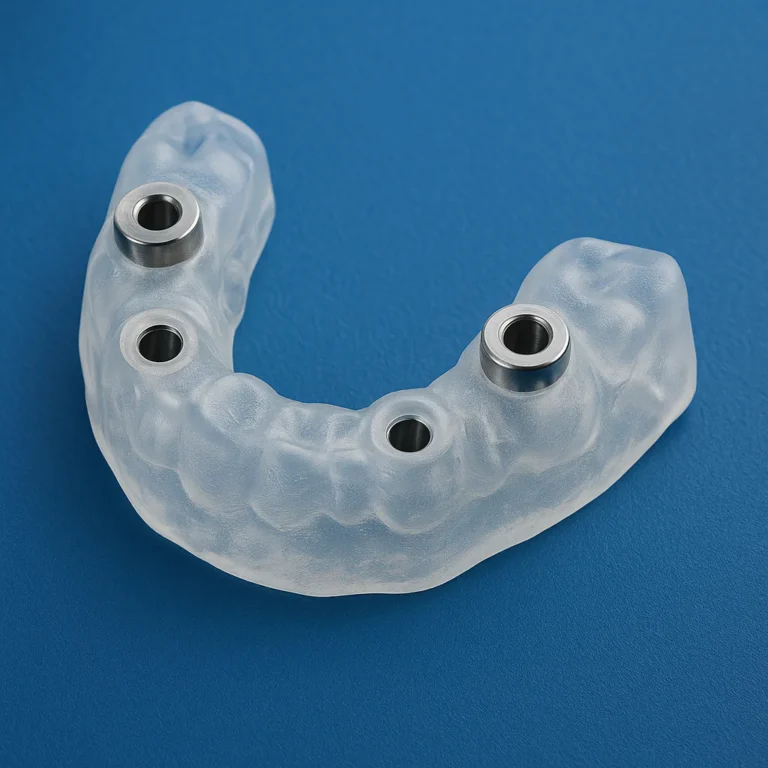
5. Surgical Guide Precision with 0.05mm Tolerance Levels
Implantology has been revolutionized by guides that fit like a glove.
- The Innovation: High-precision printing ensures that the drill guide aligns perfectly with the planned implant position.
- The Result: Less invasive surgery, faster healing, and predictable outcomes. The tolerance levels have dropped to 0.05mm, which is barely perceptible to the human eye but critical for implant success.
6. Direct Metal Laser Sintering (DMLS) for Custom Implants
Why use a standard screw when you can print a custom titanium implant?
- The Innovation: DMLS (or SLM) printers melt metal powder to create complex, porous structures that encourage osseointegration.
- The Future: Custom abutments and full-arch frameworks that are lighter and stronger than cast metal.
7. Clear Aligner Thermoforming Molds with Zero Shrinkage
The aligner industry (think Invisalign) is built on 3D printing.
- The Innovation: Specialized resins that don’t shrink during the curing process, ensuring the mold matches the digital plan exactly.
- The Impact: Consistent force application for teeth movement, leading to better treatment outcomes.
8. 4D Printing: Smart Materials That Adapt to Oral Environments
This is the bleeding edge. 4D printing involves materials that change shape or properties over time in response to stimuli (heat, moisture, pH).
- The Innovation: Imagine a retainer that adjusts its fit as your gums change, or a splint that softens when it gets hot.
- Current Status: Mostly experimental, but Stratasys and research labs are making headway.
9. In-Office Micro-Lab Setups for Immediate Patient Turnaround
Dental offices are becoming mini-labs.
- The Innovation: Compact, automated workflows that fit in a standard operatory.
- The Benefit: No more shipping fees, no lost models, and immediate patient satisfaction.
10. Sustainable Bio-Resins and Recyclable Support Structures
The environmental cost of resin printing is real.
- The Innovation: New bio-based resins and support structures that can be easily recycled or are biodegradable.
- The Goal: Reducing the chemical waste associated with dental 3D printing.
🛠️ The Tech Stack: How Dental 3D Printing Technologies Actually Work
So, you’ve heard the buzzwords. But how do they actually work? Let’s break down the mechanics. It’s not magic; it’s physics and chemistry.
Stereolithography (SLA) & Digital Light Processing (DLP): The Workhorses
These are the kings of dental printing.
- How it Works: A vat of liquid resin sits below a build platform. A light source (laser for SLA, projector for DLP) cures the resin layer by layer.
- The Difference: SLA uses a single point laser that traces the shape. DLP projects the entire layer at once.
- Why Dentists Love It: DLP is faster for batch printing (like 10 aligner models at once). SLA is often preferred for ultra-high detail on single crowns.
- Post-Processing: You must wash the part in alcohol (IPA) and then UV cure it to reach full strength.
Selective Laser Sintering (SLS) & Direct Metal Laser Sintering (DMLS): Metal Mastery
When you need metal, you need lasers.
- How it Works: A high-powered laser fuses powder particles (plastic for SLS, metal for DMLS) together.
- The Process: The build chamber is filled with powder. The laser sinters the cross-section, then the platform drops, and a new layer of powder is spread.
- The Result: Extremely strong, complex metal parts. No support structures needed for SLS (the powder acts as support), but DMLS often requires supports to handle thermal stress.
Material Jeting (PolyJet): The Multi-Material Magic
This is the closest thing to inkjet printing for 3D objects.
- How it Works: Tiny droplets of photopolymer are jeted onto the build platform and cured instantly with UV light.
- The Magic: You can jet different materials (hard, soft, transparent, opaque) simultaneously.
- Use Case: Perfect for anatomical models where you need to see bone (hard), gum (soft), and nerve (transparent) all in one print.
Fused Deposition Modeling (FDM): The Budget-Friendly Contender
Don’t laugh! FDM has its place.
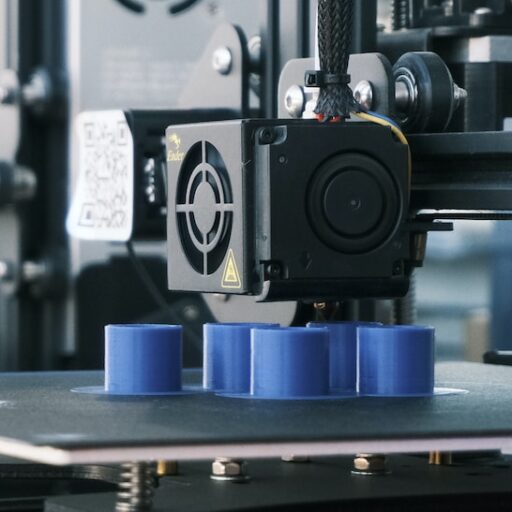
- How it Works: A nozzle melts plastic filament and extrudes it layer by layer.
- The Limitation: Low resolution and visible layer lines make it unsuitable for clinical restorations.
- The Niche: Great for educational models, training aids, and protyping. If you’re a student learning anatomy, a $20 FDM printer is a great start.
🦷 Applications: Where Innovation Mets the Mouth
Let’s get specific. Where are these technologies actually being used?
Restorative & Prosthetic Dentistry: Crowns, Bridges, and Dentures
- Crowns: From temporary “caries control” crowns printed in 15 minutes to permanent zirconia-like resin crowns.
- Dentures: The CU Anschutz breakthrough mentioned earlier uses inkjet printing to create the entire denture in one build, reducing production time to a few hours.
- Bridges: Custom frameworks printed in metal or high-strength resin.
Orthodontics & Aligners: The Clear Path to Straight Teeth
- The Workflow: Scan -> Design -> Print -> Thermoform.
- The Innovation: Printing the models for every stage of the treatment.
- Cost: Printing your own aligner molds can save thousands compared to outsourcing.
Implantology & Surgical Planning: Precision Guides and Custom Abutments
- Surgical Guides: Printed guides ensure the implant is placed exactly where the software planned.
- Custom Abutments: Instead of buying a stock abutment, you print a custom one that fits the patient’s gum line perfectly.
Diagnostic Models & Education: Teaching the Next Generation
- Anatomical Models: Multi-material prints that show pathology, bone density, and soft tissue.
- Patient Communication: Showing a patient a 3D print of their own jaw helps them understand the procedure and increases case acceptance.
⚖️ The Good, The Bad, and The Sticky: Advantages vs. Challenges
Is 3D printing perfect? No. But is it better than the old way? Absolutely. Let’s weigh the pros and cons.
Why We Love It: Speed, Precision, and Cost Savings
- Speed: Same-day dentistry is real.
- Precision: Micron-level accuracy means fewer remakes.
- Cost: Lower material waste and no lab fees for in-house work.
- Customization: Every patient gets a device tailored to their unique anatomy.
The Hiccups: Material Limitations, Regulatory Hurdles, and Learning Curves
- Material Limits: Not every material is FDA cleared yet. Some resins are brittle; others are too soft.
- Post-Processing: It’s messy. You need wash stations, cure stations, and proper ventilation.
- Regulatory Hurdles: You need to be an expert on FDA and ISO regulations. Printing a device for a patient is a medical act, not a hobby.
- Learning Curve: Designing in CAD takes time. If you can’t design, you’re stuck paying for design services.
🔮 What’s Next? Emerging Trends and the Future of Digital Dentistry
We are standing on the precipice of something huge.
- 4D Printing: As mentioned, smart materials that adapt.
- Bioprinting: Printing living cells to regenerate bone or even teeth.
- AI Automation: The day when the dentist just scans, and the AI designs, prints, and delivers the restoration without human intervention.
- Sustainability: Green resins and closed-loop recycling systems.
The future is digital, patient-centered, and powered by additive manufacturing. The question isn’t if you will adopt it, but when.
🧠 Conclusion: The Future is Digital (and It’s Smiling)

We started this journey wondering if 3D printing was just a flash in the pan. The answer is a resounding no. From the humble beginnings of stone models to the high-tech inkjet printers at CU Anschutz, the evolution has been nothing short of revolutionary.
The Verdict:
- For the Practitioner: If you aren’t looking into 3D printing, you’re falling behind. The efficiency gains and patient satisfaction are undeniable. Start with a 95-micron printer for models and guides, and scale up to 5-micron for restorations as you get comfortable.
- For the Patient: You get faster, more accurate, and often cheaper treatments.
- For the Enthusiast: The technology is accessible, but the barrier to entry is knowledge. Learn the materials, respect the regulations, and you’ll be part of the next generation of dental innovation.
The “gross” factor is manageable with the right workflow. The cost is manageable with the right ROI. The future is here, and it’s smiling back at you.
🔗 Recommended Links
Ready to dive in? Here are the resources and products we trust.
👉 CHECK PRICE on:
- SprintRay Pro S: Amazon | SprintRay Official
- Formlabs Form 3L: Amazon | Formlabs Official
- Phrozen Sonic Mega 8K: Amazon | Phrozen Official
- Anycubic Photon Mono M5s: Amazon | Anycubic Official
👉 Shop Dental Resins on:
- Formlabs Dental Resins: Formlabs Store
- Phrozen Dental Resins: Phrozen Store
- NextDent Resins: NextDent Official
Books & Guides:
❓ FAQ: Your Burning Questions About Dental 3D Printing Answered

What are the latest materials used in dental 3D printing?
The latest materials include biocompatible Class IIa and IIb resins for permanent crowns and dentures, flexible gingiva masks, and high-temperature resins for thermoforming. We are also seeing the rise of bio-resins and metal powders (titanium, cobalt-chrome) for direct metal printing.
Read more about “🚀 3D Printing Market Size: Is McKinsey Underestimating the $50B Boom? (2026)”
How is 3D printing changing the cost of dental implants?
3D printing reduces the cost by eliminating the need for manual casting and reducing material waste. Custom surgical guides and abutments can be printed in-house for a fraction of the lab cost. However, the initial investment in equipment and training is significant.
Which 3D printers are best for dental labs in 2024?
It depends on your volume. For high-volume aligner models, SprintRay and Phrozen offer excellent speed. For high-detail restorations, Formlabs and Asiga are top contenders. For metal, Desktop Metal and EOS are industry leaders.
Read more about “🚀 7 Latest 3D Printing Trends Reshaping 2024”
Can 3D printed dentures be as durable as traditional ones?
Yes, with the right materials. New multi-material inkjet printing and high-strength resins allow for dentures that are as durable as traditional acrylics, with the added benefit of a better fit and faster production.
What are the regulatory requirements for 3D printed dental devices?
In the US, devices must be FDA cleared or approved. This includes the printer, the software, and the specific resin material. You must follow strict sterilization and post-processing protocols to ensure biocompatibility.
How does 3D printing improve the accuracy of surgical guides?
By printing guides directly from the digital plan with 0.05mm tolerance, the guide fits perfectly on the patient’s anatomy. This ensures the drill follows the exact path planned, reducing surgical time and complications.
Read more about “🦷 Surgical Guides 3D Printing: The Ultimate 2026 Guide to Precision”
What future innovations are expected in dental 3D printing technology?
We expect to see 4D printing (smart materials), bioprinting of tissues, and fully AI-driven workflows that automate design and quality control. The integration of sustainable materials will also be a major focus.
Read more about “🚀 3D Printing ROI: The Ultimate 2026 Guide to Profit & Savings”
📚 Reference Links
- CU Anschutz School of Dental Medicine: 3D Printing Advances Denture Innovation at CU Anschutz School of Dental Medicine
- Phrozen 3D: 3D Printing in Dentistry Guide
- Infinia Dental: 3D Printing in Dentistry: Digital Workflows, Advancements, and Future Trends
- Formlabs: Dental Solutions
- SprintRay: Dental 3D Printers
- FDA: 3D Printed Medical Devices
- 3D Printed™: 3D Printing in Healthcare