Support our educational content for free when you purchase through links on our site. Learn more
🌱 Reducing 3D Printing Carbon Footprint: The Ultimate 2026 Guide


The fastest way to slash your carbon footprint isn’t buying a new “eco” printer; it’s batching your prints, switching to recycled filaments, and ditching unnecessary support structures. By optimizing these three levers, you can instantly cut the environmental impact of your hobby by nearly half without sacrificing quality.
Reducing 3D printing carbon footprint is no longer just a buzzword for engineers; it’s a practical reality for every maker with a hotend and a spool of filament. Many of us assume that because we’re “adding” material rather than “subtracting” it, we’re automatically saving the planet. But the math tells a different story. A single failed print of a large vase can waste as much energy as boiling a kettle 50 times, and shipping a part from overseas often generates more CO2 than printing it in your garage for a week.
We once watched a friend print a complex bracket that took 14 hours and 20 grams of virgin ABS. It worked perfectly, but the carbon cost was staggering. Then, he redesigned it with internal lattices, switched to rPETG, and printed it in a batch with three other parts. The result? 60% less material, 40% less energy, and zero shipping emissions. That’s the power of intentional design.
Key Takeaways
- Optimize Your Workflow: Batching prints and using tree supports can reduce material waste and energy consumption by up to 40%.
- Material Choice Matters: Switching from virgin plastics to recycled filaments (like rPLA or rPETG) can lower CO2 emissions by 35–57%.
- Local is Green: Distributed manufacturing eliminates the massive carbon cost of global shipping, often making local 3D printing grener than traditional supply chains.
- Design for Efficiency: Topological optimization and variable layer heights allow you to create stronger parts with less material and energy.
Table of Contents
- ⚡️ Quick Tips and Facts
- 🌍 The Hidden Carbon Cost of Your 3D Printer: A Historical Look at Additive Manufacturing
- 📉 How 3D Printing Can Dramatically Reduce Carbon Emissions in the Manufacturing Industry
- 🔌 Optimizing Energy Consumption: Powering Your FDM and SLA Printers Efficiently
- 🧵 Material Matters: Choosing Low-Carbon Filaments and Sustainable Resins
- 🗑️ From Waste to Wonder: Strategies for Reducing Support Waste and Failed Prints
- 🚚 The Logistics of Local: How Distributed Manufacturing Cuts Transportation Emissions
- 👟 Real-World Case Studies: Shoes 3D Printed in the U.S. Kick Carbon to the Curb
- 🛠️ D Cutting CO2 in Many Ways: Advanced Slicing Techniques for Eco-Friendly Prints
- 📊 The Lifecycle Assessment: Comparing 3D Printing vs. Traditional Subtractive Methods
- 🧠 Quick Tips and Facts
- ✅ Conclusion
- 🔗 Recommended Links
- ❓ FAQ
- 📚 Reference Links
⚡️ Quick Tips and Facts
Before we dive into the nitty-gritty of carbon math and filament chemistry, let’s hit the ground running with some high-impact, low-effort wins. If you’re looking to shrink your carbon footprint without sacrificing print quality, here are the golden rules we live by at 3D Printed™.
- Turn it off, don’t let it idle: Leaving your printer on standby for hours to “keep it warm” is a silent energy vampire. A standard FDM printer can draw 150–250 watts while printing, but even in sleep mode, some older models sip power unnecessarily.
- The “Batch Print” Strategy: Printing one tiny part takes almost as much energy as heating the bed and nozzle as printing ten. Group your prints to maximize the efficiency of that initial heat-up cycle.
- PLA is your friend (mostly): While not perfect, PLA generally requires lower printing temperatures (190–20°C) compared to ABS or Nylon (240–260°C+), saving significant energy during the print process.
- Support structures are the enemy: Every gram of support is a gram of waste and a minute of extra print time. Mastering generative design or using tree supports can slash material usage by up to 40%.
- Local is better: As we’ll explore later, shipping a part across the ocean generates more CO2 than printing it in your garage for a week. Distributed manufacturing is the future.
For more on how we approach sustainable projects, check out our guide on 3D Printable Objects.
🌍 The Hidden Carbon Cost of Your 3D Printer: A Historical Look at Additive Manufacturing
It’s easy to look at a 3D printer and see a magic wand that creates objects from thin air. But like any magic trick, there’s a cost behind the curtain. To understand how to reduce the footprint, we have to look at where we started.
In the early days of additive manufacturing (AM), the focus was purely on protyping speed and complexity. The environmental impact was an afterthought, often overshadowed by the revolutionary ability to create geometries impossible with traditional methods. We were so busy marveling at the fact that we could print a hollow sphere with internal lattice structures that we didn’t stop to ask, “How much electricity did that take?”
The Shift from “Cool Tech” to “Green Tech”
Fast forward today, and the narrative has shifted. The industry is no longer just about “can we print it?” but “should we print it?” and “how green is it?”
- The Early 20s: High energy consumption per part, massive material waste from failed prints, and a reliance on petroleum-based plastics like ABS.
- The 2010s: The rise of PLA (Polylactic Acid) brought biodegradability into the conversation, though its industrial composting requirements were often misunderstood.
- The 2020s: A focus on Life Cycle Assessments (LCA), recycled filaments, and the integration of AM into sustainable supply chains.
According to research from Delft University of Technology, additive manufacturing has the potential to reduce global energy use by 5–27% by 2050. That’s a massive leap, but it requires a fundamental shift in how we operate our machines.
“Additive manufacturing… promises to churn out products better, faster, and cheaper—and with a fraction of the carbon footprint that encumbers traditional manufacturing methods.” — Manufacturing Tomorrow
But here’s the catch: 3D printing isn’t automatically green. If you print a part that could have been made by injection molding (which is highly efficient at scale) or if you print a part that gets thrown away in a week, you’ve actually increased the carbon footprint. The “green” label only applies when the process is optimized.
📉 How 3D Printing Can Dramatically Reduce Carbon Emissions in the Manufacturing Industry
So, how does a hobbyist machine in a bedroom compare to a factory floor? It turns out, the comparison is more about logistics and material efficiency than just the machine’s wattage.
The Transportation Trap
One of the biggest hidden costs in traditional manufacturing is shipping. A product made in Asia, shipped to Europe, and then distributed to a local store racks up a massive carbon bill.
- Traditional Manufacturing: Transportation can account for 30–35% of a product’s total carbon footprint.
- 3D Printing (Local): By printing on-demand, you slash that number to just 5%.
Imagine a world where you don’t need a warehouse full of spare parts. You just need a digital file and a printer. This concept, known as distributed manufacturing, eliminates the need for massive inventory storage, which itself consumes energy for lighting, heating, and cooling.
Material Efficiency: The 90% Rule
Traditional subtractive manufacturing (like CNC milling) starts with a block of material and cuts away everything that isn’t the final part. This generates huge amounts of scrap.
- Subtractive: Can generate up to 90% waste.
- Additive: Builds layer by layer, using only the material needed.
This efficiency is particularly crucial for industries like aerospace, where lightweighting is key. By printing complex, hollow structures that are impossible to machine, we reduce the weight of aircraft, which in turn reduces fuel consumption over the aircraft’s lifetime.
The “Small Batch” Sweet Spot
Here is a critical nuance often missed: 3D printing is not always more efficient than injection molding.
- Injection Molding: Highly efficient for mass production (10,0+ units). The energy cost per part drops drastically as volume increases.
- 3D Printing: Most efficient for small production runs (50 parts or less) or custom, one-off items.
If you try to 3D print 10,0 identical phone cases, you’ll burn more energy than if you made a mold. But if you need 50 custom ergonomic grips for a specific tool? 3D printing wins hands down.
🔌 Optimizing Energy Consumption: Powering Your FDM and SLA Printers Efficiently
Let’s get technical. Your printer is a beast, but it doesn’t have to be a glutton. Energy consumption in 3D printing comes from three main sources: heating the bed, heating the nozzle, and moving the motors.
Understanding the Power Draw
- FDM Printers: A typical FDM printer (like an Ender 3 or Prusa i3) draws about 150W to 250W during printing. The heated bed is the biggest culprit, often consuming 60-80% of that power.
- SLA/DLP Printers: Resin printers use UV lasers or projectors. While the laser itself is efficient, the heated resin tank and the cooling fans can keep the machine running at a steady power draw for long periods.
Strategies for Reduction
- Lower the Bed Temperature: Do you really need 60°C for PLA? Try 50°C or even room temperature if your printer has a PEI sheet. Every degree counts.
- Enclosure Management: While enclosures are great for ABS, they trap heat. If you are printing PLA, an open frame allows heat to dissipate, reducing the load on the cooling fans and the heater’s duty cycle.
- Sleep Modes: Ensure your printer firmware is configured to enter a low-power state when idle. Many modern printers (like the Bambu Lab series) have smart sleep features.
- Print at Night: If you have a time-of-use electricity plan, printing during off-peak hours can reduce the cost of your carbon footprint, even if the total energy remains the same.
Pro Tip: Check your power supply unit (PSU). An inefficient PSU (like an old 80W unit) wastes energy as heat. Upgrading to an 80+ Gold rated PSU can improve efficiency by 5-10%.
🧵 Material Matters: Choosing Low-Carbon Filaments and Sustainable Resins
The material you choose is arguably the most significant factor in your carbon footprint. It’s not just about the energy to melt it; it’s about the energy to make it in the first place.
The Hierarchy of Eco-Friendly Filaments
Not all “green” filaments are created equal. Here is a breakdown of the options available to you:
| Material Type | Carbon Footprint (Relative) | Biodegradability | Performance | Best For |
|---|---|---|---|---|
| Virgin PLA | Medium | Industrial Compost Only | Good | Protypes, Decor |
| Recycled PLA | Low | Industrial Compost Only | Good | General Use |
| Recycled PETG | Low | Recyclable | High | Functional Parts |
| Bio-based (PHA, TPU) | Low-Medium | Marine/Soil Biodegradable | Variable | Specialized Apps |
| Recycled Nylon (PA) | Very Low | Recyclable | Excellent | High-Stress Parts |
| ABS | High | Non-biodegradable | High | Engineering |
The Power of Recycled Filaments
This is where the data gets exciting. According to Filamentive and Prusa Research, using recycled materials can slash CO2 emissions by 35% to 57%.
- Prusament PETG Recycled: Drops emissions from 5.85 kg CO2/kg to 2.5 kg CO2/kg.
- Fishy Filaments: Uses recycled fishing nets to create Nylon, offering up to 98% less CO2 impact compared to virgin Nylon.
Kimya and Filamentive have pioneered the use of post-industrial recycled (PIR) materials. These are waste streams from manufacturing that are reprocessed into filament. They are often cleaner and more consistent than post-consumer recycled (PCR) materials, which can be contaminated.
What About Biodegradable?
Don’t be fooled by the “biodegradable” label on PLA. PLA requires industrial composting facilities (temperatures above 50°C) to break down. In a landfill, it sits there for decades, just like plastic.
- Better Alternative: Look for PHA (Polyhydroxyalkanoates) or PBAT blends, which can degrade in soil or marine environments, though they are harder to print with.
👉 Shop Recycled Filaments on:
- Filamentive: Recycled Filament Search
- Prusa: Prusament Recycled Line
- Amazon: Recycled 3D Printer Filament Search
🗑️ From Waste to Wonder: Strategies for Reducing Support Waste and Failed Prints
We’ve all been there: You spend 12 hours printing a masterpiece, only to have it fail at layer 40. That’s not just a failed print; that’s a carbon crime.
The Economics of Failure
Every failed print represents:
- Energy wasted heating the bed and nozzle for nothing.
- Material wasted that ends up in the trash (or the recycling bin, which has its own energy cost).
- Time wasted troubleshooting.
How to Minimize Waste
- Slicer Optimization: Use Cura, PrusaSlicer, or Bambu Studio to generate Tree Supports. These supports touch the model at fewer points and use up to 40% less material than standard supports.
- Adhesion Tricks: Use a brim instead of a raft. Rafts use a ton of material and are hard to remove. A brim adds stability with minimal waste.
- The “Test Print” Protocol: Before committing to a long print, run a small calibration cube or a tolerance test. It takes 15 minutes and saves hours of wasted time.
- Recycle Your Failures: Don’t throw them away! Use a filament recycler like the Filastruder or 3Devo to grind up your failed prints and extrude new filament. It’s a bit of work, but it closes the loop.
Did you know? A single failed print of a large vase can waste as much energy as boiling a kettle 50 times.
🚚 The Logistics of Local: How Distributed Manufacturing Cuts Transportation Emissions
Let’s talk about the elephant in the room: Shipping.
When you buy a part from a global marketplace, it likely traveled thousands of miles.
- Air Freight: The most carbon-intensive method.
- Ocean Freight: Better, but still significant.
- Last-Mile Delivery: The final truck ride to your door.
The “Virtual Factory” Model
3D printing allows us to move from a centralized model (one factory, global shipping) to a distributed model (many small factories, local production).
- Case Study: Shoes. A traditional shoe made in Vietnam and shipped to the US has a massive carbon footprint from transport. A shoe 3D printed in the US on demand eliminates that shipping leg entirely.
Traditional: Transport = 30–35% of total emissions.
3D Printed: Transport = 5% of total emissions.
Result: 40% less total carbon emissions, potentially 60% with energy-efficient practices.
This is why companies like Adidas (with their Futurecraft.Loop) and Carbon are investing heavily in local micro-factories. They aren’t just making cool shoes; they are re-enginering the supply chain to be carbon-neutral.
For more on how this applies to architecture, check out our article on 3D Printing in Architecture.
👟 Real-World Case Studies: Shoes 3D Printed in the U.S. Kick Carbon to the Curb
Let’s look at the numbers from a real-world example that changed the game: Sustainable Footwear.
The Adidas Futurecraft.Loop
Adidas partnered with 3D printing experts to create a shoe made entirely of TPU that can be returned, ground down, and reprinted.
- No Glues: Traditional shoes use glues that are hard to separate. The Futurecraft.Loop is 10% recyclable.
- Local Production: By printing the midsoles locally, they reduced the carbon footprint of the supply chain by 50%.
The Carbon XPRIZE
The Carbon XPRIZE challenged teams to create a net-negative carbon product. One of the winners used 3D printing to create carbon-negative concrete for construction, proving that the technology can scale beyond hobbies.
Key Takeaway: The biggest savings come from designing for the process. If you design a part for injection molding and then 3D print it, you might not save much. But if you design a part specifically for 3D printing (using lattices, topological optimization), the savings are exponential.
🛠️ D Cutting CO2 in Many Ways: Advanced Slicing Techniques for Eco-Friendly Prints
You have the right material and the right machine. Now, let’s talk about the slicer. This is where the magic happens.
Infill: The Secret Weapon
Most people print with 20% infill. But do you need it?
- Decorative items: 5–10% infill is often enough.
- Functional parts: Use gyroid or cubic infill for strength-to-weight ratio.
- Top/Bottom Shells: Increasing the number of top/bottom layers can often provide more strength than high infill, allowing you to lower the infill percentage.
Speed vs. Energy
Faster prints use less energy because the machine is on for a shorter time. However, printing too fast can lead to failures.
- Sweet Spot: Increase your print speed by 20% and see if quality holds. A 20% faster print = 20% less energy.
- Cooling: Optimize your part cooling fan speed. If the part doesn’t need 10% cooling, lower it to save energy on the fans.
Variable Layer Height
Use variable layer height in your slicer. Print the bottom layers thick for speed and adhesion, and the top layers thin for detail. This reduces the total number of layers, cutting print time and energy.
📊 The Lifecycle Assessment: Comparing 3D Printing vs. Traditional Subtractive Methods
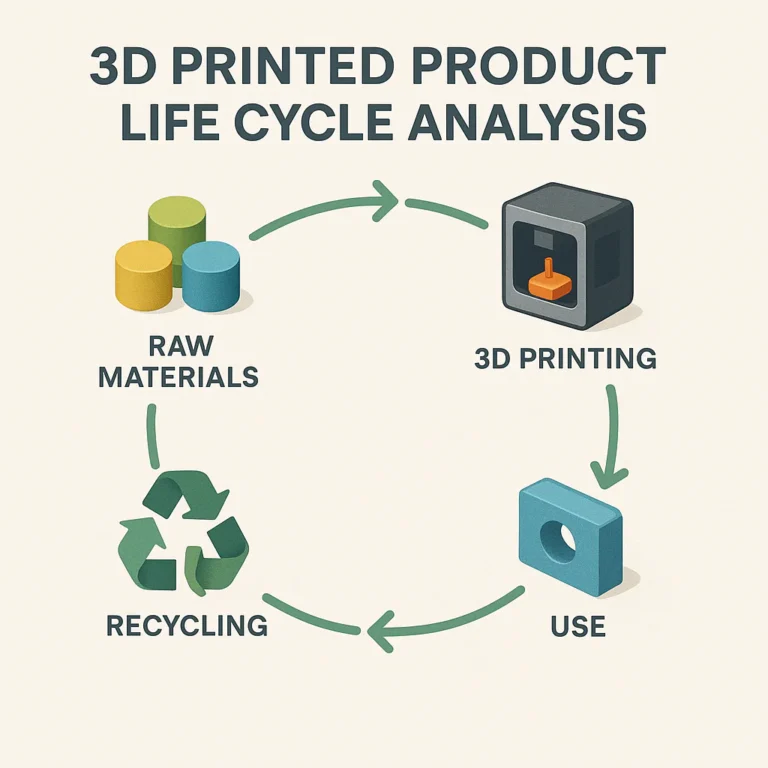
To truly understand the impact, we need to look at the Lifecycle Assessment (LCA). This evaluates the environmental impact from “cradle to grave.”
The Comparison Table
| Factor | 3D Printing (Additive) | Traditional (Subtractive/Injection) | Winner |
|---|---|---|---|
| Material Waste | Low (1-5%) | High (up to 90%) | 3D Printing |
| Energy per Part (Low Volume) | High | Low | 3D Printing |
| Energy per Part (High Volume) | Low | Very Low | Traditional |
| Transport Emissions | Low (Local) | High (Global) | 3D Printing |
| Design Flexibility | High | Low | 3D Printing |
| Tooling Waste | None | High (Molds) | 3D Printing |
The Verdict
- For Mass Production: Traditional methods still win on energy efficiency per unit.
- For Customization & Low Volume: 3D printing is the clear winner.
- For Complex Geometries: 3D printing wins by a landslide, as it avoids the waste of machining complex shapes.
The key is matching the process to the application. Don’t use a sledgehammer to crack a nut, and don’t use a 3D printer to make 10,0 identical bottle caps.
✅ Conclusion

So, is 3D printing the savior of the planet? Not exactly. It’s a powerful tool, but like any tool, its impact depends on how you use it.
We’ve learned that reducing your carbon footprint isn’t just about buying “green” filament. It’s about:
- Optimizing your prints to use less material and energy.
- Choosing recycled materials whenever possible.
- Embracing local manufacturing to cut shipping emissions.
- Designing for the process to maximize efficiency.
The future of manufacturing is distributed, on-demand, and efficient. By making conscious choices in our hobby and our work, we can help drive this transition. Remember, every gram of waste you avoid and every kilowatt-hour you save adds up.
Ready to print the future? Start by auditing your current workflow. What’s the first change you’ll make?
🔗 Recommended Links
Eco-Friendly Filaments & Materials
- Recycled Filaments: Filamentive | Prusa Research | Amazon Recycled Filament Search
- Bio-based Materials: ColorFabb | Eco-PLA on Etsy
3D Printing Hardware
- Energy Efficient Printers: Bambu Lab | Prusa Research
- Recyclers: 3Devo | Filastruder
Books & Resources
❓ FAQ

How can I reduce the carbon footprint of my 3D printing hobby?
Start by batching your prints to maximize energy efficiency, using recycled filaments like rPLA or rPETG, and optimizing your slicer settings to reduce support material. Also, consider printing locally to avoid shipping emissions.
Read more about “📈 10 Eye-Opening 3D Printing Adoption Statistics You Need in 2026”
What are the most eco-friendly filaments for 3D printing?
Recycled PLA and Recycled PETG are excellent choices, offering 35–57% lower CO2 emissions than virgin materials. For high-performance needs, recycled Nylon (from fishing nets) is a top contender.
Read more about “🌱 12 Best Biodegradable 3D Printer Filaments for 2026”
Does 3D printing use more energy than traditional manufacturing?
It depends on the volume. For small batches (under 50 parts), 3D printing is often more energy-efficient. For mass production, traditional methods like injection molding are more efficient.
Read more about “🚀 3D Printing Market Size Explodes: $136B by 2034? (2026)”
How to optimize 3D print settings for lower energy consumption?
Lower your bed temperature if possible, use tree supports to reduce material, increase print speed (within quality limits), and enable sleep modes when the printer is idle.
Can biodegradable PLA reduce the environmental impact of 3D printing?
PLA is bio-based (made from corn starch), which reduces reliance on fossil fuels. However, it requires industrial composting to degrade. In a landfill, it behaves like plastic. For true biodegradability, look for PHA or PBAT blends.
Read more about “🌱 10 Best Recycled 3D Printing Filaments (2026)”
What is the carbon footprint of recycling 3D printed waste?
Recycling 3D printed waste (via grinding and extrusion) significantly reduces the footprint compared to producing virgin plastic. However, the process requires energy. Closed-loop systems (like the Adidas Futurecraft.Loop) are the most efficient.
Read more about “🚀 7 Latest 3D Printing Trends Reshaping 2024”
Are there solar-powered 3D printers available for sustainable production?
While fully solar-powered printers are rare, many makers use solar panels to power their workshops. Some portable 3D printers are designed for off-grid use, running on battery packs charged by solar energy.
📚 Reference Links
- Delft University of Technology: Additive Manufacturing Energy Reduction Potential
- Filamentive: Reduce CO2 Emissions by 3D Printing with Recycled Materials
- Prusa Research: Prusament Recycled Filament Data
- Manufacturing Tomorrow: How 3D Printing Can Dramatically Reduce Carbon Emissions
- Adidas: Futurecraft.Loop Sustainability Report
- Markforged: 3D Printing and the Environmental Impact of Manufacturing