Support our educational content for free when you purchase through links on our site. Learn more
🏙️ 10 Urban Infrastructure 3D Printing Projects Reshaping Cities (2026)

Forget the slow crawl of traditional construction; urban infrastructure 3D printing is already building smarter, faster, and more sustainable cities right now. From a self-monitoring steel bridge in Amsterdam to entire neighborhoods of affordable homes in Texas, additive manufacturing is no longer a futuristic concept but a tangible reality transforming our skylines.
Imagine a world where a bridge is printed in mid-air by dancing robots, or where a park bench is crafted from the plastic waste collected from your own neighborhood. This isn’t science fiction; it’s the MX3D Bridge in action, a structure that “fels” the weight of pedestrians and reports its own health to engineers in real-time.
The shift is happening faster than you might think. While a traditional concrete wall takes days to cure, a 3D printed shell can be erected in 24 hours, slashing labor costs and material waste by up to 60%. We are moving from a era of “bricks and mortar” to one of “data and deposition,” where every beam and bench is optimized by algorithms for maximum strength and minimum environmental impact.
Key Takeaways
- Speed and Efficiency: 3D printing reduces construction time by up to 70% and cuts material waste significantly compared to traditional methods.
- Design Freedom: Complex, organic shapes that were previously impossible or too expensive to build are now standard practice with robotic arms.
- Sustainability: The technology enables the use of recycled plastics and geopolymers, drastically lowering the carbon footprint of city building.
- Smart Integration: Modern printed infrastructure often includes embedded sensors, turning static structures into data-generating assets for smart cities.
- Cost-Effectiveness: While initial setup is high, long-term savings in labor, maintenance, and material usage make it a viable economic choice for municipalities.
Table of Contents
- ⚡️ Quick Tips and Facts
- 🏗️ From Concrete to Code: The History of Urban Infrastructure 3D Printing
- 🏙️ The Big Print: How Additive Manufacturing is Reshaping Cityscapes
- 🌉 Case Study: The MX3D Bridge and the Future of Pedestrian Walkways
- 🧱 Top 7 Materials Revolutionizing Construction 3D Printing
- 🏭 Top 5 Companies Leading the Charge in Large-Scale 3D Printing
- 🚧 Top 10 Real-World Urban Infrastructure Projects Printed to Date
- 💰 Cost Analysis: Is 3D Printed Infrastructure Cheaper Than Traditional Methods?
- 🛡️ Safety, Durability, and Building Codes: Can Printed Structures Last?
- 🌍 Sustainability: The Environmental Impact of 3D Printed Cities
- 🤖 The Role of Robotics and Automation in Urban Fabrication
- 🔮 Future Trends: Smart Cities, Self-Healing Concrete, and Beyond
- 🧐 Common Myths and Misconceptions About Printing Cities
- 🏁 Conclusion
- 🔗 Recommended Links
- ❓ FAQ
- 📚 Reference Links
⚡️ Quick Tips and Facts
Before we grab our hard hats and dive into the muddy waters of construction sites, let’s hit the rewind button on some mind-bending realities. You might think 3D printing is just for making plastic figurines or replacement parts for your broken toaster, but the scale of what’s happening in urban infrastructure is absolutely mind-blowing.
Here is the lowdown from our team at 3D Printed™:
- Speed is the new currency: Traditional concrete walls take days to cure and build. A 3D printed wall? We’re talking 20 days for an entire house shell, with the printer working 24/7 while humans sleep.
- Material waste is a thing of the past: Traditional construction is messy. Additive manufacturing is precision. We only use the material we need, layer by layer, slashing waste by up to 30-60% compared to traditional methods.
- It’s not just concrete: While concrete gets all the hype, we are seeing stainless steel, recycled plastics, and even geopolymers being printed into bridges and park benches.
- The “Smart” factor: The world’s first 3D-printed bridge in Amsterdam isn’t just a walkway; it’s a data collector. It “fels” the weight of pedestrians and monitors air quality in real-time.
- Local is the future: The “Fab City” concept suggests we won’t ship heavy furniture or building materials across oceans. We’ll print them locally from recycled waste right in the neighborhood.
Did you know? The first 3D-printed bridge in Amsterdam was printed in mid-air by robots, without any scaffolding! It sounds like magic, but it’s actually robotic welding on steroids.
If you’re curious about how we got here, keep reading. But first, let’s link up with our community. For more on the objects we can print, check out our guide to 3D Printable Objects. And if you want to see the full scope of our mission, visit 3D Printed.
🏗️ From Concrete to Code: The History of Urban Infrastructure 3D Printing

You might be wondering, “How did we go from printing tiny plastic dragons to printing entire city bridges?” It wasn’t an overnight success story. It was a slow, gritty evolution, much like the city itself.
The Early Days: From Protyping to Production
In the 1980s, 3D printing (or additive manufacturing) was the domain of engineers creating rapid prototypes. It was expensive, slow, and limited to small, plastic parts. The idea of printing a skyscraper or a bridge was the stuff of sci-fi novels.
However, the seeds were sown. As the technology matured, the focus shifted from “can we print this?” to “what can we print that matters?”
The Turning Point: The Rise of Contour Crafting
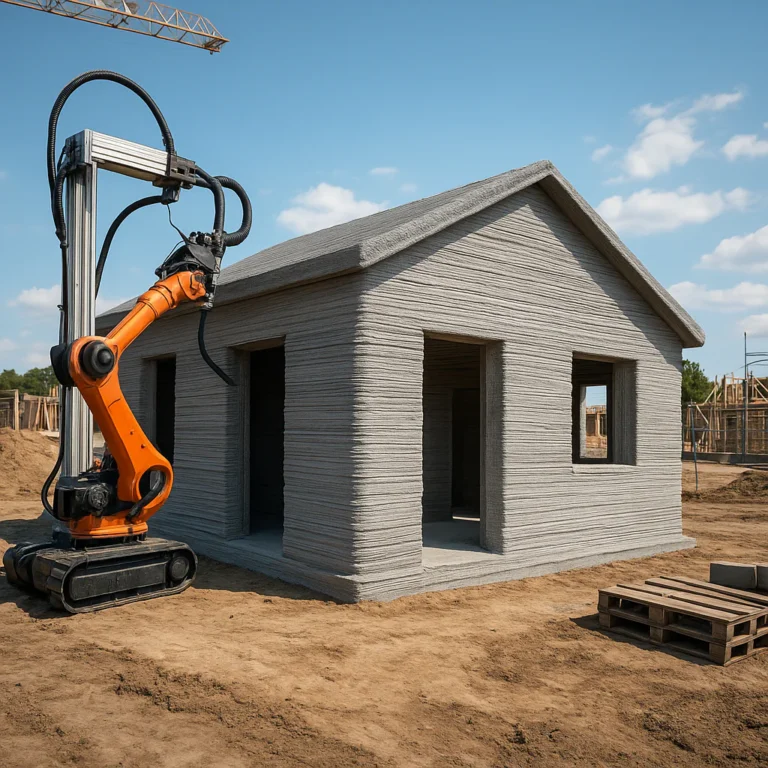
The real game-changer for infrastructure came with the development of Contour Crafting by Dr. Behrokh Khoshnevis at the University of Southern California in the 190s. This wasn’t just about layering plastic; it was about extruding concrete with a robotic arm to build walls at incredible speeds.
Fun Fact: Dr. Khoshnevis envisioned a future where a single robot could build a house in a day. While we aren’t quite there yet, the technology has evolved significantly since then.
The Metal Revolution: MX3D and the Amsterdam Bridge
Fast forward to the 2010s. If concrete was the first wave, metal was the tsunami. The company MX3D took industrial welding robots and turned them into 3D printers. They didn’t just print a model; they printed a functional, load-bearing steel bridge in mid-air.
This project, completed in 2018, proved that 3D printing could handle the structural integrity required for public infrastructure. It wasn’t just a gimmick; it was a living lab for the future of cities.
The Fabrication City Movement
Simultaneously, the Fab City Global Initiative emerged, championed by MIT’s Centre for Bits and Atoms. The idea? Shift from “Product In, Trash Out” to “Data In, Product Out.” Cities like Barcelona and Amsterdam began adopting the “Fab City” model, aiming to produce everything they consume within their own borders using local 3D printing and digital fabrication.
This historical shift marks the transition from centralized manufacturing to distributed, local production. We are no longer just building cities; we are programming them.
🏙️ The Big Print: How Additive Manufacturing is Reshaping Cityscapes
So, how exactly does this tech reshape a city? It’s not just about slapping a printer on a construction site and waiting. It’s a fundamental shift in design philosophy, logistics, and urban planning.
Generative Design: Leting Algorithms Do the Heavy Lifting
Traditional construction relies on straight lines and right angles because they are easy to build. 3D printing? It thrives on organic shapes.
Using generative design software (like Autodesk’s Fusion 360), engineers input constraints (load, material, budget), and the AI spits out a structure that looks like a bone or a spiderweb. These shapes are often lighter and stronger than anything a human could draft by hand.
- Topology Optimization: Removing material where it’s not needed, leaving it only where the stress is.
- Biomimicry: Copying nature’s efficient structures (like honeycombs) to create stronger, lighter infrastructure.
The “Just-in-Time” Construction Model
Imagine a city where you don’t need a massive warehouse of bricks and steel. Instead, you have a digital library of designs. When a park bench breaks, you don’t ship a new one from a factory across the country. You download the file and print a replacement on-site using recycled plastic from the city’s waste stream.
This reduces:
- Transportation emissions: No more long-haul trucks.
- Storage costs: No need for massive inventory.
- Lead times: From months to hours.
Customization at Scale
One of the biggest myths is that 3D printing is only for mass production. Actually, it’s the opposite. It allows for mass customization. Every bench, every lamp post, every facade panel can be unique without increasing the cost.
Think about it: Why should every street in your city look the same? With 3D printing, the local culture can be encoded directly into the infrastructure.
🌉 Case Study: The MX3D Bridge and the Future of Pedestrian Walkways
Let’s zoom in on the crown jewel of urban 3D printing: The MX3D Bridge in Amsterdam. This isn’t just a bridge; it’s a proof of concept for the entire industry.
The Project Overview
- Location: Oudezijds Achterburgwal, Amsterdam (in the heart of the Red Light District).
- Dimensions: 12.2 meters long, 6.3 meters wide.
- Material: Stainless steel.
- Weight: 6,0 kg (6 tons).
- Construction Time: Printed between 2017 and 2018.
How It Was Built
Unlike traditional bridges that require massive scaffolding, this bridge was printed in mid-air. Four industrial robots (ABB) were programmed to weld the steel layer by layer, moving along the path of the bridge as it grew.
The “First Video” Perspective: If you’ve seen the footage of this process, you know it looks like a dance. The robots move with precision, depositing molten steel that cols instantly. It’s a mesmerizing display of robotic automation meeting structural engineering.
The “Smart” Element
What makes this bridge truly revolutionary is that it’s smart. It’s equipped with a network of sensors that monitor:
- Structural Health: Strain, vibration, and load.
- Environmental Data: Air quality and temperature.
- Human Behavior: Pedestrian counts and movement patterns.
This data feeds into a Digital Twin, a virtual replica of the bridge that allows engineers to predict maintenance needs before they happen. It’s a Living Lab for the BRIDGE project, researching the ethical and social implications of smart infrastructure.
Key Takeaways from the MX3D Bridge
- Feasibility: Metal 3D printing is viable for large-scale, load-bearing structures.
- Design Freedom: The organic, flowing shape would have been incredibly difficult (and expensive) to achieve with traditional welding.
- Data Integration: Infrastructure can now be a source of data, not just a passive object.
Quote from Gijs van der Velden, CEO of MX3D: “With this new technology, specific 3D printed urban infrastructure solutions can be developed, without wasting materials and with a design fully flexible in shape and style.”
🧱 Top 7 Materials Revolutionizing Construction 3D Printing
You can’t print a city with just one type of “ink.” The material you choose dictates the strength, durability, and environmental impact of the structure. Here are the top 7 materials making waves in the industry.
| Material | Best For | Pros | Cons | Real-World Example |
|---|---|---|---|---|
| Concrete (Geopolymer) | Walls, Foundations, Dams | High strength, fast curing, low cost | Heavy, requires reinforcement, limited shape complexity | ICON (Homes in Texas) |
| Stainless Steel | Bridges, Complex Joints | Extremely strong, durable, recyclable | High energy cost, expensive material | MX3D Bridge (Amsterdam) |
| Recycled Plastics | Park Benches, Street Furniture | Sustainable, lightweight, colorful | Lower structural strength, UV degradation | ByFusion (Recycled plastic bricks) |
| Geopolymers | Sustainable Concrete Alternatives | Lower carbon footprint than Portland cement | Limited availability, complex mixing | COBOD (Various projects) |
| Hempcrete | Insulation, Non-load-bearing walls | Carbon negative, breathable, renewable | Low compressive strength, moisture sensitivity | Hempitecture (Commercial buildings) |
| Soil/Earth | Low-cost Housing, Rural Areas | Abundant, zero transport cost, thermal mass | Weather vulnerability, requires stabilization | WASP (3D printed earth homes) |
| Glass | Facades, Artistic Elements | Aesthetic, transparent, durable | Britle, difficult to print, high energy | Glasfabrik (Experimental facades) |
Deep Dive: Concrete vs. Geopolymers
While standard concrete is the workhorse of the industry, it has a massive carbon footprint due to the cement production. Geopolymers are the eco-friendly alternative. They use industrial byproducts (like fly ash) instead of cement, reducing CO2 emissions by up to 80%.
Deep Dive: Recycled Plastics
Companies like ByFusion are turning ocean plastic into “RePlast” bricks. These aren’t just for decoration; they are being used to build sound barriers and retaining walls. It’s a perfect example of the circular economy in action.
🏭 Top 5 Companies Leading the Charge in Large-Scale 3D Printing
The market is heating up, and these five companies are the ones to watch. They are the pioneers turning the “what if” into “what is.”
1. MX3D (Netherlands)
- Specialty: Metal 3D printing (Steel).
- Flagship Project: The Amsterdam Smart Bridge.
- Why They Lead: They proved that robotic welding can create complex, load-bearing structures without scaffolding.
2. ICON (USA)
- Specialty: Concrete 3D printing for housing.
- Flagship Project: “Project Milestone” (Texas) and partnerships with New Story.
- Why They Lead: They are solving the affordable housing crisis by printing homes in days, not months. Their Vulcan printer is a beast.
3. COBOD (Denmark)
- Specialty: Large-scale concrete printers (BOD – Building on Demand).
- Flagship Project: The world’s first 3D printed office building in Dubai.
- Why They Lead: Their printers are modular and can be scaled to print massive structures. They are a favorite for commercial projects.
4. WASP (Italy)
- Specialty: Earth and clay printing.
- Flagship Project: “Crater” (3D printed earth homes).
- Why They Lead: They focus on sustainability and using local, natural materials. Their “3W” (Wasp World Workshop) is a hub for open-source construction.
5. ByFusion (New Zealand/USA)
- Specialty: Recycled plastic construction blocks.
- Flagship Project: RePlast bricks for infrastructure.
- Why They Lead: They are tackling the plastic waste crisis by turning it into building materials.
👉 Shop for Inspiration: Want to see what these companies are capable of? Check out their official sites or search for their projects on Thingiverse for related design concepts.
🚧 Top 10 Real-World Urban Infrastructure Projects Printed to Date
We’ve talked about the tech, but let’s look at the tangible results. Here are 10 projects that are currently changing the way we interact with our cities.
- The MX3D Bridge (Amsterdam, Netherlands): The world’s first 3D-printed steel bridge. A smart structure monitoring its own health.
- The World’s First 3D-Printed Office (Dubai, UAE): A 250 sqm office building printed by COBOD. It serves as a model for future government buildings.
- Project Milestone (Texas, USA): A community of 3D-printed homes by ICON, designed to provide affordable housing for families.
- The 3D-Printed Park Bench (Amsterdam, Netherlands): A bench made from recycled plastic waste, designed to be modular and replaceable.
- The 3D-Printed House in France (Nantes, France): The “Yhnova” project, the first 3D-printed house in Europe, featuring a unique wavy facade.
- The 3D-Printed Pedestrian Bridge (Shanghai, China): A steel bridge printed by WinSun, showcasing the scalability of metal printing in Asia.
- The 3D-Printed Canal House (Amsterdam, Netherlands): A house printed using a mix of concrete and recycled materials, demonstrating the potential for custom architecture.
- The 3D-Printed Fire Station (Texas, USA): A fully functional fire station printed by ICON, proving that 3D printing can handle complex, high-traffic facilities.
- The 3D-Printed School (China): A school building printed in just 45 days, addressing the need for rapid educational infrastructure.
- The 3D-Printed Sound Barrier (Netherlands): A noise-reducing wall made from recycled plastic, installed along a highway to reduce traffic noise.
Curiosity Check: Which of these projects do you think will have the biggest impact on your daily life? Is it the affordable housing, or the smart bridge that knows when you’re walking across it?
💰 Cost Analysis: Is 3D Printed Infrastructure Cheaper Than Traditional Methods?
This is the million-dollar question. If it’s cheaper, why isn’t everyone doing it? Let’s break down the economics.
The Upfront Costs
- Machinery: Large-scale 3D printers are expensive. A single unit can cost hundreds of thousands of dollars.
- R&D: Developing the software, materials, and safety protocols requires significant investment.
- Training: You need skilled operators who understand both robotics and construction.
The Long-Term Savings
- Labor: 3D printing reduces the need for manual labor by up to 50-80%. One robot can do the work of a dozen workers.
- Material Waste: By using only the necessary amount of material, you save on raw material costs and disposal fees.
- Speed: Faster construction means lower financing costs and earlier occupancy.
- Maintenance: Smart infrastructure (like the MX3D bridge) can predict failures, reducing emergency repair costs.
The Verdict
For standard, repetitive structures (like walls or simple bridges), 3D printing is becoming cost-competitive. For complex, custom designs, it is often cheaper than traditional methods because it eliminates the need for expensive molds and formwork.
The Catch: The initial investment is high. It’s a capital-intensive shift. But as the technology matures and economies of scale kick in, the costs will drop.
🛡️ Safety, Durability, and Building Codes: Can Printed Structures Last?
You wouldn’t want to cross a bridge that might collapse, right? So, how do we ensure 3D printed infrastructure is safe?
Structural Integrity
- Testing: Every printed structure undergoes rigorous load testing. The MX3D bridge, for example, was tested to withstand 10 times the expected load.
- Reinforcement: Concrete prints often include rebar or steel fibers to enhance strength. Metal prints are tested for fatigue and fracture.
Building Codes
- The Challenge: Traditional building codes were written for brick and mortar, not layered concrete.
- The Solution: Countries like the Netherlands and the USA are developing new codes specifically for 3D printed construction. The International Code Council (ICC) is also working on standards.
Durability
- Weather Resistance: Modern concrete mixes are designed to withstand freeze-thaw cycles and corosion.
- Lifespan: Early studies suggest that 3D printed structures can last 50-10 years, comparable to traditional methods.
Key Insight: The biggest hurdle isn’t the technology; it’s the regulatory framework. Once the codes catch up, we’ll see a boom in adoption.
🌍 Sustainability: The Environmental Impact of 3D Printed Cities
We all want a grener planet. Does 3D printing help?
Carbon Footprint
- Concrete: Traditional concrete production is responsible for 8% of global CO2 emissions. 3D printing can reduce this by using geopolymers or optimizing material use.
- Transport: Local production reduces shipping emissions.
Waste Reduction
- Precision: Additive manufacturing produces minimal waste.
- Recycling: Using recycled plastics and industrial byproducts keeps waste out of landfills.
Energy Efficiency
- Thermal Mass: 3D printed walls can be designed with thermal mass to regulate indoor temperatures, reducing heating and cooling costs.
- Smart Integration: Smart infrastructure can optimize energy use in real-time.
The Future: Imagine a city that produces more energy than it consumes, built from recycled waste using solar-powered printers. That’s the vision.
🤖 The Role of Robotics and Automation in Urban Fabrication
Robots are the unsung heroes of this revolution. They are the hands that build the future.
Types of Robots
- Gantry Systems: Large, fixed frames that move the print head. Great for houses.
- Robotic Arms: Flexible, articulated arms (like ABB or KUKA). Great for complex shapes and metal printing.
- Drones: Emerging technology for aerial printing and inspection.
Automation Benefits
- Precision: Robots don’t get tired or make mistakes.
- Speed: They can work 24/7.
- Safety: They take over dangerous tasks, like working at heights or with hazardous materials.
Did you know? The robots used in the MX3D bridge were programmed to collaborate with each other, moving in sync to build the structure. It’s like a robotic ballet.
🔮 Future Trends: Smart Cities, Self-Healing Concrete, and Beyond
What’s next? The future is brighter (and more automated) than you think.
Self-Healing Concrete
Imagine a crack in your sidewalk that heals itself when it rains. Scientists are developing concrete with bacteria that produce limestone to fill cracks. 3D printing could make this a reality for entire cities.
4D Printing
This is 3D printing with a time dimension. Structures that can change shape or adapt to their environment. Imagine a bridge that expands in the heat or a building that adjusts its ventilation based on the weather.
Integration with IoT
Every printed object will be connected. Streetlights that adjust to traffic, benches that charge your phone, and bridges that monitor their own health.
Localized Manufacturing
The “Fab City” model will become the norm. Cities will produce their own furniture, tools, and even vehicles locally, reducing the need for global supply chains.
The Big Question: Will we eventually print our own homes from recycled trash in our backyards? It sounds crazy, but the technology is already there.
🧐 Common Myths and Misconceptions About Printing Cities
Let’s bust some myths that are holding us back.
Myth 1: “3D Printed Buildings Are Weak”
Fact: They are often stronger and more durable than traditional buildings due to optimized designs and precise material placement.
Myth 2: “It’s Too Expensive”
Fact: While upfront costs are high, the long-term savings in labor, materials, and time make it cost-effective.
Myth 3: “It’s Only for Houses”
Fact: We are printing bridges, schools, fire stations, and street furniture. The applications are limitless.
Myth 4: “It’s Not Safe”
Fact: Rigorous testing and new building codes are ensuring that 3D printed structures are safe for public use.
Myth 5: “It Will Replace All Construction Workers”
Fact: It will change the nature of work, not eliminate it. We need skilled operators, enginers, and designers to run these systems.
Final Thought: The future of construction isn’t about replacing humans; it’s about empowering them with better tools.
🏁 Conclusion

We’ve journeyed from the early days of rapid protyping to the smart bridges of Amsterdam and the affordable homes of Texas. The evidence is clear: 3D printing is revolutionizing urban infrastructure.
It’s not just a trend; it’s a paradigm shift. We are moving from a world of mass production to mass customization, from centralized factories to local fabrication, and from static structures to smart, adaptive environments.
The challenges are real—regulatory hurdles, high initial costs, and public perception. But the benefits—sustainability, speed, cost-efficiency, and design freedom—are too significant to ignore.
As we look to the future, the question isn’t “Will 3D printing change our cities?” The question is “How fast can we adapt?”
Our Recommendation: If you’re an urban planner, architect, or just a curious citizen, embrace the change. Support local Fab Labs, advocate for new building codes, and stay informed about the latest developments. The city of the future is being printed right now.
🔗 Recommended Links
Ready to dive deeper? Here are some resources to keep you updated.
- 👉 Shop for 3D Printed Models: Thingiverse – Construction | Cults3D – Architecture | Brand Official – MX3D
- Books on the Future of Cities: The Fabrication City | 3D Printing in Construction
- Explore More: 3D Printable Objects | 3D Design Software | 3D Printer Reviews
❓ FAQ

What materials are best for 3D printing urban infrastructure?
The “best” material depends on the application. For structural elements like walls and foundations, concrete and geopolymers are top choices due to their strength and durability. For bridges and complex joints, stainless steel is unmatched. For street furniture and non-load-bearing elements, recycled plastics offer a sustainable and cost-effective solution.
Can 3D printed bridges support heavy traffic loads?
Yes, absolutely. The MX3D Bridge in Amsterdam is a prime example. It was designed and tested to support pedestrian traffic and is equipped with sensors to monitor its structural integrity. While most current projects focus on pedestrian use, the technology is rapidly advancing to support light vehicular traffic as well.
How much does 3D printing reduce the cost of building city infrastructure?
While initial setup costs are high, 3D printing can reduce labor costs by up to 50-80% and material waste by 30-60%. For complex, custom designs, the savings can be even more significant due to the elimination of expensive molds and formwork.
What are the largest 3D printed structures in urban environments?
The MX3D Bridge (12.2m long) is one of the largest metal structures. In terms of concrete, the Dubai Office (250 sqm) and the Project Milestone homes in Texas are among the largest. The scale is constantly increasing as the technology matures.
Are 3D printed sidewalks durable enough for public use?
Yes. 3D printed sidewalks made from recycled plastics or concrete have been tested and proven to be durable and weather-resistant. They are designed to withstand the wear and tear of daily pedestrian traffic.
How long does it take to 3D print a public park bench?
A typical park bench can be printed in a few hours to a day, depending on the size and complexity of the design. This is significantly faster than traditional manufacturing methods.
What software is used to design 3D printable urban infrastructure?
Designers use generative design software like Autodesk Fusion 360, Grasshopper (for Rhino), and Blender to create complex, optimized structures. These tools allow for topology optimization and biomimicry, ensuring that the final design is both strong and efficient.
📚 Reference Links
- MX3D Bridge Project: MX3D Official Site
- AMS Institute – World’s First 3D-Printed Smart Bridge: AMS Institute
- The Conversation – Print your city? 3D printing is revolutionizing urban futures: The Conversation
- ICON – 3D Printed Homes: ICON Official Site
- COBOD – Large Scale 3D Printing: COBOD Official Site
- WASP – 3D Printing with Earth: WASP Official Site
- ByFusion – Recycled Plastic Construction: ByFusion Official Site
- International Code Council (ICC): ICC Website
- MIT Centre for Bits and Atoms: MIT CBA