Support our educational content for free when you purchase through links on our site. Learn more
30 Best 3D-Printed Items to Sell in 2026 💸

What are the best 3D printed items to sell? Start with useful, customizable products—such as desk organizers, personalized signs, replacement parts, board-game inserts, and made-to-measure storage. The best sellers solve a clear problem or fit a specific customer better than a generic, mass-produced alternative.
We’ve seen a simple custom bracket win more attention than a flashy print because it fixed annoying fit problem. That’s the real sweet spot: choose an idea people want, make sure you can produce it reliably, and price in all the work—not just the filament.
Key Takeaways
- Solve a specific problem. Niche organizers, replacement parts, personalized gifts, and hobby accessories stand out when they offer a clear reason to buy.
- Test demand before scaling. Make a prototype, check competing listings, and listen for real purchase intent before printing a large batch.
- Price the whole job. Include materials, machine time, labor, failed prints, finishing, packaging, and selling fees.
- Choose materials for the use. PLA can suit many indoor products; products exposed to heat, weather, or repeated flexing may need a different material and careful testing.
- Check licenses and safety. A free STL isn’t automatically cleared for commercial sales, and food-contact, child-focused, or load-bearing products need extra care.
- Compare printers and printable designs before investing: 3D Printer Reviews | 3D Printable Objects
Table of Contents
- ⚡️ Quick Tips and Facts
- 🧵 How 3D-Printed Products Became a Small-Business Favorite
- 🔎 How to Find Profitable 3D Printing Ideas
- Spoting customer problems worth solving
- Researching demand, trends, and competition
- Choosing a niche and defining your customer
- 🏆 Best 3D-Printed Items to Sell in 2026
- 1. Custom phone stands and device holders
- 2. Desk organizers and cable-management accessories
- 3. Planters and self-watering pots
- 4. Wall hooks, shelves, and storage solutions
- 5. Custom keychains and bag tags
- 6. Personalized nameplates and signs
- 7. Board-game organizers and token trays
- 8. Tabletop miniatures and terrain
- 9. Cosplay props and costume accessories
- 10. Fidget toys and articulated figures
- 11. Cookie cutters and baking tools
- 12. Kitchen organizers and utensil accessories
- 13. Replacement parts and repair components
- 14. Car and bike accessories
- 15. Pet tags, toy accessories, and feeding aids
- 16. Camera, microphone, and streaming mounts
- 17. Headphone stands and gaming accessories
- 18. Jewelry, earrings, and fashion accessories
- 19. Holiday decorations and seasonal gifts
- 20. Wedding favors and event decorations
- 21. Educational models and STEM kits
- 22. Accessibility aids and adaptive tools
- 23. Custom stamps, stencils, and craft tools
- 24. Plant labels and gardening accessories
- 25. Lamp shades and decorative lighting parts
- 26. Custom display stands and product fixtures
- 27. Drawer inserts and made-to-measure organizers
- 28. Personalized lithophanes and photo gifts
- 29. Architecture, terrain, and scale models
- 30. Original digital designs and downloadable STL files
- 📊 Quick Comparison: Profitable 3D-Printed Products by Category
- Startup effort, print time, materials, and customization
- Best products for beginners, batch printing, and premium orders
- 💰 How to Price 3D-Printed Products for Profit
- Calculating filament, resin, machine time, and labor
- Accounting for failed prints, packaging, fees, and taxes
- Setting wholesale, bundle, and personalization prices
- 🖨️ Choosing a 3D Printer, Filament, and Resin for Your Products
- FDM versus resin printing for sellable items
- PLA, PETG, ABS, ASA, TPU, and specialty materials
- Print quality, reliability, and production capacity
- 🧰 Designing, Testing, and Finishing Products Customers Love
- Making products functional, durable, and easy to print
- Personalization, color choices, and custom orders
- Post-processing, quality checks, and safe packaging
- ⚖️ Copyright, Trademarks, and 3D Model Licensing
- Selling prints made from downloaded STL files
- Avoiding protected characters, logos, and branded designs
- Getting commercial licenses and protecting original work
- 🛍️ Best Platforms to Sell 3D-Printed Items in 2026
- Etsy, eBay, Amazon, and other online marketplaces
- Shopify and your own online store
- Craft fairs, local shops, and in-person markets
- Selling 3D models and STL files online
- 📦 How to Sell 3D Prints Successfully
- Creating product photos, listings, and compelling descriptions
- Improving search visibility with 3D printing SEO
- Managing orders, shipping, returns, and customer service
- Building a brand and encouraging repeat customers
- 🚀 From First Print to First Sale: A Practical Launch Plan
- Testing demand before buying more equipment
- Starting a small-batch production workflow
- Tracking sales, expenses, and business growth
- ❌ Common Mistakes When Selling 3D-Printed Products
- 🌱 Sustainable Materials and Responsible 3D Printing
- 🔗 Keep Learning: 3D Printing Business Resources
- ✅ Conclusion
- 🧭 Recommended Links
- ❓ FAQ
- What 3D-printed items sell the best?
- Can you make money selling 3D prints?
- What is the most profitable thing to 3D print?
- Do I need a commercial license to sell 3D prints?
- Can I sell 3D prints made from free STL files?
- Which 3D printer is best for a small printing business?
- Is FDM or resin printing better for selling products?
- How do I calculate the cost of a 3D print?
- Where can I sell 3D-printed items online?
- Are 3D-printed products safe to sell?
- 📚 Reference Links
Quick Tips and Facts
The best 3D-printed items to sell aren’t automatically the cutest, cleverest, or most viral. They’re products that solve a specific problem, appeal to a reachable buyer, and leave enough margin after printing, finishing, packing, fees, and your time.
If you’re browsing for inspiration, our guide to 3D-printed ideas and objects is a useful starting point. But before you load a spool, here’s the short version from our printer benches:
| Quick fact | What it means for your shop |
|---|---|
| Niche beats generic | A phone stand designed for a particular camera, desk setup, or accessibility need can be more compelling than another plain phone stand. |
| Customization adds value | Names, measurements, colors, and modular options help distinguish a print from mass-produced goods. |
| Print cost is not total cost | Include machine time, failures, design work, finishing, packaging, shipping, marketplace fees, and customer support. |
| Small products are easier to test | Compact, sturdy products are cheaper to ship and simpler to make in small batches. |
| A popular product can still be a poor business | Competition, print time, quality expectations, and IP restrictions can erase an apparent opportunity. |
| Licenses matter | A downloadable STL file is not automatically cleared for commercial use. Read the model’s license and marketplace rules. |
| Material must match the job | PLA is convenient for indoor décor; PETG, ASA, or TPU may suit products exposed to moisture, heat, or flexing. |
| Demand needs proof | Search results and social-media likes are clues. Orders, inquiries, and repeat buyers are stronger evidence. |
✅ Our practical rule: Start with one product family, make a small test batch, and listen to buyers before investing in more machines or materials.
❌ Avoid: printing a huge catalog because a file looks fun, then discovering that it takes six hours to make and nobody wants to pay for the finishing.
A seller can make a beautiful object and still lose money. The useful question is not just “Can we print it?” It’s “Can we reliably make it, explain why it’s better, and sell it for more than the full cost?”
How 3D-Printed Products Became a Small-Business Favorite
Desktop 3D printing makes low-volume, custom production practical: you can change the dimensions or name one order without ordering a thousand units from a factory. That flexibility is the business advantage—not simply the printer itself.
The U.S. Small Business Administration’s market-research guidance recommends investigating demand, market size, customer location, and competition before committing to a business idea. That advice fits a 3D-printing shop especially well. We can prototype quickly, but the market still has to want the result.
A 3D printer is strongest where traditional manufacturing is awkward:
- One-off and low-volume products: Custom brackets, adapters, display stands, and fit-to-space organizers.
- Personalized products: Nameplates, pet tags, wedding details, and made-to-order gifts.
- Hard-to-find parts: Obsolete clips, knobs, covers, and non-critical replacement components.
- Niche accessories: A mount organizer tailored to a particular hobby, device, or workspace.
- Digital design sales: Original printable files sold repeatedly, subject to platform and license rules.
What 3D printing does well—and where it doesn’t
| 3D printing advantage | Business opportunity | Trade-off |
|---|---|---|
| Design changes are relatively quick | Offer sizes, names, and fit options | Custom orders need clear specifications and extra communication |
| No mold is required for a single design | Test niche products in small quantities | Unit cost may be higher than mass production |
| Complex shapes can be printed directly | Create integrated hooks, channels, hinges, or lattice forms | Complex parts can take longer and need more testing |
| Local production can reduce inventory | Make to order and avoid large stockpiles | Printer downtime can delay orders |
| Many materials and finishes are available | Match material to the use case | Material behavior, heat resistance, and durability vary |
We’ve seen sellers get excited about the freedom to print anything, then spend a week making a complicated object that competes with a cheap factory product. That’s usually the wrong contest. The best opportunities are often the items that mass producers don’t offer in the right size, shape, configuration, or level of personalization.
For inspiration across practical and decorative projects, browse our 3D Printable Objects category. The next step is turning an interesting idea into a product someone will actually seek out.
How to Find Profitable 3D Printing Ideas
A profitable 3D-printing idea sits at the intersection of buyer demand, useful differentiation, manageable production, and legal permission. Start with the customer’s problem, not the printer’s capabilities.
One of the strongest pieces of advice in the first YouTube video is to look for products that “can’t be mass manufactured or haven’t been mass manufactured yet.” That doesn’t mean a product must be unprecedented. It means you should have a clear reason someone would pick your version: better fit, personalization, a useful feature, a cleaner design, or a missing option.
Spoting customer problems worth solving
Ask what your customer is trying to do, store, repair, display, or personalize. The specific use case often matters more than the broad product category.
Try this simple exercise:
- Choose a group of people. Examples: miniature painters, gardeners in small apartments, wedding planners, musicians, teachers, or owners of a particular device.
- List annoying recurring problems. Loose cables, missing replacement clips, cramped drawers, difficult-to-store tools, or accessories that don’t fit.
- Look for workarounds. A customer using tape, cardboard, an awkward adapter, or a badly fitting generic holder may be signalling an unmet need.
- Check what people ask for. Read marketplace reviews, hobby forums, and social comments. Repeated requests are more informative than a single enthusiastic reaction.
- Sketch a solution and test it. A quick prototype can reveal whether the idea is comfortable, stable, and easy to print.
- Ask for a real commitment. A preorder, paid prototype, or bulk inquiry is stronger evidence than “That’s cool!”
A niche product can be as simple as a magnetic cable dock for a particular desk layout or a planter accessory designed for a narrow windowsill. As JLC3DP’s 2025 guide puts it, “Broad gets you started, but specific gets you paid.” That’s a good summary of why “X for Y” ideas tend to stand out.
Researching demand, trends, and competition
No trend tool can tell you precisely how many units you’ll sell. Use several kinds of evidence and look for patterns.
| Research method | What to look for | What it can’t prove |
|---|---|---|
| Marketplace searches on Etsy, eBay, and Amazon | Similar product count, review themes, personalization options, buyer questions | Search results don’t always reveal exact sales or true profitability |
| Google Trends | Whether interest is seasonal, rising, or declining | Search interest is not a purchase |
| Pinterest and social searches | Visual styles, use cases, common questions, emerging themes | Views and likes can be weak buying signals |
| Niche communities | Repeated frustrations, compatibility needs, product requests | Community interest may not represent a broad market |
| Your own test listing or preorder form | Clicks, inquiries, conversion, and objections | A small test may not predict future demand exactly |
Review counts can help you understand what buyers discuss, but don’t treat them as a reliable sales counter. Instead, note what customers praise or complain about:
- Is the product hard to assemble?
- Do buyers want more sizes or colors?
- Does a fit problem keep appearing?
- Are photos unclear about scale or compatibility?
- Do buyers mention weak clips or rough edges?
Competitors are not always bad news. A crowded category can demonstrate active demand. The key is whether you can make a meaningfully better or more specific offer rather than joining a race to the lowest price.
A fast demand check before you print a batch
- Search a few exact phrases buyers might use.
- Compare the best competing listings, not just the total search count.
- Record how each product differs in sizing, materials, options, delivery, and reviews.
- Show your prototype to likely customers and ask what they would change.
- Publish a short demo or waitlist page, then track actual inquiries.
- Recalculate the unit economics before accepting orders.
One competing article suggests testing interest with a short demonstration video and a preorder form. We like the principle, but not a rigid “green light” based on a universal deadline: customer behavior varies by product, audience, and season. Look for qualified questions and purchase intent, not an arbitrary number of clicks.
Choosing a niche and defining your customer
“Home décor” is a category. “A custom, low-profile headphone hook for people with narrow standing desks” is closer to a product brief.
Define the buyer and use case before finalizing the design:
- Who buys it? Be specific enough to find those people.
- What problem does it solve? Describe the benefit in everyday language.
- Why is a printed version better? Fit, modularity, personalization, or availability?
- What does a good product have to withstand? Weight, sunlight, moisture, repeated flexing, or frequent handling?
- What would make it easy to ship and support? Fewer parts, clear sizing, replacement components, or a fit guide?
The most promising niche is not necessarily the one with the fewest competitors. It’s the one where you can reach buyers, make a clear improvement, and produce consistently.
Best 3D-Printed Items to Sell in 2026
The list below is a practical menu, not a promise of guaranteed sales. We rate each product family on five dimensions from 1 to 10: design opportunity, functionality, customization, printability, and sales potential. The scores are our editorial assessments, not audited marketplace data.
| Product category | Design opportunity | Functionality | Customization | Printability | Sales potential |
|---|---|---|---|---|---|
| Custom phone stands and holders | 7 | 9 | 8 | 9 | 8 |
| Desk organizers and cable accessories | 8 | 9 | 8 | 9 | 8 |
| Planters and self-watering pots | 9 | 7 | 8 | 8 | 7 |
| Wall hooks and storage solutions | 8 | 9 | 7 | 9 | 8 |
| Custom keychains and bag tags | 8 | 6 | 10 | 10 | 7 |
| Personalized signs and nameplates | 9 | 7 | 10 | 8 | 8 |
| Board-game organizers and trays | 8 | 9 | 8 | 7 | 8 |
| Tabletop miniatures and terrain | 10 | 6 | 8 | 6 | 8 |
| Cosplay props and accessories | 10 | 7 | 9 | 4 | 7 |
| Fidget toys and articulated figures | 9 | 7 | 9 | 8 | 8 |
| Cookie cutters and baking tools | 7 | 8 | 8 | 9 | 7 |
| Kitchen organizers and accessories | 7 | 9 | 7 | 9 | 8 |
| Replacement parts and repair components | 7 | 10 | 9 | 8 | 9 |
| Car and bike accessories | 8 | 9 | 8 | 7 | 7 |
| Pet tags and accessories | 8 | 7 | 9 | 9 | 8 |
| Camera and streaming mounts | 7 | 9 | 8 | 8 | 7 |
| Headphone stands and gaming accessories | 8 | 8 | 9 | 9 | 8 |
| Jewelry and fashion accessories | 10 | 5 | 9 | 7 | 7 |
| Holiday decorations and gifts | 9 | 5 | 9 | 9 | 7 |
| Wedding favors and event decorations | 9 | 6 | 10 | 8 | 8 |
| Educational models and STEM kits | 8 | 8 | 7 | 7 | 7 |
| Accessibility aids and adaptive tools | 8 | 10 | 10 | 7 | 8 |
| Custom stamps, stencils, and craft tools | 7 | 8 | 8 | 9 | 7 |
| Plant labels and gardening accessories | 7 | 8 | 8 | 9 | 7 |
| Lamp shades and lighting accessories | 9 | 7 | 8 | 7 | 6 |
| Display stands and product fixtures | 8 | 9 | 9 | 8 | 8 |
| Made-to-measure drawer inserts | 7 | 10 | 10 | 7 | 8 |
| Personalized lithophanes and photo gifts | 9 | 6 | 10 | 7 | 7 |
| Architectural and scale models | 10 | 8 | 9 | 5 | 7 |
| Original STL files | 10 | 7 | 10 | 10 | 8 |
These scores are meant to help you compare business characteristics, not predict your income. A model file can make a category look easy while hiding substantial design, testing, finishing, customer service, and licensing work. Let’s look at where the opportunities—and the snags—actually are.
1. Custom phone stands and device holders
Why they sell: Most people recognize the use immediately, and stands are simple to photograph and explain. The opportunity is in a better fit or a more specific function: adjustable viewing angles, a charging-cable channel, a fold-flat profile, or a holder designed for a particular work setup.
Design and print notes:
- Use a broad, stable base and a support angle that resists tipping.
- Add a channel for charging cables, but keep it wide enough for common cable plugs.
- Check clearance for phone cases, camera bumps, and charging connectors.
- Print a fit-test coupon or prototype before offering device-specific dimensions.
- PLA works for many indoor stands; PETG can be a sensible upgrade if you want more toughness.
Drawback: Generic stands compete with inexpensive mass-produced products. Make the difference obvious in the product photos and title.
Search for inspiration on Thingiverse or Etsy.
2. Desk organizers and cable-management accessories
Desk accessories are a strong test category because they’re useful, compact, and easy to customize. Consider modular trays, pen cups, headset hooks, under-desk cable docks, organizers sized for a specific tool or device.
- Best angle: Design around a real desk, not an imaginary perfectly tidy one.
- Helpful features: Screw holes, adhesive channels, cable routes, stackable modules, and labels.
- Materials: PLA is often adequate indoors; PETG may be preferable for clips that flex or see repeated use.
- Risk: A clip that looks neat but snaps after a few weeks turns a clever listing into a customer-service project.
Before committing, print and test the product with the cables or tools it is supposed to hold. For further ideas, browse our 3D Printable Objects and 3D Design Software categories.
3. Planters and self-watering pots
Planters offer plenty of room for distinctive shapes, modular designs, and personalized colors. The engineering challenge is the less glamorous bit: water.
- Use a watertight design: Check wall thickness, seams, and drainage before calling a print leak-resistant.
- Include drainage deliberately: Add a removable tray or explain whether the planter is intended as a decorative cachepot.
- Consider outdoor exposure: Sun and heat can deform some plastics; material choice should match the intended location.
- Test before listing: Fill the planter, place it on a dry surface, and leave it long enough to find slow leaks.
A small indoor cachepot may be a good beginner product. A large outdoor planter is a different beast: more print time, more material, more shipping risk, and greater exposure to weather. Thingiverse planter models can help you study common forms, but check the individual file license before selling a printed version.
4. Wall hooks, shelves, and storage solutions
Hooks and small organizers solve obvious problems, but they need to be designed for real loads—not just attractive product photos.
- Reinforce the connection between the hook and its mounting plate.
- Offer mounting guidance, including the type of fastener required.
- Test with a safety margin and state the product’s intended use clearly.
- Avoid claims that imply a load rating unless you have tested and documented it.
- For larger objects, consider whether a printed bracket is appropriate at all.
A lightweight key hook is low-risk. A ceiling-mounted bike hook or a bracket holding valuable equipment has a much higher consequence if it fails. Design accordingly, or choose a safer product category.
5. Custom keychains and bag tags
Keychains are compact, personalization-friendly, and well suited to batch printing. They can also work as event favors, team tags, luggage labels, or branded giveaways—with permission to use the branding.
Features buyers may value:
- Clear, legible names or initials
- Attachment holes sized for the intended split ring
- Raised or recessed lettering
- Color combinations that remain readable
- A choice of shapes, fonts, or short messages
Drawback: Small items can have a low order value, so consider custom multipacks or event orders. Check that text remains readable after printing and that thin loops aren’t fragile.
Browse custom 3D-printed keychain ideas on Thingiverse and Etsy.
6. Personalized nameplates and signs
Names, dates, hobbies, and roles make signs personal—especially for desks, bedrooms, classrooms, shops, weddings, and gifts. The first YouTube video highlights custom signs tailored to specific audiences, such as teacher-themed or gamer-themed designs. That’s a more compelling proposition than offering only one generic font.
A reliable made-to-order workflow:
- Ask customers to submit spelling, capitalization, and preferred size.
- Send a proof image for longer names or complex layouts.
- Check minimum letter thickness and spacing in your slicer.
- Make mounting options clear: stand, adhesive, screw holes, or wall hook.
- Confirm the final text before printing custom orders.
Names are easy to personalize, but that also makes errors expensive: the misspeled custom sign is not exactly a great candidate for the clearance bin.
7. Board-game organizers and token trays
Board-game players often care about setup time, table space, and keeping pieces sorted. Organizers, card holders, token trays, and insert systems can be valuable when tailored to a specific game box or expansion.
- State the exact game edition and expansion compatibility.
- Publish dimensions and photos showing how the components fit.
- Test whether cards fit in sleeves if the listing claims they do.
- Design parts that can be printed separately if the full insert is too large.
- Avoid using protected game art or trademarks in ways that imply endorsement.
The design work can be substantial, but well-planned modular products may serve a loyal hobby audience. See Thingiverse board-game organizer searches.
8. Tabletop miniatures and terrain
Miniatures and terrain are visually appealing and can serve tabletop role-playing and wargaming communities. Resin printing can capture fine details; FDM can work well for larger scenery, tiles, and terrain features.
| Product | Common production fit | Main challenge |
|---|---|---|
| Small character miniatures | Resin printing | Safe handling, washing, curing, supports, and fragile details |
| Buildings and terrain | FDM or resin, depending on scale | Print time and surface finishing |
| Tokens and bases | FDM | Precision, compatibility, and differentiation |
| Original modular scenery | FDM or resin | Design effort and assembly instructions |
Be cautious with famous characters, game logos, and copied sculpts. A file being popular in a community does not mean you have permission to sell prints made from it. Explore original design references through MyMiniFactory and Thingiverse, checking licenses before use.
9. Cosplay props and costume accessories
Cosplay pieces—armor panels, costume details, masks, badges, and prop components—can be highly customized and visually impressive. They can also swallow printer hours like a hungry dragon.
- Split large props into sections designed for easy alignment.
- Add registration keys or dowels for assembly.
- Consider weight, wearer comfort, and how the object will be secured.
- Document sanding, filling, priming, and finishing requirements honestly.
- Check event rules and local laws around prop weapons and wearable items.
Large, heavily finished pieces make sense when the order price accounts for labor and design time. For a first product, smaller accessories and repairable costume components are usually easier to ship and reproduce.
10. Fidget toys and articulated figures
Fidgets, articulated animals, and mechanical desk toys photograph well and can be satisfying to handle. They are also easy to copy, which makes original features, reliable movement, and clear product photos important.
- Test joints through repeated movement before listing.
- Avoid sharp edges, weak pin connections, and pieces that detach unexpectedly.
- Offer original design variations, not merely a new color on someone else’s model.
- Keep age guidance and safety considerations clear, especially for small parts.
The first YouTube video also discusses fidget sliders with optional names or designs. Personalization can help, but magnets and moving components need careful assembly and secure retention. For products intended for children, applicable safety rules matter; the U.S. Consumer Product Safety Commission’s toy-safety information is a starting point, not a substitute for product-specific compliance advice.
11. Cookie cutters and baking tools
Cookie cutters are easy to customize for celebrations, local themes, and customer-suplied shapes. But anything intended to contact food deserves special caution.
- Use materials and manufacturing processes appropriate to the intended contact and use.
- Design smooth, cleanable surfaces and avoid hard-to-clean crevices.
- Provide clear care instructions, including temperature limits.
- Don’t assume that a filament labelled “food safe” makes the complete printed product safe: pigments, printer components, layer lines, cleaning, and use conditions matter.
The FDA’s food-contact materials resources explain that food-contact safety depends on the material and conditions of use. If you cannot substantiate safety for your specific product and process, don’t market it as food-safe. Consider selling decorative stencils or cutters for non-food craft materials instead.
12. Kitchen organizers and utensil accessories
Drawer dividers, bag clips, spice-label systems, utensil holders, and countertop organizers solve everyday clutter problems. For products used near heat or moisture, material selection and cleaning instructions matter.
- Make organizers removable and easy to wash or wipe.
- Avoid putting printed parts near hot cookware, ovens, or flames.
- State whether an item is decorative or intended for food contact.
- Test fit in common drawers and list exact dimensions.
The best kitchen products are often not “a kitchen gadget” in general. They’re a specific organizer for a narrow drawer, a particular appliance accessory, or a clearly explained storage problem.
13. Replacement parts and repair components
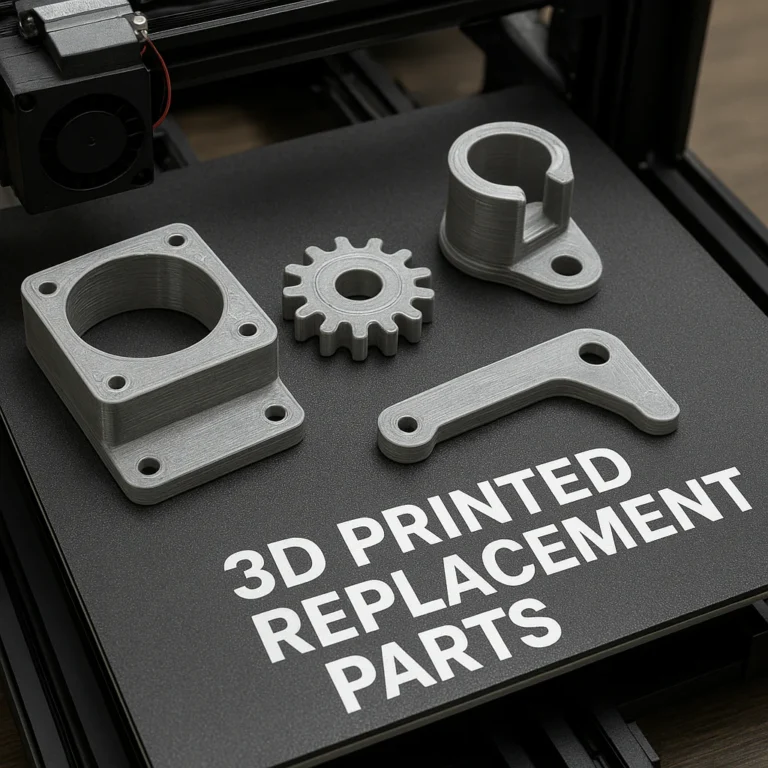
A tiny broken clip can make a large object inconvenient or unusable. Replacement parts are one of the most promising niches because the customer is paying for fit and availability, not simply plastic.
Examples: appliance knobs, furniture clips, vacuum attachments, battery covers, curtain brackets, and discontinued plastic tabs.
Step-by-step replacement-part workflow:
- Identify the device’s exact make, model, and revision.
- Measure the original part, including holes, tabs, and clearance.
- Build a digital model using tools such as Autodesk Fusion, FreeCAD, or other 3D design software.
- Print a quick fit prototype in an economical material.
- Test fit and function without putting a person or valuable equipment at risk.
- Choose a final material based on temperature, chemicals, UV exposure, and mechanical stress.
- Label compatibility carefully and include dimensions or a fit guide.
A part that restores a low-risk household drawer is very different from a component in a vehicle, appliance safety system, medical device, or structural application. Do not represent a printed replacement as a tested safety-critical component unless it has been appropriately validated. For regulated product contexts, seek qualified engineering and legal advice.
14. Car and bike accessories
Model-specific organizers, cable clips, bike-light mounts, and small storage accessories can serve enthusiastic communities. But vehicles bring heat, vibration, and safety considerations.
- Inside a parked car: Cabin temperatures can become very high, so PLA may deform depending on conditions.
- Near moving parts: A mount that detaches can create a hazard.
- For cycling: Test attachment security and avoid interfering with steering, brakes, or visibility.
- For model-specific parts: State the vehicle model years and variants tested.
Use suitable material and testing for the environment. ASA or other heat-resistant materials may be more appropriate than PLA for some applications, but the printed part’s geometry and installation still matter. If a failure could affect vehicle control or safety, don’t treat a home-printed prototype as automatically suitable for road use.
15. Pet tags, toy accessories, and feeding aids
Personalized pet tags, leash hooks, treat containers, and accessories are appealing gift products. Their use involves animals, so reliability and material suitability matter.
- Keep ID information legible and attachment holes strong.
- Avoid small parts that could break off and be swallowed.
- Don’t market a printed object as chew-proof unless you have robust evidence.
- For feeding or water-contact products, investigate applicable material and hygiene requirements.
- Offer fit measurements and clear care instructions.
Simple decorative tags or wall-mounted leash holders are generally easier to assess than chew toys or food-contact items. A product may look adorable in a listing photo and still be unsuitable for unsupervised chewing.
16. Camera, microphone, and streaming mounts
Creators often want mounts for specific cameras, microphones, lights, and desk layouts. The opportunity is a reliable, device-specific fit; the risk is a mount failing while holding expensive gear.
- State supported device models and mounting standards.
- Test clamp force, fasteners, and repeated adjustment.
- Use generous radi around stress concentrations.
- Include hardware details and assembly guidance.
- Don’t promise a load capacity without testing it.
For a small cable guide or remote holder, a printed part is straightforward. For a suspended camera or heavy microphone arm, the consequences of failure are greater. Design conservatively and test under realistic conditions.
17. Headphone stands and gaming accessories
Headphone hooks, controller stands, card holders, headset wall mounts, and desk docks are practical, giftable, and easy to personalize. The first YouTube video calls out headphone holders and other device-specific accessories as product ideas, while also warning that highly generic designs face plenty of competition.
Features worth considering:
- A stable base or secure mounting system
- Smooth contact surfaces that won’t scuff headbands
- Cable routing or a controller charging-cable channel
- Modular add-ons for a phone, game cards, or earbuds
- Optional initials, colors, or desk-theme variants
Search existing Thingiverse gaming accessories to study what’s out there, then focus on a design improvement rather than copying the most downloaded model.
18. Jewelry and fashion accessories
Earrings, pendants, broches, rings, bracelets, and jewelry stands offer design freedom and personalization. FDM can produce bold geometric pieces; resin can capture finer detail. Wearability still depends on finish, weight, durability, and skin-contact materials.
- Make lightweight pieces that remain comfortable over time.
- Smooth edges and remove support marks carefully.
- Disclose the actual materials and any coatings.
- Don’t imply that a plastic print is precious metal.
- For jewelry involving metal findings, describe the components accurately.
Small products can have a strong perceived-value component, but quality photographs and a distinct design language are essential. Explore Thingiverse jewelry models for design references, while checking commercial permissions before using files.
19. Holiday decorations and seasonal gifts
Ornaments, Halloween décor, Easter decorations, and themed table pieces can attract seasonal interest. Their biggest production problem is timing: if you launch when everyone is already decorating, the shopping window may have closed.
- Design and photograph products well ahead of the season.
- Offer personalization with clear order cutoffs.
- Keep fragile elements protected for shipping.
- Track what sells and what remains unsold after the season.
- Favor designs that can be adapted for more than one holiday.
A seasonal product may sell rapidly for a few weeks and then sit quietly the rest of the year. Plan print capacity and inventory around that reality.
20. Wedding favors and event decorations
Custom place cards, cake toppers, table numbers, small keepsakes, and event signage can produce batch orders. Buyers value consistent appearance and delivery reliability, not just clever design.
Plan the order carefully:
- Confirm guest count, names, spelling, colors, and deadline.
- Send a proof for personalized items.
- Print a sample and approve the finish before a full batch.
- Account for replacements and rejected pieces.
- Package sets so parts remain sorted at the venue.
Wedding work can be profitable when you price design revisions, proofs, and batch labor. It can become a stressful midnight print marathon if you promise a delivery date without testing the full production process.
21. Educational models and STEM kits
Anatomical models, mechanical demonstrations, geography models, geometric puzzles, and classroom kits can help students explore a subject hands-on. Buyers may include teachers, parents, museums, and hobby educators.
- Make models accurate enough for the intended educational purpose.
- Clearly label simplified or illustrative features.
- Include a short guide explaining assembly or learning objectives.
- Offer replacement pieces where practical.
- Check whether your product makes medical or scientific claims requiring expert review.
Educational pieces are a good opportunity for original design and collaboration with educators. For more background on additive manufacturing applications, see our 3D Printing in Healthcare and 3D Printing in Architecture categories.
22. Accessibility aids and adaptive tools
Custom grips, switch extenders, zipper aids, utensil handles, and other adaptive tools can address specific needs. A good fit may make an everyday task easier, but the stakes vary widely by product.
- Ask users what is difficult before designing around assumptions.
- Prototype with the intended user when possible.
- Make dimensions adjustable or offer multiple sizes.
- Avoid medical, therapeutic, or safety claims you cannot substantiate.
- Treat products supporting mobility, weight, or medical functions as higher-risk and involve qualified professionals.
Personalization is not a substitute for appropriate design validation. The National Institute of Standards and Technology’s additive manufacturing resources provide technical background on the technology, but a specific adaptive product still needs use-specific testing.
23. Custom stamps, stencils, and craft tools
Stamps, stencils, paint masks, clay tools, model-making jigs, and quilting guides can serve makers who need a particular size or pattern.
- Make small test samples to confirm detail and edge quality.
- State compatible materials and intended use.
- Add handles or alignment marks where they help.
- Offer custom shapes only after confirming the customer’s artwork and dimensions.
- Consider selling bundles of related tools rather than a single low-value piece.
The strongest products in this space are usually tools that make a repeated task easier, not novelty shapes with no clear application.
24. Plant labels and gardening accessories
Plant labels, trellis clips, seedling markers, watering aids, and pot accessories are lightweight and easy to bundle. Outdoor products need tolerate moisture and sunlight, and labels must remain readable.
- Choose a material appropriate for outdoor exposure.
- Make lettering deep or high-contrast enough to stay legible.
- Design clips to fit a range of stems or pot rims when possible.
- Include drainage and cleaning advice for reusable items.
- Test in realistic conditions before making durability claims.
A small “plant care kit” can be more useful than a single marker: labels, clips, and a matching watering accessory can share a design theme and ship together.
25. Lamp shades and lighting accessories
Decorative lamp shades and light diffusers can show off complex patterns, but heat and electrical safety must come first.
- Use only materials and designs suitable for the light source and temperature.
- Keep printed parts away from hot bulbs and electrical connections.
- Never imply a printed component is an electrical safety-certified fixture unless it has the necessary testing and certification.
- Prefer designs intended for cool-running LED lighting, with clear installation instructions.
A decorative cover for an LED display is not the same thing as a complete lamp. If you aren’t equipped to validate heat and electrical safety, stay with non-electrical décor or sell a shade intended for a specific, tested setup.
26. Custom display stands and product fixtures
Display stands serve collectors, market sellers, photographers, stores, and creators. They are easy to customize for a product’s footprint and can be ordered in small quantities.
- Offer precise compatibility measurements.
- Add adjustable angles or modular components where useful.
- Design a stable base and protect products from scratches.
- Provide options for tabletop, wall, or retail-display use.
- Use customer-provided dimensions only after confirming them.
Business-to-business customers may value repeat orders and consistent branding. Confirm permission before incorporating a customer’s logo, and document the approved artwork.
27. Drawer inserts and made-to-measure organizers
Custom drawer inserts are an excellent example of 3D printing’s low-volume advantage. A tray sized to a specific drawer, tool collection, or craft supply can be more useful than a generic bin.
How to reduce fit problems:
- Ask the customer to measure drawer width, depth, and usable height.
- Provide a diagram showing exactly where to measure.
- Subtract a small installation clearance based on the drawer and print tolerances.
- Print a corner or small fit coupon for unusual dimensions.
- Confirm the final measurements in writing.
- Package sections separately if the organizer prints in multiple parts.
The main drawback is the risk of customer measurement errors. A measurement guide—and a confirmation message—can save both sides from the world’s least exciting custom product: an organizer that doesn’t fit the drawer.
28. Personalized lithophanes and photo gifts
A lithophane turns an image into a light-dependent relief. Personalized photo lamps, ornaments, and display panels can make memorable gifts, but image quality and orientation matter.
- Ask for a high-resolution image with good contrast.
- Explain how the final product will appear when backlit.
- Confirm crop and orientation before printing.
- Protect thin sections during handling and shipping.
- Make the light source and electrical components a separate, appropriately chosen product decision.
A sample preview helps customers understand what they’re buying. Avoid using a person’s photo or commissioned artwork beyond the customer’s intended use.
29. Architecture, terrain, and scale models
Architectural mockups, landscape models, historical buildings, and scale terrain can serve firms, schools, collectors, and hobbyists. These orders are often more design-intensive than they first appear.
- Confirm scale, base dimensions, and required features.
- Agree on the level of detail and finish before quoting the work.
- Split complex assemblies into logical components.
- Label conceptual features versus measured or validated details.
- Clarify ownership and permitted use of supplied building plans.
For related projects and industry context, visit our 3D Printing in Architecture category.
30. Original digital designs and downloadable STL files
Selling original STL files can remove the need to print and ship each order. It does not remove the work: buyers expect files that slice properly, clear instructions, sensible licensing, and support when their printer behaves like a tiny, heated diva.
A good digital product may include:
- Clean, tested STL or 3MF files
- Multiple sizes or versions
- Recommended orientations and print settings
- Assembly instructions
- Clear commercial-use terms
- A changelog when you update the model
You can research digital-product marketplaces such as Cults3D, MyMiniFactory, and Printables. Read each platform’s current seller terms and be explicit about what buyers may do with the file and with prints made from it.
Quick Comparison: Profitable 3D-Printed Products by Category
The table below compares production characteristics rather than making unsupported promises about earnings. Actual costs depend on your machine, material, design, labor, order volume, and selling channel.
Startup effort, print time, materials, and customization
| Product family | Typical print setup | Relative print time | Customization potential | Common concern |
|---|---|---|---|---|
| Keychains and small tags | FDM, often batch-friendly | Low | Very high | Low order value; attachment strength |
| Phone stands | FDM | Low to medium | Medium to high | Stability and device compatibility |
| Desk organizers | FDM | Low to medium | High | Fit, dimensions, and crowded competition |
| Planters | FDM | Medium to high | High | Leakage, drainage, outdoor durability |
| Miniatures | Resin for fine detail; FDM for terrain | Medium | Medium | Resin handling, fragility, licensing |
| Cosplay props | Large-format FDM, often multi-part | High | High | Finishing labor, assembly, shipping |
| Replacement parts | FDM or resin, case-specific | Low to medium | High | Fit validation and safety-critical use |
| Wedding favors | FDM, batch-oriented | Low per unit, high batch total | Very high | Spelling, deadlines, sorting |
| Custom organizers | FDM, modular designs | Medium | Very high | Customer-suplied measurements |
| STL files | Design and file testing | No physical print per order | Very high | Licensing, documentation, support |
“Low print time” doesn’t necessarily mean “easy product.” A small part can need complex calibration or extensive customer-specific CAD work. A large product can be simple to print but costly to pack. Measure the whole workflow.
Best products for beginners, batch printing, and premium orders
| Seller goal | Categories worth testing | Why they can fit | Watch out for |
|---|---|---|---|
| Beginer-friendly | Keychains, simple stands, plant labels, desk trays | Small, easy to prototype, visible defects are easier to inspect | Generic designs and thin margins |
| Batch production | Event favors, tags, clips, small organizers | Repeated jobs can use the build plate efficiently | Sorting, quality consistency, and delivery deadlines |
| Custom orders | Nameplates, drawer inserts, replacement parts | 3D printing handles personalization and fit changes well | Proofs, measurement mistakes, and design labor |
| Premium, labor-intensive work | Cosplay pieces, architectural models, detailed miniatures | Buyers may value detail and customization | Finishing, assembly, shipping, and support time |
| Digital products | Original STL files and modular kits | No physical inventory or parcel handling per sale | Upfront design effort, piracy, license clarity, and support |
A sensible first product is usually small enough to test, useful enough to explain, and original enough to distinguish. If it takes most of a day to finish, be sure the customer is buying more than raw print time.
How to Price 3D-Printed Products for Profit
The price of a 3D print is not the weight of filament multiplied by a number. Your price has to cover the complete production process and leave room for profit.
A simple starting calculation:
Total unit cost = materials + machine time + design and labor + finishing + packaging + shipping subsidy + platform/payment fees + overhead + expected failure allowance
Then add a profit target that reflects your time, risk, and market position. The SBA’s guidance on pricing and business costs is useful for thinking beyond raw materials.
Calculating filament, resin, machine time, and labor
Track what happens to one real product from customer order to packed parcel.
| Cost category | What to include |
|---|---|
| Material | Filament or resin consumed, supports, purge waste, inserts, magnets, screws |
| Machine time | Printer use, routine maintenance, wear, and production capacity |
| Design work | CAD changes, customer proofs, sizing, and revision time |
| Labor | Printer setup, bed removal, support cleanup, assembly, sanding, packing |
| Finishing | Primer, paint, adhesive, coatings, labels, or surface treatment |
| Packaging | Mailer, box, cushioning, tape, insert cards, and product protection |
| Selling costs | Marketplace fees, payment processing, advertising, or shop subscriptions |
| Risk allowance | Failed prints, reprints, returns, and replacement parts |
For material, a slicer’s estimated grams are a helpful start. They are not the whole story: brims, supports, purge towers, failed jobs, and test pieces consume material too.
For labor, time yourself. We often underestimate the “small” steps—removing support material, cleaning a part, checking the fit, and answering the customer’s sizing question. Those minutes add up.
Accounting for failed prints, packaging, fees, and taxes
A product that succeeds nine times out of ten still has to account for the tenth print. Record your actual failure and rework rate rather than assuming every job is perfect.
- Keep a log of print time, material, and failed jobs.
- Include packaging designed to prevent damage—not just the cheapest available mailer.
- Check the current fee schedule for each marketplace and payment processor.
- Separate business income and expenses where appropriate.
- Learn your local tax, consumer-protection, and record-keeping obligations.
- Revisit calculations when filament, shipping, or platform fees change.
The IRS small-business and self-employed tax center is a U.S.-specific starting point; sellers elsewhere should consult their local tax authority or a qualified accountant.
Setting wholesale, bundle, and personalization prices
A personalized product often takes extra time: customer messages, proofing, text layout, and one-off setup. Charge for the work instead of silently absorbing it.
Price custom features deliberately:
- Base product: standard design and standard size
- Personalization: name, initials, date, or short message
- Custom fit: customer-specific measurements or CAD changes
- Finish upgrade: sanding, coating, color, or assembly
- Rush production: only if your workflow can genuinely support it
Bundles can make sense when items share a buyer or use case—for example, a plant-care set or desk-organization kit. But don’t bundle products just to move slow stock; the bundle should solve a coherent problem.
Choosing a 3D Printer, Filament, and Resin for Your Products
Your ideal printer depends on what you plan to sell. A fine-detail miniature shop and a batch-printing organizer shop do not need the same setup. Before buying equipment, review our 3D Printer Reviews and match the machine to your product requirements.
FDM versus resin printing for sellable items
| Factor | FDM printing | Resin printing |
|---|---|---|
| Best suited to | Organizers, brackets, stands, larger objects, functional parts | Fine-detail miniatures, jewelry prototypes, small decorative parts |
| Common advantage | Broader range of practical thermoplastics and larger parts | Smooth surfaces and fine detail |
| Common drawback | Visible layer lines and limitations on tiny details | Resin handling, washing, curing, ventilation, and waste management |
| Production considerations | Nozzle, bed, filament, enclosure, and calibration | Resin type, exposure settings, wash/cure workflow, protective equipment |
| Good fit for | Household accessories and functional products | Detailed collectible or display products |
Resin printing requires appropriate protective handling and careful waste disposal. Follow the resin manufacturer’s safety data sheet and instructions; the NIOSH additive-manufacturing safety resources discuss hazards relevant to engineering and manufacturing workplaces.
PLA, PETG, ABS, ASA, TPU, and specialty materials
| Material | Typical strengths | Common limitations | Example use |
|---|---|---|---|
| PLA | Convenient to print, crisp detail, many colors | Can soften in heat; not ideal for every outdoor or high-stress use | Indoor décor, organizers, prototypes |
| PETG | Tougher and more moisture-tolerant than basic PLA in many applications | Can string; properties depend on brand and settings | Clips, utility parts, planters, accessories |
| ABS | Useful mechanical properties and higher temperature capability than PLA | Warping and emissions require a suitable setup and ventilation | Enclosed, tested functional parts |
| ASA | Often chosen for outdoor UV and weather exposure | Requires tuned printing and appropriate ventilation | Outdoor accessories |
| TPU | Flexible and resilient | Slower printing; fit and flexibility depend on hardness | Grips, bumpers, flexible straps |
| Engineering polymers | Can offer specialized strength or temperature properties | Higher processing demands and safety considerations | Validated, application-specific components |
Material names alone do not guarantee a finished part’s performance. Print orientation, wall thickness, infill, layer bonding, environment, and design all matter. Consult the filament manufacturer’s technical data sheet and test your actual geometry.
Print quality, reliability, and production capacity
A business printer should be judged by repeatability, not only by a spectacular first print.
Before taking regular orders:
- Print the same part several times and compare dimensions and finish.
- Test your preferred materials, not just the filament supplied with the machine.
- Track maintenance, nozzle changes, bed preparation, and downtime.
- Keep spare consumables and a backup plan for urgent orders.
- Consider whether an enclosure, multi-material system, or second printer solves a real production bottleneck.
Reliable workflow often matters more than adding another machine. If your shop depends one printer running continuously, build in maintenance time and realistic delivery estimates.
Designing, Testing, and Finishing Products Customers Love
A customer buys an outcome: a part that fits, a sign that looks good on a desk, a gift that arrives on time, or an organizer that solves a clutter problem. Print quality is part of the promise, but it isn’t the whole product.
Making products functional, durable, and easy to print
Design for the real conditions the item will face:
- Force: Is it pulled, bent, dropped, squeezed, or loaded?
- Environment: Will it see sunlight, heat, moisture, cleaning products, or cold?
- Orientation: Does the print direction create weak layer interfaces in the load path?
- Fit: Are clearances generous enough for your printer’s tolerances and the material’s behavior?
- Maintenance: Can the product be cleaned, repaired, or assembled without specialist tools?
Use filets at stress concentrations, avoid knife-thin features, and test press-fit parts before selling them. A design that prints beautifully but fails at its first snap-fit is still a failed product.
For CAD options, explore our 3D Design Software category. Tools such as Autodesk Fusion, FreeCAD, and Blender serve different design workflows.
Personalization, color choices, and custom orders
Customization makes a product more specific, but too many options can make ordering confusing.
- Offer a short menu of tested sizes, colors, and finishes.
- Show examples of text length and placement.
- Use a proof step for names, dates, and customer-suplied artwork.
- State which changes are included and which count as custom design work.
- Avoid promising an exact color match between a screen, filament spool, and finished print.
For names and artwork, confirm spelling and rights before production. A clear order form saves time and helps customers feel confident about what will arrive.
Post-processing, quality checks, and safe packaging
Create a repeatable inspection checklist:
- Confirm the part matches the order and correct version.
- Check for cracks, poor layer bonding, sharp edges, and visible print defects.
- Verify fit, moving features, and included hardware.
- Remove support material and debris.
- Apply finish or coating only when compatible with the intended use.
- Protect the product from scuffs, crushing, and movement in the parcel.
- Include care, assembly, or fit instructions where useful.
Test packaging by shaking the parcel gently and checking whether parts collide. Small pieces may need individual bags or compartments; large printed objects may need structural support inside the box.
Copyright, Trademarks, and 3D Model Licensing
A model being searchable or free to download does not mean it is free to sell. Rights can apply to the design file, the physical print, characters, logos, photographs, and brand names.
The U.S. Copyright Office’s overview of copyright explains the general role of copyright in protecting original creative works. Trademark and other intellectual-property rules are separate, and the details vary by country. If your shop depends on a licensed character or branded product, seek qualified legal advice.
Selling prints made from downloaded STL files
Before selling a print from someone else’s model, check:
- Is commercial use explicitly allowed?
- Does the license require attribution?
- Are physical sales restricted even if downloading is free?
- Does the designer require a separate membership or commercial license?
- Does the license permit modifications?
- Are there additional marketplace or platform terms?
Keep a record of the license, purchase, and permission that applied when you began selling. If the terms are unclear, ask the designer or choose a model with clear commercial permissions.
Avoiding protected characters, logos, and branded designs
Famous fictional characters, team logos, company marks, and game artwork can attract attention—and legal complaints. “Fan art” or “inspired by” does not automatically make a commercial listing safe.
✅ Safer approach: Create original creatures, shapes, and themes, and avoid brand names or character likenesses in product titles and photos unless you have permission.
❌ Risky approach: Selling a recognizable franchise character because a model is easy to download or many other shops are doing it.
Marketplace policies can also remove listings or suspend shops, independently of any legal action. Review current platform rules before publishing.
Getting commercial licenses and protecting original work
When licensing a model, read the actual terms rather than relying on a thumbnail that says “commercial.” Confirm what the license covers, its duration, permitted sales channels, attribution requirements, and whether it covers physical products, digital files, or both.
For original work:
- Save design files and dated drafts.
- Keep clear records of commissions and ownership terms.
- State what buyers may do with digital files.
- Use product photos that show your work without exposing every detail of a proprietary design when appropriate.
- Consider seeking legal advice before using patents, trademarks, or customer-provided IP.
Best Platforms to Sell 3D-Printed Items in 2026
There is no single best sales platform. Choose the channel that fits the product, the buyer, your production capacity, and the amount of customer interaction you want.
Etsy, eBay, Amazon, and other online marketplaces
| Channel | Often a good fit for | What to consider |
|---|---|---|
| Etsy | Personalized gifts, décor, jewelry, and handmade-style items | Listing competition, search optimization, fees, seller policies, and custom-order workload |
| eBay | Replacement parts, niche accessories, one-off items, and testing demand | Clear compatibility details, customer expectations, and listing visibility |
| Amazon Handmade | Useful products with consistent production and broad appeal | Eligibility, competition, fulfillment, policies, and fee structure |
| Facebook Marketplace | Local pickup, bulky products, community testing | Local demand, buyer coordination, and platform terms |
| Local craft fairs | Gifts, décor, accessories, and demonstration-friendly products | Booth logistics, stock, payment setup, and local event rules |
Marketplace terms and fees change, so verify current conditions directly. Don’t choose a platform solely because a competitor uses it. Ask where your buyer already shops and what kind of listing best communicates the product.
Shopify and your own online store
A standalone store gives you more control over branding, product pages, customer email, and bundles. It also means you have to attract visitors yourself.
Consider an independent shop when you have:
- A clear product range and brand identity
- A way to bring customers through search, social content, partnerships, or repeat orders
- Time to manage payments, policies, customer data, and store maintenance
- A plan for shipping, returns, and support
You can start on a marketplace to test demand and build an independent store later. Don’t pay for a complicated shop before you know which product people actually want.
Craft fairs, local shops, and in-person markets
In-person selling lets customers touch the product, ask questions, and see how it works. It’s particularly useful for products whose benefit is hard to show in a small listing photo.
- Bring samples, not just a menu of designs.
- Display clear signs showing customization options and turnaround times.
- Offer a way to capture custom orders after the event.
- Track which products generate questions and sales.
- Check event fees, insurance requirements, and local business rules.
A booth can function as a live product test. If five people ask the same question, your listing should answer it before the next customer has to ask.
Selling 3D models and STL files online
Digital files suit designers who want to sell a repeatable product without handling physical inventory or shipping. Marketplaces such as Cults3D, MyMiniFactory, and Printables have communities focused on printable designs.
Before uploading, include:
- Clear photos or renders of the finished print
- Supported file formats and dimensions
- Print orientation and recommended settings
- Assembly notes and a test-print report
- License terms that state what buyers may do
A digital file can still create support work and licensing concerns. Test the download on more than one slicer or printer setup when practical.
How to Sell 3D Prints Successfully
A strong product needs a clear listing, good evidence, reliable fulfillment, and a simple reason to buy it. Product-market fit comes before clever marketing.
Creating product photos, listings, and compelling descriptions
Show the product doing its job. Include:
- A clean hero photo
- A close-up of the surface and detail
- A photo showing scale in context
- A demonstration of moving, mounting, or assembly features
- A size diagram or compatibility chart
- Color and personalization examples
Write the listing so a customer can quickly understand:
- What the item is
- What problem it solves
- What it is made from
- What size or models it fits
- Whether assembly or hardware is included
- How long production and dispatch usually take
- What customization is available
Avoid vague statements such as “high-quality material” without naming the material or explaining its intended use. Be specific and honest.
Improving search visibility with 3D printing SEO
Use the words a buyer would actually search for. Product titles should lead with the item and use case, not a long string of unrelated keywords.
For example, a listing title might describe a custom under-desk cable holder for a standing desk rather than simply saying “cool 3D-printed gadget.”
Helpful SEO practices:
- Use a descriptive, readable title.
- Put key dimensions and compatibility in the description.
- Use relevant category and attribute fields.
- Include alternate terms naturally, such as “desk organizer” and “cable management.”
- Write image alt text where the platform supports it.
- Avoid trademarked keywords unless you have the right to use them.
Marketplace search systems change. Treat SEO as accurate product description and customer discovery—not as a trick for stuffing every possible phrase into one title.
Managing orders, shipping, returns, and customer service
Make the order-to-delivery process predictable.
- Set realistic processing times based on your actual print queue.
- Confirm custom spelling, dimensions, and proof approvals.
- Keep order records and message customers when delays occur.
- Use packaging suited to the product’s shape and fragility.
- Publish a clear returns and replacement policy that follows local consumer law.
- Record the reason for each return or complaint and improve the product where appropriate.
For customized products, clearly explain which details customers must provide. A required field is better than trying to guess what “make it like the photo, but more personal” means.
Building a brand and encouraging repeat customers
A brand can be a consistent visual style and a reliable buying experience—not necessarily a complicated logo.
- Use consistent product photography and packaging.
- Offer compatible accessories and replacement pieces.
- Invite feedback without pressuring customers for reviews.
- Share short demonstrations that show the problem and solution.
- Keep customers informed about new sizes, colors, or related products.
The first YouTube video makes the point that sellers need product-market fit, not simply a pile of downloadable models. That’s why our favorite product demos show a real task being solved, not just a print slowly rotating under dramatic lighting like it’s auditioning for a sci-fi film.
From First Print to First Sale: A Practical Launch Plan
You don’t need a warehouse full of products to learn whether your idea has potential. Start with a controlled test and build a process you can repeat.
Testing demand before buying more equipment
- Pick one customer group and one problem.
- Sketch or CAD a simple prototype.
- Print one functional sample and test it in context.
- Ask likely buyers for specific feedback. “Would you use this?” is weaker than “Which of these two layouts would fit your drawer?”
- Research comparable listings and product reviews.
- Calculate full unit cost and realistic production time.
- Create a clear test listing or preorder page.
- Review inquiries, conversions, and objections before scaling.
If customers like the idea but balk at the price, investigate whether your cost structure, product value, or target audience needs to change. Don’t immediately lower the price below your full cost.
Starting a small-batch production workflow
- Choose a small range of tested colors and materials.
- Create a standard slicer profile for each product.
- Document print orientation, supports, and inspection points.
- Batch similar products when it improves efficiency.
- Keep a simple stock of common hardware and packaging.
- Record failures and update the design or process.
- Set a daily order limit until you understand your capacity.
A small batch gives you enough prints to spot consistency problems without filling a closet with unsold inventory.
Tracking sales, expenses, and business growth
Track more than gross sales. A simple spreadsheet can record:
- Product and order date
- Material and machine time
- Design and finishing labor
- Platform and payment fees
- Shipping and packaging
- Returns, replacements, and failed prints
- Customer questions and product feedback
Look at profit per order and profit per hour of hands-on work. A product that sells steadily but requires extensive sanding may not be as attractive as a simpler item with repeat buyers.
Common Mistakes When Selling 3D-Printed Products
These mistakes are easy to make because the printer makes production feel deceptively simple.
- Choosing products by popularity alone: A viral model may be saturated, poorly differentiated, or legally risky.
- Ignoring commercial licenses: Free downloads do not automatically include resale rights.
- Pricing only the filament: Labor, failed prints, packaging, fees, and maintenance count.
- Skipping product testing: A nice prototype is not evidence of durability or compatibility.
- Overpromising strength or safety: Don’t claim a load capacity, food safety, or medical benefit without suitable support.
- Taking custom measurements without a guide: Ask for the information you need in a clear format.
- Launching too many products at once: More listings can mean more setup, more inventory, and more customer questions.
- Using generic photos: Customers need to see scale, finish, and the product in use.
- Underestimating finishing time: Sanding, painting, assembly, and cleanup are real production costs.
- Depending one printer without a backup plan: Maintenance and failures happen; communicate realistic lead times.
- Competing only on price: A specific design, better fit, or useful bundle is a stronger long-term advantage.
Sustainable Materials and Responsible 3D Printing
A small-batch printer can reduce overproduction by making products to order, but material use and failed prints still matter. Responsible production is a process, not a claim printed on a label.
- Optimize orientation and supports to reduce waste without weakening the part.
- Reuse suitable test prints as fit gauges or prototypes.
- Track failed jobs and fix the root cause rather than treating scrap as inevitable.
- Choose a material that lasts in the intended environment.
- Avoid making broad “biodegradable” or “compostable” claims without explaining the conditions required.
- Follow manufacturer safety information for filament, resin, adhesives, coatings, and cleaning agents.
- Use appropriate ventilation and handling practices, especially for resin and higher-temperature materials.
The U.S. Environmental Protection Agency’s sustainable materials management resources offer broader guidance on materials and waste. For 3D printing, the most practical starting point is often simple: design products customers can use for a long time, and print fewer rejects.
Keep Learning: 3D Printing Business Resources
A stronger product shop comes from repeated testing, better design, and honest customer feedback—not from collecting a hundred unused STL files.
- Explore 3D Printable Objects for product inspiration.
- Compare machines in our 3D Printer Reviews category.
- Find tools and workflows in 3D Design Software.
- Learn about specialized applications in 3D Printing in Architecture and 3D Printing in Healthcare.
- Check Etsy’s seller handbook and Amazon Handmade’s program information for current platform guidance.
- Read the model terms on Thingiverse, Printables, Cults3D, and MyMiniFactory before commercial use.
The useful question to keep asking is: What does a particular customer need that a standard product doesn’t provide—and can we make that solution reliably? That’s where a promising 3D print starts to become a real product.