Support our educational content for free when you purchase through links on our site. Learn more
🌱 Sustainable 3D Printing Materials Market Growth (2026)


The growth of sustainable 3D printing materials market is being driven by recycled polymers, bio-based feedstocks, lightweight parts, localized production, and tougher expectations around waste. The best opportunity is not simply choosing a “green” filament; it is matching a durable, efficient material to the job and keeping that material useful for as long as possible.
The broader 3D printing materials market is forecast by MarketsandMarkets to rise from USD 3.88 billion in 2025 to USD 10.02 billion by 2030, a projected 20.9% CAGR. Sustainable materials are only one part of that total, but recycled PETG, recycled PLA, bio-based PLA, recycled nylon, flexible polymers, and lower-impact resins are gaining attention from manufacturers and makers alike.
We learned the hard way that “biodegradable” does not mean “indestructible.” A PLA plant pot looked wonderfully responsible until heat and watering turned it into a slightly wilted plastic pancake. That little failure captured the central lesson: sustainability depends on feedstock, print efficiency, service life, safety, and end-of-life recovery—not a single label on the spool.
From desktop filament to recycled metal powders, the market is expanding across aerospace, healthcare, automotive, construction, education, and home workshops. So which materials genuinely move additive manufacturing toward a circular economy, and which are merely wearing a green hat? Let’s separate the evidence from the eco-flavored marketing.
Key Takeaways
- The market is growing quickly: The wider 3D printing materials market is forecast to reach USD 10.02 billion by 2030, according to MarketsandMarkets.
- Recycled PETG is a practical all-rounder for many functional household parts because it combines toughness, printability, and recycled-content potential.
- PLA can be a lower-impact choice, particularly when renewable feedstock and low-temperature printing matter, but it is not automatically home-compostable or suitable for heat.
- Durability is part of sustainability: A long-lasting nylon, TPU, PETG, or engineering-polymer part may outperform a weaker material that requires frequent replacement.
- Bio-based, biodegradable, recycled, and recyclable mean different things. Check the supplier’s exact claims, certifications, and end-of-life instructions.
- Circular design matters as much as material choice: Reduce supports, prevent failed prints, design for repair, identify the polymer, and sort waste correctly.
- Resin printing requires extra care: Bio-based resin is not automatically harmless, recyclable, or compostable; uncured resin and wash fluids need responsible handling.
- Market forecasts need context: Many reports combine conventional, recycled, bio-based, metal, ceramic, and resin materials, so sustainable-material growth is rarely reported as one perfectly isolated figure.
- The strongest future trend is material circularity: Recycled feedstocks, take-back programs, digital traceability, repairable designs, and localized manufacturing will shape the next stage of additive manufacturing.
Table of Contents
- ⚡ Quick Tips and Facts About the Sustainable 3D Printing Materials Market
- 🌱 Sustainable 3D Printing Materials Market: Scope, Definitions, and Key Terms
- 📚 From PLA to Bio-Based Resins: The Evolution of Eco-Friendly 3D Printing
- 📈 Growth of Sustainable 3D Printing Materials Market: Current Landscape and Outlook
- Market Size, CAGR, and Forecast Period Explained
- Regional Growth Hotspots: North America, Europe, Asia-Pacific, and Beyond
- Industrial, Commercial, and Consumer Adoption Trends
- 🔬 10 Sustainable 3D Printing Materials Reshaping Additive Manufacturing
- 1. Recycled PLA and Post-Consumer PLA Filament
- 2. Bio-Based PLA and Other Bioplastics
- 3. Recycled PETG and rPET Filament
- 4. Recycled ABS and Engineering Polymer Filaments
- 5. Bio-Based and Recycled Nylon
- 6. Recycled TPU and Flexible Materials
- 7. Wood-, Hemp-, and Agricultural-Waste Composites
- 8. Algae-Based and Microbial Materials
- 9. Recycled Metal Powders and Metal 3D Printing Feedstock
- 10. Bio-Based Photopolymer Resins and Recycled Resin Systems
- ⚙️ What Makes a 3D Printing Material Sustainable?
- Renewable Feedstocks and Bio-Based Content
- Recycled Content and Closed-Loop Material Recovery
- Durability, Product Lifespan, and Material Efficiency
- End-of-Life Options: Reuse, Recycling, Composting, and Disposal
- Certifications, Traceability, and Greenwashing Risks
- 🚀 Key Drivers Accelerating Sustainable 3D Printing Material Adoption
- Stricter Environmental Regulations and Extended Producer Responsibility
- Corporate ESG Targets and Supply-Chain Decarbonization
- Demand for Lightweight, Localized, and On-Demand Manufacturing
- Advances in Recycling, Compounding, and Material Formulation
- Consumer Interest in Low-Waste Desktop 3D Printing
- 🧱 Major Challenges Limiting Sustainable 3D Printing Materials
- Inconsistent Material Quality and Print Performance
- Contamination, Sorting, and Collection Problems
- Limited Recycling Infrastructure for Filament and Resin
- Mechanical Properties, Moisture Sensitivity, and Shelf Life
- Biodegradability Misconceptions and Industrial Composting Requirements
- Certification Gaps, Supply Constraints, and Scale-Up Costs
- 🏭 Sustainability Across 3D Printing Technologies
- Material Extrusion: FDM and FF Filament
- SLA, MSLA, and DLP Photopolymer Resin
- Selective Laser Sintering and Polymer Powder
- Metal Laser Powder Bed Fusion and Binder Jeting
- Pelet Extrusion and Large-Format Additive Manufacturing
- 🌍 Environmental Impact and Life-Cycle Assessment
- Carbon Footprint of Feedstock Production and Manufacturing
- Energy Consumption: Printing, Post-Processing, and Transportation
- Waste Reduction Through Topology Optimization and Generative Design
- Water Use, Land Use, Toxicity, and Air Quality Considerations
- How to Compare Materials Using a Life-Cycle Assessment
- ♻️ Circular Economy Models for 3D Printing Materials
- Turning Failed Prints and Supports Into New Filament
- Filament Recycling Machines and Distributed Recycling
- Manufacturer Take-Back Programs and Material Traceability
- Designing Parts for Repair, Reuse, and Recycling
- 🏢 Sustainable Materials by Industry and Application
- Automotive and Transportation
- Aerospace and Defense
- Healthcare, Prosthetics, and Biomedical Research
- Construction and 3D-Printed Buildings
- Packaging, Retail, and Consumer Products
- Education, Makerspaces, and Public Fabrication Labs
- 🏷️ Leading Companies and Sustainable Material Brands
- Recycled and Bio-Based Filament Manufacturers
- Sustainable Resin Developers and Photopolymer Suppliers
- Industrial Polymer, Composite, and Metal Feedstock Producers
- Recycling Technology Companies and Circular Manufacturing Startups
- 🧪 Material Performance: Sustainability Versus Print Quality
- Strength, Toughness, Flexibility, and Heat Resistance
- Dimensional Accuracy, Warping, Layer Adhesion, and Surface Finish
- Odor, VOCs, Ultrafine Particles, and Workshop Ventilation
- Post-Processing, Coatings, and Support-Material Compatibility
- 🛒 How to Choose Sustainable 3D Printing Filament or Resin
- Match the Material to Your Printer and Nozzle
- Check Recycled Content, Feedstock Origin, and Certifications
- Evaluate Drying, Storage, Packaging, and Spool Design
- Compare Technical Data Sheets and Safety Data Sheets
- Avoiding Greenwashing in Sustainable 3D Printer Materials
- 🛠️ Practical Tips for Lower-Waste 3D Printing
- Reduce Failed Prints With Calibration and Preventive Maintenance
- Optimize Infill, Walls, Supports, and Orientation
- Dry and Store Filament Correctly
- Reuse Rafts, Brims, Supports, and Purge Waste Safely
- Track Material Usage, Energy Consumption, and Waste
- 📊 How to Analyze Sustainable 3D Printing Market Forecasts
- Understanding Research Methodologies and Market Definitions
- Comparing CAGR, Revenue, Volume, and Segment Forecasts
- Verifying Data From Industry Reports, Standards, and Public Sources
- Why Different Market Research Firms Publish Different Numbers
- 🔮 Future Trends in Bio-Based, Recycled, and Circular 3D Printing
- Smart Materials, Self-Healing Polymers, and Reprocessable Composites
- AI-Assisted Material Development and Print Optimization
- Carbon-Negative Feedstocks and Regenerative Biomaterials
- Digital Product Passports and Material Traceability
- Localized Microfactories and Distributed Manufacturing
- ⚖️ Regulations, Standards, and Sustainability Certifications
- ISO and ASTM Standards for Additive Manufacturing
- Environmental Product Declarations and Life-Cycle Reporting
- Recycling, Compostability, Chemical Safety, and Waste Regulations
- EU, United States, and Global Policy Developments
- ✅ Benefits and ❌ Trade-Offs of Sustainable 3D Printing Materials
- 💡 Quick Takeaways for Manufacturers, Designers, and Makers
- 🏁 Conclusion: Where the Sustainable 3D Printing Materials Market Is Heading
- 🔗 Recommended Links
- ❓ FAQ About the Growth of Sustainable 3D Printing Materials Market
- What is driving the growth of sustainable 3D printing materials?
- Is PLA genuinely a sustainable 3D printing material?
- Are recycled 3D printing filaments as strong as virgin materials?
- Can 3D printer filament be recycled at home?
- Are 3D printing resins recyclable or biodegradable?
- Which industries are adopting sustainable additive manufacturing materials fastest?
- How can companies measure the sustainability of 3D printing?
- What will the sustainable 3D printing materials market look like by 2030?
- 📖 Reference Links
⚡ Quick Tips and Facts About the Sustainable 3D Printing Materials Market
The growth of the sustainable 3D printing materials market is being propelled by several forces at once: recycled feedstocks, bio-based polymers, lightweight parts, localized manufacturing, and stricter expectations around waste and carbon emissions. For broader context, our statistics about 3D printing guide explores adoption and industry trends behind that expansion.
Here are the fast facts we keep coming back to in our workshop:
- The wider 3D printing materials market is projected by MarketsandMarkets to grow from USD 3.88 billion in 2025 to USD 10.02 billion by 2030, representing a forecast 20.9% CAGR. That figure covers the complete materials market, not sustainable materials alone.
- PLA remains a major entry point for lower-impact desktop printing because it is bio-based and generally associated with a lower carbon footprint than conventional ABS or virgin PET in the comparisons cited by Filamentive.
- Recycled PETG can be compelling when recycled content is your priority. Filamentive reports 99.5% recycled content for one of its PETg products, supported by ISO 14021 documentation. That percentage is product-specific, not a universal PETG statistic.
- “Biodegradable” does not mean “put it in the garden compost heap.” Many PLA products require industrial composting conditions, and a printed part containing pigments, additives, glue, or mixed polymers may not be accepted.
- Durability is sustainability. A part that lasts ten years can be environmentally preferable to a “green” part that breaks after ten weeks. The shortest filament spool is not always the smallest environmental footprint.
- Additive manufacturing can reduce waste, but only when the design and process are suitable. Supports, failed prints, purge lines, sanding dust, packaging, and electricity still count.
- Metal printing can produce dramatic material savings in the right application. MarketsandMarkets cites GE Aerospace’s LEAP fuel-nozzle example, where consolidation and redesign reportedly delivered approximately 25% weight reduction.
- A sustainable filament is not automatically the best filament. Choose based on the application, service life, repairability, material recovery route, and actual supplier evidence.
- FDM/FFF dominates plastic 3D printing in the 2020 data cited by Filamentive, accounting for approximately 91% of plastic 3D printing. That makes filament decisions especially consequential.
- The biggest trap? Confusing bio-based, biodegradable, recyclable, and recycled. They describe different things, and occasionally marketing departments toss them into one ecological smoothie.
Our quick decision guide
| Your main sustainability goal | Strong starting point | Why | Watch out for |
|---|---|---|---|
| Lower feedstock carbon impact | PLA | Bio-based PLA can compare favorably with petrochemical plastics in life-cycle studies | Industrial composting requirements, brittleness, heat limitations |
| High recycled content | Recycled PETG | Often available with documented recycled feedstock | Quality variation, moisture, local recycling access |
| Mechanical durability | Recycled PETG, recycled ABS, recycled nylon, engineering polymers | Longer service life can reduce replacement waste | Processing energy, fumes, certification, recyclability |
| Flexible reusable parts | Recycled TPU | Useful for gaskets, feet, bumpers, and protective parts | Difficult printing and limited recycling routes |
| High-temperature industrial parts | PEEK, PEKK, high-performance composites, recycled engineering polymers where qualified | Long life and high performance | Specialized printers, high energy demand, qualification burden |
| Closed-loop protyping | Clean, single-polymer PLA or PETG scrap | Easier sorting and reprocessing | Mixed colors, additives, adhesives, and contamination |
Our rule of thumb: first make the part useful, then make it efficient, then choose the lowest-impact material that can survive its job. A compostable cable clip that melts beside a radiator is not a sustainability triumph; it is a tiny green failure with excellent irony.
🌱 Sustainable 3D Printing Materials Market: Scope, Definitions, and Key Terms
The phrase sustainable 3D printing materials market covers more than “eco-friendly filament.” It includes the development, manufacturing, distribution, use, recovery, and disposal of materials used in additive manufacturing.
That means the market may include:
- Thermoplastic filaments: PLA, PETG, ABS, nylon, TPU, PP, PC, and composites.
- Photopolymer resins: SLA, MSLA, and DLP materials, including bio-based and lower-toxicity formulations.
- Polymer powders: SLS and related powder-bed processes.
- Metal powders and wires: Titanium, aluminum, stainless steel, nickel alloys, copper, and cobalt-chrome.
- Ceramics: Alumina, zirconia, hydroxyapatite, and other technical or medical ceramics.
- Composite materials: Carbon-fiber, glass-fiber, wood-filled, mineral-filled, hemp-filled, and agricultural-waste compounds.
- Construction feedstocks: Concrete, clay, geopolymer, and recycled aggregate mixtures.
- Recycling systems: Filament extruders, shredders, powder-recovery equipment, take-back programs, and material-tracking software.
The market can also be measured in several ways:
| Measurement | What it tells you | Why figures differ |
|---|---|---|
| Revenue | Monetary value of material sales | Includes premium engineering and medical materials |
| Volume | Tons, kilograms, liters, or cubic meters sold | Low-cost plastics can dominate volume |
| Material type | Plastics, metals, ceramics, composites | Definitions vary by research company |
| Technology | FDM, SLA, SLS, DMLS, binder jeting, construction printing | Some materials work across multiple processes |
| Sustainability segment | Recycled, bio-based, recyclable, biodegradable, low-carbon | No universal market boundary exists |
| End use | Prototyping, tooling, healthcare, aerospace, automotive, consumer goods | One material may serve several markets |
Sustainable does not mean one single thing
The United Nations Brundtland Commission definition of sustainability describes development as meeting present needs without compromising the ability of future generations to meet their own needs. Applied to 3D printing, that requires a wider lens than the material label.
A useful sustainability assessment asks:
- Where did the feedstock come from?
- How much energy and water were used to make it?
- How far did it travel?
- How efficiently can it be printed?
- How long will the finished object last?
- Can it be repaired, reused, remelted, recycled, composted, or safely disposed of?
- Does it create harmful emissions or waste during printing?
The answer can change by application. PLA may look excellent on embodied carbon, while PETG may win on recycled content and practical recyclability. A durable nylon component might outperform both over a long service life. There is no universal sustainability champion wearing a tiny biodegradable crown.
Four terms that are frequently confused
| Term | Meaning | Example | Common misunderstanding |
|---|---|---|---|
| Bio-based | Made partly or wholly from renewable biological feedstocks | Corn- or sugar-derived PLA | It does not automatically mean biodegradable |
| Biodegradable | Can be broken down by biological activity under defined conditions | Certain certified compostable polymers | It may require industrial composting |
| Recycled | Contains material recovered from previous products or manufacturing waste | rPETG from recycled PET | Recycled content can vary substantially |
| Recyclable | Can technically enter a recycling process | PETG or PP in suitable systems | Local facilities may not accept it |
The European Commission’s circular economy resources are useful for understanding why material recovery depends on product design, collection systems, sorting, and actual processing infrastructure, not just a recycling symbol.
📚 From PLA to Bio-Based Resins: The Evolution of Eco-Friendly 3D Printing
Our first memorable “sustainable” print was a PLA plant pot. It looked charming, printed cleanly, and survived exactly until we watered the plant too enthusiastically. The failure taught us a useful lesson: a material’s environmental story and its engineering performance must be judged together.
Early desktop 3D printing largely focused on accessibility and printability. PLA became popular because it prints at relatively modest temperatures, has low warping compared with ABS, and is widely available. As adoption grew, attention shifted toward:
- Recycled production scrap.
- Post-consumer plastics.
- Bio-based polymer feedstocks.
- Lower-impact pigments and packaging.
- Stronger composite filaments.
- Material take-back schemes.
- Better product life-cycle data.
- Closed-loop production.
Filamentive summarizes the pressure clearly: “Material sustainability is an issue that can no longer be ignored due to wide adoption of 3D printing.” That concern becomes more urgent as the installed base of printers grows and every failed calibration cube becomes part of a larger waste stream.
The progression of sustainable material development
| Development phase | Main priority | Typical materials | Sustainability opportunity |
|---|---|---|---|
| Early desktop printing | Easy, affordable protyping | PLA, ABS | Reduce tooling and prototype waste |
| Recycled-content expansion | Use manufacturing and consumer waste | Recycled PLA, rPETG, recycled ABS | Keep polymers in circulation |
| Bio-based materials | Reduce fossil feedstock dependence | PLA, bio-based nylon, bio-based resins | Renewable feedstock and lower fossil reliance |
| Engineering sustainability | Extend service life and reduce part count | Carbon-fiber nylon, PEEK, PEKK, metal alloys | Durable lightweight parts |
| Circular manufacturing | Connect design, use, repair, and recovery | Reprocessed polymers, reusable powders | Create closed-loop material pathways |
| Data-driven sustainability | Verify claims and optimize life cycles | Certified compounds, material passports | Improve transparency and comparability |
Why the market is expanding now
The market is moving beyond novelty prints because businesses increasingly need:
- Shorter supply chains
- Reduced inventory
- On-demand spare parts
- Lightweight components
- Customized healthcare devices
- Lower material waste
- Traceable environmental reporting
- More resilient manufacturing
The International Energy Agency’s work on industry and clean energy transitions helps explain the wider pressure on manufacturers to reduce energy and material intensity. 3D printing does not erase those pressures, but it gives designers more control over geometry, production location, and part consolidation.
📈 Growth of Sustainable 3D Printing Materials Market: Current Landscape and Outlook
MarketsandMarkets forecasts the broader 3D printing materials market to rise from USD 3.88 billion in 2025 to USD 10.02 billion by 2030, with a 20.9% CAGR. It also reports a 2024 market size of USD 3.22 billion. Those numbers should be treated as a forecast for the overall materials market, not a clean measurement of recycled or bio-based materials alone.
That distinction matters. Market reports often group conventional plastics, engineering polymers, resins, metals, ceramics, and sustainable grades together. A headline such as “the sustainable 3D printing materials market is growing at X%” may therefore imply a level of precision the underlying segmentation does not support.
How to read the forecast without getting fooled
| Question | What to check |
|---|---|
| Is the figure for all 3D printing materials? | Look for the report’s material segmentation |
| Does it include equipment or only consumables? | Printer sales can inflate apparent market size |
| Is sustainability a separate segment? | Some reports mention bio-based materials only as a driver |
| Is growth measured by value or volume? | Premium titanium can grow in value without dominating tonage |
| What is the base year? | Forecasts shift when the starting year changes |
| Are recycled materials measured separately? | Often they are grouped into plastics or specialty materials |
| Is the forecast independently verifiable? | Compare company filings, trade data, and standards |
Grand View Research’s accessible page in the supplied competitor material displayed only “Performing security verification” and stated that its security service was protecting the site from malicious bots. Since the substantive report could not be independently checked, we would not use it to support a market size, CAGR, or sustainability claim.
Current market structure
The market is developing on several tracks at once:
- High-volume desktop polymers
- PLA, PETG, ABS, and TPU.
- Strong demand from education, protyping, makers, and small businesses.
- Sustainability improvements often come from recycled content, renewable feedstock, and spool reduction.
- Engineering-grade polymers
- Nylon, polycarbonate, PEEK, PEKK, PPS, and composites.
- Used when heat, chemical resistance, fatigue performance, or durability matters.
- Their sustainability case often depends on extended service life and lightweighting.
- Photopolymer resins
- Used in dental, jewelry, medical, casting, protyping, and industrial applications.
- Sustainability challenges include uncured resin handling, washing fluids, supports, and end-of-life recovery.
- Metal and ceramic materials
- Used in aerospace, healthcare, energy, tooling, and industrial production.
- Potential benefits include part consolidation, near-net-shape production, and reduced buy-to-fly ratios.
- Energy intensity, powder handling, support removal, and post-processing remain important.
- Construction materials
- Concrete, clay, geopolymer, and recycled aggregates.
- Promising for localized construction and form-efficient structures, but not automatically low-carbon.
Current market growth drivers
MarketsandMarkets identifies several forces behind expansion:
- Increasing demand for bio-based plastic grades.
- Adoption of recyclable polymers and composites.
- Lightweighting in aerospace and automotive.
- Localized and on-demand manufacturing.
- Growth in healthcare customization.
- Transition from protyping to end-use production.
- Improved material performance and process reliability.
The report calls mass customization “the current revolution in the 3D printing industry.” We agree with the direction, but with one qualification: customization becomes materially efficient when the part is designed well and made close to its point of use. A badly optimized one-off print shipped across continents is still a one-off print with frequent-flyer miles.
Regional growth patterns
| Region | Sustainability-related strengths | Constraints |
|---|---|---|
| North America | Aerospace, healthcare, automotive, materials research, government support | Fragmented recycling and qualification requirements |
| Europe | Circular-economy policy, product sustainability rules, industrial R&D | Compliance cost and energy-price volatility |
| Asia-Pacific | Manufacturing scale, electronics, automotive, government-backed research | Uneven standards and waste infrastructure |
| Middle East | Localized spare-parts initiatives, construction innovation | Feedstock imports and qualification capacity |
| Latin America | Emerging distributed manufacturing and education | Limited collection, recycling, and technical support |
| Africa | Repair, local production, and development applications | Equipment access, skills, and material availability |
Market Size, CAGR, and Forecast Period Explained
A CAGR, or compound annual growth rate, describes the annualized rate required for a market to move from one value to another over a defined period. It is not a promise that the market grows by exactly the same percentage every year.
The standard calculation is:
[
\text{CAGR} = \left(\frac{\text{Ending Value}}{\text{Starting Value}}\right)^{1/n} – 1
]
where n is the number of years.
Why market forecasts disagree
Two respected reports can produce different results because they may use different:
- Product definitions.
- Geographic coverage.
- Currency conversions.
- Base years.
- Sales channels.
- Treatment of captive manufacturing.
- Inclusion or exclusion of industrial powders.
- Definitions of “sustainable.”
- Assumptions about printer adoption and material substitution.
For the sustainable materials segment specifically, the reporting problem is sharper. A recycled PETG spool may be counted under plastics, specialty filament, recycled materials, or not separated at all.
What we trust most
For a grounded view, combine:
- Market research forecasts.
- Public company reports from firms such as Stratasys, 3D Systems, and Materialise.
- Supplier technical documentation.
- Government policy and waste data.
- Peer-reviewed life-cycle assessments.
- Standards from ISO and ASTM International.
Best practice: use market research to understand direction and scale, then use technical and environmental data to judge whether a particular material actually improves sustainability.
Regional Growth Hotspots: North America, Europe, Asia-Pacific, and Beyond
North America
North America benefits from strong aerospace, medical, automotive, defense, and technology sectors. Companies such as Stratasys and 3D Systems offer broad polymer, resin, and industrial material portfolios.
Sustainability growth here is often linked to:
- Aerospace lightweighting.
- Medical customization.
- Distributed spare-parts production.
- Domestic production resilience.
- University and government research.
- Corporate environmental reporting.
However, the presence of advanced materials does not guarantee easy recovery. A carbon-fiber-filled nylon part may be excellent in service and awkward at end of life. That is not a contradiction; it is the engineering trade-off we need to document honestly.
Europe
Europe’s circular economy policy and product sustainability initiatives are pushing manufacturers toward:
- Recycled content.
- Product durability.
- Repairability.
- Traceability.
- Waste reduction.
- Environmental product declarations.
The European Environment Agency provides useful background on circular material systems and the difference between recycling aspirations and actual infrastructure.
European filament makers such as Filamentive have built their positioning around recycled-content documentation and material sustainability. Their comparisons between PLA, PETG, and other polymers are useful, but we recommend checking the exact technical sheet for each product rather than assuming every spool from a category has identical credentials.
Asia-Pacific
Asia-Pacific combines manufacturing scale with major demand in electronics, automotive, tooling, healthcare, and industrial production. China, Japan, South Korea, Singapore, India, and Thailand are all developing additive manufacturing capabilities, although adoption and material standards vary widely.
Sustainability opportunities include:
- Local production of spare parts.
- Lower shipping distances.
- Metal powder innovation.
- High-volume industrial applications.
- Bio-based polymer research.
- Recycling and compounding at manufacturing scale.
The challenge is consistency. Large-volume production needs repeatable powders, stable filament diameters, validated print parameters, and reliable quality control. Sustainability claims cannot compensate for parts that fail inspection.
Industrial, Commercial, and Consumer Adoption Trends
Industrial adoption
Industrial companies are increasingly using 3D printing for more than visual prototypes:
- Jigs and fixtures.
- Low-volume production.
- Replacement parts.
- Lightweight brackets.
- Heat-resistant ducts.
- Medical implants.
- Dental aligners.
- Tooling and molds.
- Customized fluid channels.
MarketsandMarkets highlights GE Aerospace’s fuel-nozzle work as an example of part consolidation, reduced weight, and improved durability. The sustainability benefit is not simply “metal printing is green.” It comes from the combination of geometry, service life, fewer components, and reduced operational weight.
Commercial and retail adoption
Consumer goods, fashion, décor, and jewelry benefit from:
- Made-to-order production.
- Reduced unsold inventory.
- Custom sizing.
- Small-batch manufacturing.
- Digital inventory.
- Regional production.
A digital file can replace physical stock in a warehouse, but a file is not automatically environmentally harmless. Data centers, print farms, failed iterations, packaging, and shipping still exist. The advantage appears when digital inventory reduces overproduction and parts are printed near demand.
Consumer and maker adoption
We have seen a shift from “Can I print this?” to “Can I print this responsibly?” Questions now include:
- Is the spool recycled?
- Is the cardboard packaging recyclable?
- Can failed prints be returned?
- Is the material food-safe?
- Does it release fumes?
- Will the part survive?
- Can I repair it instead of replacing it?
That shift is particularly visible in projects from our 3D Printable Objects category, where selecting a material based on the object’s actual job often prevents unnecessary waste.
🔬 10 Sustainable 3D Printing Materials Reshaping Additive Manufacturing
There is no perfect material, so we evaluate these options against feedstock, performance, waste, recovery, and practical printability.
Material comparison table
| Material | Feedstock or sustainability route | Best uses | Main advantages | Main drawbacks |
|---|---|---|---|---|
| Recycled PLA | Reprocessed PLA waste or production scrap | Models, organizers, prototypes | Easy printing, lower-impact positioning | Britle, heat-sensitive, recycling access varies |
| Bio-based PLA | Renewable biological feedstock | Decorative and low-load parts | Low warping, widely supported | Usually industrialy compostable only |
| Recycled PETG | Recycled PET/PETG streams | Functional household parts, brackets | Strength, impact resistance, recycled content | Moisture, string, contamination |
| Recycled ABS | Recovered ABS waste | Automotive-style parts, enclosures | Tough and heat-capable | Fumes, warping, inconsistent feedstock |
| Recycled nylon | Recovered nylon or industrial waste | Gears, brackets, wear parts | Toughness and fatigue resistance | Moisture sensitivity, difficult printing |
| Recycled TPU | Reprocessed flexible polymer | Feet, gaskets, bumpers | Flexible and durable | Harder to extrude and recycle |
| Wood/hemp composites | Polymer blended with plant fibers | Décor, handles, models | Renewable filler, attractive texture | Reduced strength, nozzle wear |
| Algae or microbial polymers | Biomass-derived feedstock | Emerging packaging and design | Renewable innovation potential | Limited availability and qualification |
| Recycled metal powder | Recovered or reused industrial metal | Aerospace, medical, tooling | High performance and material efficiency | Energy, powder safety, certification |
| Bio-based resin | Partly renewable resin chemistry | Models, dental, specialty parts | Lower fossil-feedstock dependence | Resin handling and end-of-life concerns |
1. Recycled PLA and Post-Consumer PLA Filament
Recycled PLA is attractive because it preserves the familiar print behavior of PLA while reducing reliance on virgin polymer. It works especially well for:
- Display models.
- Plant markers.
- Cable organizers.
- Prototyping.
- Educational projects.
- Low-load household objects.
Benefits:
- Low printing temperatures compared with many engineering polymers.
- Relatively low warping.
- Broad printer compatibility.
- Often available in recycled spool or cardboard-spool formats.
- Suitable for parts where heat resistance is not critical.
Drawbacks:
- Britle compared with PETG or nylon.
- Properties can vary with the number of thermal cycles.
- Mixed colors and additives complicate reprocessing.
- “Recycled” may mean factory scrap rather than post-consumer waste.
We usually print a small tensile or fit-test sample before committing to a large object. Recycled filament is not automatically inconsistent, but the supplier’s drying and compounding quality matters enormously.
2. Bio-Based PLA and Other Bioplastics
PLA is commonly produced from renewable feedstocks such as corn or sugar-derived sources. NatureWorks’ Ingeo PLA Eco Profile provides an example of supplier life-cycle information for PLA production.
Best applications:
- Models.
- Containers for dry goods.
- Desk organizers.
- Decorative objects.
- Low-temperature fixtures.
- Rapid design iterations.
Where PLA struggles:
- Hot cars.
- Dishwashers.
- Radiators.
- Outdoor exposure without stabilization.
- Repeated impact or flexing.
- High-load mechanical assemblies.
PLA’s lower carbon profile in the comparisons cited by Filamentive makes it a sensible starting point when carbon footprint and embodied energy are the primary criteria. Yet PLA’s sustainability advantage can shrink if the part fails rapidly and needs replacement.
3. Recycled PETG and rPET Filament
Recycled PETG is one of the most practically interesting options for functional prints. It provides a useful balance of:
- Impact resistance.
- Layer adhesion.
- Moderate heat resistance.
- Chemical resistance.
- Ease of printing.
- Recycled-content potential.
Filamentive states that its PETg contains 99.5% recycled material, based on ISO 14021 documentation. That is a product-specific claim worth checking against the supplier’s current technical documentation.
Good projects include:
- Drawer organizers.
- Tool holders.
- Protective covers.
- Brackets.
- Storage bins.
- Reusable workshop fixtures.
- Custom hooks and mounts.
Typical problems:
- String if retraction is not tuned.
- Moisture-related popping and surface defects.
- Bed adhesion that is either too enthusiastic or mysteriously absent.
- Reduced clarity compared with some virgin grades.
- Recycling confusion if PETG is mixed with PET or other polymers.
For useful household items, recycled PETG is often our practical recommendation when the part needs more toughness than PLA can provide.
4. Recycled ABS and Engineering Polymer Filaments
Recycled ABS can be valuable for:
- Enclosures.
- Automotive trim prototypes.
- Functional brackets.
- Heat-exposed parts.
- Impact-resistant components.
It brings the familiar ABS challenges:
- Warping.
- Strong odor.
- Potential emissions during printing.
- Enclosure requirements.
- More demanding bed and chamber control.
The NIOSH guidance on 3D printer emissions supports using ventilation and exposure controls appropriate to the material and printer. Sustainability includes worker safety; a recycled material that fills a room with unpleasant emissions is not a complete environmental solution.
5. Recycled and Bio-Based Nylon
Nylon is prized for toughness, fatigue resistance, and functional performance. Recycled and bio-based grades can reduce fossil feedstock demand or recover industrial waste while preserving useful mechanical properties.
Recommended for:
- Gears.
- Hinges.
- Cable guides.
- Wear strips.
- Robotics components.
- Custom brackets.
- Flexible snap-fit designs.
Print requirements:
- Dry the filament thoroughly.
- Use a drybox during printing.
- Set a suitable nozzle temperature.
- Use an enclosure when required.
- Tune cooling carefully.
- Test layer adhesion and shrinkage.
- Store the spool in a sealed container with desiccant.
Nylon absorbs moisture quickly. Wet nylon can produce weak, rough, bubbly prints. We once blamed a “bad recycled batch” for a gear that crumbled under load; the real culprit was a damp spool that had spent a weekend beside an open window. The filament was innocent. The storage habits were not.
6. Recycled TPU and Flexible Materials
Recycled TPU is useful when flexibility and resilience reduce replacement frequency:
- Anti-slip feet.
- Protective bumpers.
- Gaskets.
- Cable strain reliefs.
- Phone cases.
- Vibration dampers.
- Custom seals.
Flexible filament requires:
- A short, constrained filament path.
- Slow and consistent extrusion.
- Careful retraction.
- A clean nozzle.
- Strong bed adhesion.
- Patience when the filament decides to behave like cooked spaghetti.
Recycling flexible polymers is more complicated than recycling a clean stream of rigid PLA or PETG because sorting, additives, and contamination matter. The finished part may last a long time, which can still make it the better choice for a reusable object.
7. Wood-, Hemp-, and Agricultural-Waste Composites
Plant-fiber composites combine a thermoplastic binder with wood flour, hemp, cork, bamboo, or other biomass-derived fillers. Brands such as ColorFabb offer specialty composite filaments, while suppliers such as Fillamentum provide a wide range of filled materials.
Advantages:
- Distinctive texture.
- Lower polymer fraction than an unfilled filament.
- Attractive decorative surfaces.
- Useful for models, handles, signs, and décor.
Limitations:
- Lower structural strength than the base polymer.
- Nozzle abrasion, particularly with mineral or carbon fillers.
- More difficult recycling because the material is a composite.
- Moisture sensitivity.
- Variable surface finish.
Use a hardened nozzle for abrasive blends, and do not assume that a wood-filled print belongs in the paper or garden-waste stream. The polymer binder and additives remain part of the disposal equation.
8. Algae-Based and Microbial Materials
Algae-based and microbial materials are emerging options rather than mainstream workhorses. They may reduce dependence on fossil feedstocks or use biological biomass that would otherwise have limited value.
Potential applications include:
- Decorative objects.
- Packaging concepts.
- Educational demonstrations.
- Bio-inspired design.
- Experimental architecture.
- Research prototypes.
The key questions are still being answered:
- How consistently can the feedstock be produced?
- What happens to mechanical properties over time?
- Is the material recyclable or compostable?
- What additives are included?
- How does its life-cycle footprint compare with established polymers?
This category is exciting, but we would not specify it for a safety-critical bracket merely because “algae” sounds wonderfully aquatic.
9. Recycled Metal Powders and Metal 3D Printing Feedstock
Metal additive manufacturing can deliver sustainability gains through:
- Lower buy-to-fly ratios.
- Part consolidation.
- Lightweight lattice structures.
- Localized spare parts.
- Reduced machining waste.
- Longer-lasting components.
Common materials include:
- Titanium alloys.
- Aluminum alloys.
- Stainless steel.
- Nickel-based superalloys.
- Cobalt-chrome.
- Copper.
- Maraging steel.
Powder reuse requires strict controls. Particle-size distribution, oxidation, contamination, flowability, and chemistry can change after repeated processing. In aerospace and healthcare, a recycled powder may be technically possible but still require extensive validation and certification.
10. Bio-Based Photopolymer Resins and Recycled Resin Systems
Bio-based resin chemistry can reduce reliance on fossil feedstocks, but resin sustainability needs careful handling because:
- Uncured resin can be hazardous.
- Wash solvents become waste.
- Supports add material.
- Cured thermosets generally cannot be remelted like thermoplastics.
- “Plant-based” does not mean harmless or compostable.
For resin printing, we recommend:
- Wear the protective equipment specified in the safety data sheet.
- Keep uncured resin contained.
- Cure waste and contaminated materials according to local guidance.
- Do not pour resin or wash fluid down a drain.
- Separate supports and disposable consumables.
- Ventilate the printer and cleaning area.
The U.S. Environmental Protection Agency’s waste resources are a useful starting point, although local rules govern disposal.
⚙️ What Makes a 3D Printing Material Sustainable?
Filamentive’s article asks the right question: what makes a 3D printing material sustainable beyond a fashionable label? It identifies carbon footprint, embodied energy, recycled content, recyclability, and longevity as key indicators.
We would add:
- Manufacturing yield.
- Print failure rate.
- Packaging.
- Transportation.
- Storage requirements.
- Toxicity and emissions.
- Repairability of the printed part.
- Availability of local recovery systems.
- Certification quality.
- Actual service life.
A practical sustainability scorecard
| Criterion | Questions to ask | Evidence to request |
|---|---|---|
| Feedstock | Fossil, bio-based, recycled, or mixed? | Supplier declaration, chain-of-custody data |
| Carbon | What are the cradle-to-gate emissions? | LCA or environmental product declaration |
| Energy | How much energy is used to produce and print it? | LCA, machine data, process study |
| Recycled content | What percentage is recycled, and from what stream? | ISO 14021 claim or third-party verification |
| Recyclability | Can the finished part be identified and collected? | Local facility guidance |
| Longevity | How long does the part remain functional? | Mechanical and aging data |
| Safety | Does printing release particles or VOCs? | SDS, emissions testing, ventilation guidance |
| Packaging | Is the spool or container recyclable or reusable? | Packaging specification |
| Consistency | Can it print reliably batch after batch? | Technical data sheet, lot information |
| End of life | Can it be reused, recycled, repaired, or safely disposed of? | Supplier and local waste instructions |
Renewable Feedstocks and Bio-Based Content
Renewable feedstocks can include:
- Corn and sugar-derived lactic acid for PLA.
- Castor-oil-derived components in some nylons.
- Plant oils in certain resin formulations.
- Cellulose, wood flour, hemp, cork, and agricultural fibers.
- Algae and microbial biomass.
The percentage of bio-based content matters. A polymer may be marketed as bio-based while containing only a limited renewable fraction. Look for:
- Bio-based carbon percentage.
- Mass balance explanation.
- Feedstock origin.
- Land-use information.
- Agricultural inputs.
- Certification details.
Bio-based feedstock can reduce fossil resource demand, but it may introduce land, water, fertilizer, and biodiversity considerations. A rigorous life-cycle study should examine the complete system rather than stopping at “plant-derived.”
Recycled Content and Closed-Loop Material Recovery
Recycled content comes from different sources:
- Pre-consumer scrap: Factory waste generated before a product reaches the consumer.
- Post-consumer waste: Material recovered after consumer use.
- Internal regrind: Waste generated and reused within the same manufacturing operation.
- Chemical recycling output: Polymer or feedstock recovered through chemical processes.
- Mechanical recycling: Material shredded, melted, filtered, compounded, and reprocessed.
These pathways have different environmental and quality profiles. Post-consumer plastic may offer a strong circularity story but can be harder to sort and clean. Factory scrap may be more consistent but does not address end-user waste in the same way.
The ISO 14021 standard is relevant to self-declared environmental claims, including recycled content. Still, a standard claim does not replace the need to check the product’s actual documentation.
Durability, Product Lifespan, and Material Efficiency
Durability often gets less attention than biodegradability because it is less glamorous. Yet replacing a broken object repeatedly can consume more material than printing one robust object that lasts.
When evaluating longevity, consider:
- Tensile and flexural strength.
- Impact resistance.
- Heat deflection.
- UV exposure.
- Moisture and chemical exposure.
- Fatigue cycles.
- Creep under load.
- Layer adhesion.
- Repairability.
A recycled PETG hook that lasts five years may be preferable to a PLA hook replaced every six months. A nylon gear can be more sustainable than a lower-carbon but brittle polymer if it avoids repeated failures.
End-of-Life Options: Reuse, Recycling, Composting, and Disposal
Reuse
The best end-of-life option is often to keep the object in service:
- Repair it.
- Modify it.
- Reprint only the failed component.
- Use it for a different task.
- Harvest fasteners or inserts.
Mechanical recycling
Mechanical recycling generally works best when the stream is:
- Clean.
- Single-polymer.
- Clearly identified.
- Free from paint, glue, metal, and mixed composites.
Composting
Composting depends on:
- Polymer chemistry.
- Certification.
- Temperature.
- Humidity.
- Time.
- Facility capability.
- Additives and pigments.
A home compost pile usually does not provide the controlled conditions used industrial composting. The Biodegradable Products Institute provides certification information for compostable products, but certification of a raw resin does not automatically certify every printed object made from it.
Disposal
If recovery is unavailable, follow local waste rules. Never burn unknown plastics in a household fire or heater. Burning can release harmful compounds and is not a DIY recycling strategy; it is a chemistry experiment with a terrible safety review.
Certifications, Traceability, and Greenwashing Risks
Look for precise language:
✅ “Contains 80% post-consumer recycled content by mass.”
❌ “Made with green materials.”
✅ “Certified industrialy compostable under [named standard].”
❌ “Biodegrades naturally anywhere.”
✅ “Life-cycle assessment conducted using [named scope and method].”
❌ “Zero impact.”
Useful evidence includes:
- Technical data sheets.
- Safety data sheets.
- ISO 14021 recycled-content claims.
- ISO 14025 environmental product declarations.
- ASTM or EN compostability standards.
- Third-party chain-of-custody certification.
- Batch or lot traceability.
- Carbon accounting methodology.
We become suspicious when a product page has more leaves than technical data. Green design needs evidence, not just botanical decoration.
🚀 Key Drivers Accelerating Sustainable 3D Printing Material Adoption
Stricter environmental regulations and extended producer responsibility
Regulations are pushing manufacturers to consider:
- Packaging waste.
- Product durability.
- Repairability.
- Recycled content.
- Chemical safety.
- Producer responsibility.
- End-of-life recovery.
The EU Circular Economy Action Plan illustrates the policy direction: products and materials should remain useful longer and generate less waste.
Corporate ESG targets and supply-chain decarbonization
Businesses increasingly need measurable environmental improvements. 3D printing can support those goals through:
- Lightweight components.
- Local manufacturing.
- Reduced tooling.
- Lower inventory.
- Fewer assembled parts.
- Digital spare-parts libraries.
- More efficient geometries.
But ESG reporting also creates a greenwashing risk. A company may report reduced material waste while ignoring electricity, powder refresh rates, resin cleaning, or failed production runs. Good reporting includes both benefits and burdens.
Demand for lightweight, localized, and on-demand manufacturing
Aerospace and automotive companies use additive manufacturing to reduce weight and consolidate parts. Healthcare uses it for patient-specific devices. Utilities can manufacture spare parts closer to where they are needed.
MarketsandMarkets cites a localized spare-parts initiative involving 3D Systems and NAMI for Saudi Electricity Company. Such systems may reduce shipping and inventory, but their sustainability depends on printer utilization, material sourcing, energy mix, and part qualification.
Advances in recycling, compounding, and material formulation
Material suppliers are improving:
- Filtration.
- Additive packages.
- Moisture control.
- Color consistency.
- Filament diameter control.
- Fiber dispersion.
- Recycled polymer stabilization.
- Powder characterization.
These improvements matter because reliable materials reduce failed prints. Every failed print avoided is a small victory, although our printer still occasionally celebrates by producing a perfect spaghetti sculpture.
Consumer interest in low-waste desktop 3D printing
Makers are asking for:
- Recycled spools.
- Recyclable packaging.
- Take-back programs.
- Recycled-content filament.
- Local brands.
- Material transparency.
- Lower-odor printing.
- Durable designs.
That demand is reinforced by the growing number of practical objects people make, from organizers and replacement knobs to adaptive tools and repair components.
🧱 Major Challenges Limiting Sustainable 3D Printing Materials
Inconsistent material quality and print performance
Recycled material may differ in:
- Molecular weight.
- Moisture content.
- Additive concentration.
- Color.
- Filtration.
- Fiber length.
- Melt flow.
- Thermal history.
That does not make recycled material unusable. It means the supplier must control compounding and provide reliable print guidance.
Contamination, sorting, and collection problems
A box of failed prints may contain:
- PLA.
- PETG.
- ABS.
- TPU.
- Glue.
- Paint.
- Brass inserts.
- Dust.
- Support materials.
A recycler cannot treat that pile as one clean polymer stream. Separate waste at the point of generation and label it clearly.
Limited recycling infrastructure for filament and resin
Many local recycling systems accept packaging bottles but not 3D printed parts. Resin is even more complicated because uncured material and contaminated cleaning fluid require careful handling.
Before claiming that a print is recyclable, ask:
- Does the local facility accept this polymer?
- Does it accept printed objects?
- Must labels, glue, or inserts be removed?
- Is the item too small to sort?
- Does the facility process the material mechanically or send it elsewhere?
Mechanical properties, moisture sensitivity, and shelf life
A sustainable material that fails during printing wastes:
- Filament.
- Electricity.
- Time.
- Cleaning materials.
- Packaging.
- Machine capacity.
Store filament properly, calibrate temperature and flow, and keep a small test library for each material. We use a simple set of coupons: a bridging test, overhang test, dimensional block, and functional snap-fit. They reveal far more than a single decorative benchy.
Biodegradability misconceptions and industrial composting requirements
PLA can be bio-based and industrialy compostable while remaining stable for a long time in ordinary outdoor conditions. The printed part’s thickness, surface area, pigments, fillers, and additives can also affect decomposition.
Never treat “compostable” as permission to discard a finished part in nature.
Certification gaps, supply constraints, and scale-up costs
Advanced materials face:
- Limited suppliers.
- High qualification costs.
- Machine-specific parameters.
- Certification requirements.
- Batch variability.
- Restricted recycling streams.
- Energy-intensive production.
MarketsandMarkets identifies advanced materials as expensive, difficult to scale, and insufficiently standardized. That assessment aligns with our experience: printing a sample is easy; qualifying thousands of repeatable production parts is a completely different sport.
🏭 Sustainability Across 3D Printing Technologies
Material extrusion: FDM and FF filament
FDM/FFF is the most accessible route for sustainable material experiments because users can compare:
- Virgin and recycled grades.
- Different spool designs.
- Local and imported materials.
- Part orientation.
- Infill and support strategies.
- Reprocessing options.
Its weaknesses include support waste, failed prints, purge towers, and emissions. Good slicing can make a dramatic difference.
SLA, MSLA, and DLP photopolymer resin
Resin printing produces excellent detail but adds:
- Uncured resin handling.
- Washing fluid.
- Cured supports.
- Gloves and paper towels.
- UV curing energy.
- Thermoset end-of-life limitations.
Bio-based resin can reduce fossil-feedstock reliance, but it does not remove the need for safe handling.
Selective laser sintering and polymer powder
SLS can reduce support structures because surrounding powder supports the part. Potential sustainability benefits include:
- Complex geometry.
- Batch production.
- Reduced support waste.
- Powder reuse within validated limits.
- No filament spool waste.
However, refresh ratios, unsintered powder handling, energy use, and powder aging must be measured. “No supports” does not mean “no waste.”
Metal laser powder-bed fusion and binder jeting
Metal processes can produce:
- Lightweight lattices.
- Consolidated assemblies.
- Internal channels.
- Near-net-shape components.
- Repair parts.
The sustainability calculation must include:
- Powder production.
- Powder handling.
- Inert gas.
- Laser energy.
- Build-plate removal.
- Heat treatment.
- Surface finishing.
- Inspection.
- Powder refresh and recycling.
Pellet extrusion and large-format additive manufacturing
Pelet extrusion can reduce material costs and packaging compared with filament, particularly for large parts. It also opens opportunities for:
- Recycled pellets.
- Construction-scale structures.
- Furniture.
- Molds.
- Architectural components.
The trade-offs include lower resolution, material drying requirements, feedstock consistency, and potentially substantial scrap during trimming.
🌍 Environmental Impact and Life-Cycle Assessment
A life-cycle assessment, or LCA, evaluates impacts across defined stages. The ISO 140 family provides the foundation for life-cycle assessment principles and framework.
Carbon footprint of feedstock production and manufacturing
Carbon emissions can arise from:
- Raw material extraction.
- Agricultural production.
- Polymerization.
- Compounding.
- Drying.
- Spooling.
- Packaging.
- Shipping.
- Printing.
- Post-processing.
- Disposal or recycling.
PLA may perform favorably in certain studies, including the Shen et al. comparison referenced by Filamentive, but the result depends on system boundaries and assumptions. A study that excludes shipping or end-of-life will not answer the same question as one that includes them.
Energy consumption: printing, post-processing, and transportation
Printing energy depends on:
- Heated-bed temperature.
- Nozzle temperature.
- Chamber heating.
- Print duration.
- Part size.
- Printer efficiency.
- Ambient conditions.
- Failed-print rate.
- Post-processing.
A smaller object printed locally can outperform an injection-molded object in some low-volume scenarios, while a large, slow print may not. Compare complete systems, not just kilograms of filament.
Waste reduction through topology optimization and generative design
Design tools can reduce mass by:
- Removing low-stress material.
- Adding lattices.
- Consolidating components.
- Optimizing wall thickness.
- Orienting parts for strength.
- Minimizing support overhangs.
Our 3D Design Software coverage explores tools that help turn these ideas into printable geometry.
Water use, land use, toxicity, and air quality considerations
Sustainability includes more than carbon:
- Bio-based feedstocks may involve land and water.
- Resin washing consumes liquid and creates contaminated waste.
- Metal powder production can be energy-intensive.
- Fumes and ultrafine particles affect indoor air quality.
- Composite recycling can be difficult.
- Pigments and additives may complicate recovery.
The EPA’s indoor air and pollution resources and NIOSH’s 3D-printing guidance provide useful safety context.
How to Compare Materials Using a Life-Cycle Assessment
Follow this process:
-
Define the functional unit.
Compare one finished, functional bracket rather than one kilogram of material if the application is part-based. -
Set system boundaries.
Decide whether the assessment includes extraction, production, shipping, printing, finishing, use, and disposal. -
Collect supplier data.
Request carbon footprint, recycled content, energy inputs, and packaging details. -
Measure your printer.
Use a plug-in energy meter to record actual electricity use during a representative print. -
Include failures.
If one in ten parts fails, divide useful output by total material and energy consumed. -
Account for service life.
A part that lasts twice as long may justify a more energy-intensive material. -
Model end of life realistically.
Use the recycling route available to the user, not an idealized global recycling system. -
Compare alternatives.
Test PLA, recycled PETG, recycled ABS, or another technically suitable material. -
Document assumptions.
Record printer, settings, infill, support, electricity source, transport, and disposal path. -
Report uncertainty.
Avoid false precision. A range is often more honest than a suspiciously exact decimal.
♻️ Circular Economy Models for 3D Printing Materials
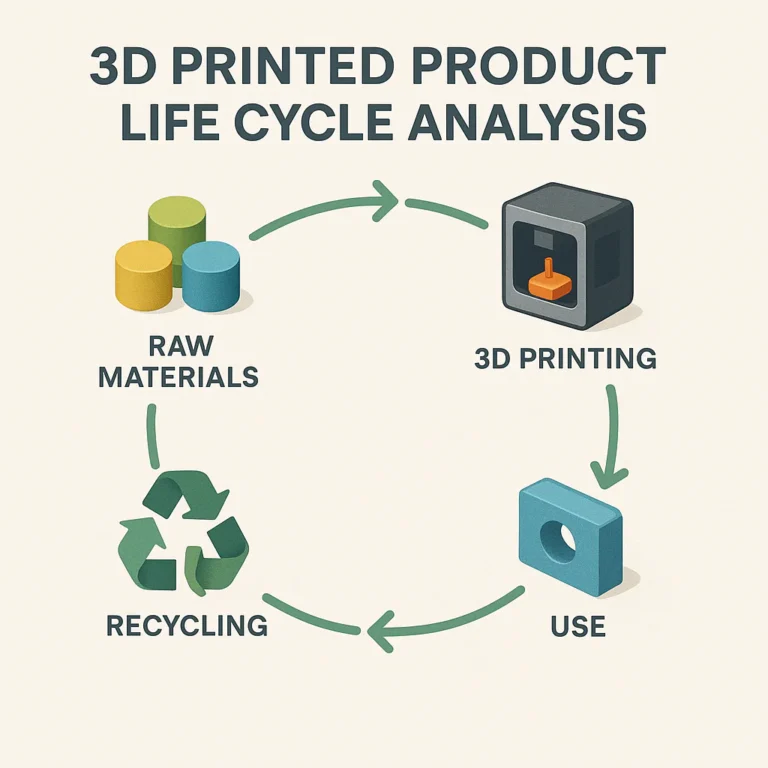
The featured video’s circular-economy perspective describes sustainability as “doing things in such a way that allows them to carry on for as long as possible.” It frames the circular system as a loop connecting Material, Design, Manufacturing, Product, and End-of-Life, rather than the traditional “take-make-discard” line. You can revisit that perspective at #featured-video.
That model changes the question from “Is this filament green?” to “How long can the material remain useful?”
Turning failed prints and supports into new filament
A small-scale recycling workflow typically looks like this:
- Sort by polymer.
- Remove metal, glue, labels, and foreign objects.
- Separate colors when appearance matters.
- Shred the material into consistent flakes.
- Dry the flakes.
- Extrude through a controlled filament line.
- Measure diameter continuously.
- Wind onto a spool under consistent tension.
- Print calibration samples.
- Label the recycled batch and record its history.
Home filament recycling can be educational and useful, but it is not automatically lower-impact. The shreder, extruder, heater, failed batches, electricity, and labor all belong in the calculation.
Filament recycling machines and distributed recycling
Examples of recycling equipment and initiatives include:
- Filabot systems for shredding and extrusion.
- ReDeTec ProtoCycler for distributed filament production.
- 3devo recycling and materials-processing equipment.
- University and makerspace recycling programs.
The best use case is a controlled stream of one polymer generated close to the recycling equipment. Mixing every colorful print in the building produces material with the aesthetic character of a parking-lot rainbow and the predictability of a mystery box.
Manufacturer take-back programs and material traceability
Take-back programs can improve recovery by:
- Providing labeled collection routes.
- Separating resin and filament.
- Returning scrap to the original compounder.
- Tracking material batches.
- Offering recycled-content products.
- Educating users about contamination.
Traceability becomes increasingly important in aerospace, healthcare, and industrial applications where material history affects qualification.
Designing parts for repair, reuse, and recycling
Design for circularity includes:
- Avoiding unnecessary mixed materials.
- Using mechanical fasteners rather than permanent adhesives.
- Adding replaceable wear components.
- Marking polymer type.
- Designing parts for disassembly.
- Minimizing pigment and coating complexity.
- Printing only the component that needs replacement.
- Keeping spare-part files available.
Our 3D Printing in Healthcare and 3D Printing in Architecture categories show why application-specific design matters: the material and recovery requirements for a prosthetic aid differ sharply from those of a decorative façade panel.
🏢 Sustainable Materials by Industry and Application
Automotive and transportation
Applications include:
- Lightweight brackets.
- Tooling.
- Interior components.
- Prototypes.
- Replacement parts.
- Air ducts.
- Custom fixtures.
Recycled ABS, PETG, nylon, and high-performance composites are relevant, while metal printing supports lightweight and consolidated components.
Aerospace and defense
Aerospace prioritizes:
- Weight reduction.
- Heat resistance.
- Fatigue life.
- Traceability.
- Reliability.
- Complex internal geometry.
MarketsandMarkets identifies aerospace and defense as a leading end-use segment. The sustainability benefit often appears through lower operational fuel use and reduced part mass rather than through biodegradable feedstock.
Healthcare, prosthetics, and biomedical research
Healthcare uses:
- Patient-specific implants.
- Surgical guides.
- Prosthetic devices.
- Dental aligners.
- Anatomical models.
- Biocompatible tooling.
Stryker and 3D Systems illustrate how customized geometry and porous structures can support medical applications. However, medical sustainability must never override sterilization, biocompatibility, regulatory compliance, or patient safety.
Construction and 3D-printed buildings
Construction-scale printing can reduce formwork and enable complex geometry. Potential sustainability benefits include:
- Local material sourcing.
- Reduced transportation.
- Less formwork waste.
- Topology-informed structures.
- Recycled aggregate use.
The actual result depends on cement content, reinforcement, curing energy, machine transport, and building lifespan. A concrete structure is not low-carbon simply because a robot extruded it layer by layer.
Packaging, retail, and consumer products
On-demand production can reduce:
- Excess inventory.
- Warehousing.
- Unsold seasonal products.
- Custom-tooling requirements.
- Long-distance shipping for small batches.
Designers should prioritize repairable, reusable, and recyclable products rather than disposable novelty objects printed in an “eco” color.
Education, makerspaces, and public fabrication labs
Schools and makerspaces can teach:
- Polymer identification.
- Waste sorting.
- Filament drying.
- Design efficiency.
- LCA basics.
- Repair culture.
- Circular-economy principles.
A successful program tracks waste and celebrates useful prints, not just the tallest tower of calibration cubes.
🏷️ Leading Companies and Sustainable Material Brands
Recycled and bio-based filament manufacturers
Notable suppliers include:
- Filamentive for recycled and sustainability-focused FDM materials.
- NatureWorks for Ingeo PLA resin and sustainability data.
- ColorFabb for specialty and composite filaments.
- Fillamentum for engineering and specialty materials.
- Polymaker for broad polymer and recycled-material development.
- 3D-Fuel for bio-based and specialty filament options.
- Prusament for documented material production and quality control.
- Recreus for flexible materials and specialty filaments.
Brand sustainability claims change over time, so check current technical pages, not only marketing summaries.
Sustainable resin developers and photopolymer suppliers
Relevant companies include:
For resin, examine the safety data sheet, disposal guidance, curing requirements, and specific bio-based percentage. “Plant-based resin” is not a substitute for a complete safety assessment.
Industrial polymer, composite, and metal feedstock producers
Major participants include:
- Arkema.
- Evonik.
- BASF.
- EOS.
- Sandvik Additive Manufacturing.
- Höganäs.
- Carpenter Additive.
- Stratasys.
- 3D Systems.
These suppliers support applications where durability, certification, and process control may matter more than simple recycled content.
Recycling technology companies and circular manufacturing startups
Examples include:
- Filabot.
- ReDeTec.
- 3devo.
- The Virtual Foundry for metal and ceramic-filled filament approaches.
- Local university and makerspace recycling initiatives.
🧪 Material Performance: Sustainability Versus Print Quality
Strength, toughness, flexibility, and heat resistance
| Property | PLA | PETG | ABS | Nylon | TPU |
|---|---|---|---|---|---|
| Ease of printing | High | Medium-high | Medium | Medium-low | Medium-low |
| Impact resistance | Low-medium | High | High | Very high | High |
| Heat resistance | Low | Medium | Medium-high | High | Medium |
| Flexibility | Low | Medium | Medium | Medium-high | Very high |
| Moisture sensitivity | Low-medium | Medium | Low-medium | Very high | High |
| Enclosure helpful? | Usually no | Usually no | Yes | Often | Usually no |
| Common sustainability route | Bio-based/recycled | Recycled | Recycled | Recycled/bio-based | Recycled |
| Best general use | Models and light-duty parts | Functional household parts | Tough enclosures | Mechanical parts | Flexible parts |
These ratings are broad material-family comparisons, not guarantees for every brand.
Dimensional accuracy, warping, layer adhesion, and surface finish
Sustainable materials can print beautifully, but process control remains critical:
- Dry moisture-sensitive filament.
- Calibrate extrusion.
- Use a clean build surface.
- Tune first-layer height.
- Adjust cooling.
- Control ambient temperature.
- Avoid overbuilding supports.
- Confirm dimensional tolerances with test parts.
Recycled materials may have more variation, but a high-quality supplier can produce excellent results. Virgin material can also print badly if stored like a forgotten sock.
Odor, VOCs, ultrafine particles, and workshop ventilation
ABS, ASA, nylon, PC, and some composites can produce unpleasant odors and emissions. Resin printing requires additional controls for uncured chemicals and cleaning fluids.
Use:
- Enclosures where appropriate.
- Local exhaust or filtered ventilation.
- Manufacturer-recommended PPE.
- Separate resin and filament work areas.
- No food preparation near printers.
- Monitoring and maintenance of filters.
The NIOSH 3D-printing topic page is an authoritative resource for occupational exposure considerations.
Post-processing, coatings, and support-material compatibility
Post-processing can add significant environmental burdens:
- Solvent washing.
- UV curing.
- Sanding.
- Painting.
- Epoxy coating.
- Acetone vapor smoothing.
- Support disposal.
- Protective packaging.
A printed part requiring heavy coating and repeated sanding may have a larger footprint than a slightly less attractive part printed with fewer supports and no finish.
🛒 How to Choose Sustainable 3D Printing Filament or Resin
Match the material to your printer and nozzle
Check:
- Maximum hot-end temperature.
- Heated-bed temperature.
- Enclosure requirements.
- Nozzle material.
- Filament diameter.
- Direct-drive or Bowden path.
- Build-surface compatibility.
- Chamber temperature.
- Manufacturer-approved resin wavelength.
A hardened nozzle is advisable for carbon-fiber, glass-fiber, wood, mineral, and metal-filled filaments.
Check recycled content, feedstock origin, and certifications
Look for:
- Percentage by mass.
- Pre-consumer or post-consumer source.
- Polymer identity.
- ISO 14021 basis.
- Third-party verification.
- Batch consistency.
- LCA scope.
- End-of-life instructions.
Avoid claims that do not define what was recycled or how the percentage was calculated.
Evaluate drying, storage, packaging, and spool design
Good packaging may include:
- Recyclable cardboard.
- Reusable containers.
- Vacuum-sealed moisture barriers.
- Desiccant.
- Spool-free coils.
- Recycled plastic spools.
- Clear batch labeling.
A cardboard spool is useful only if it remains dimensionally stable and feeds correctly. A spool that causes a tangle is an eco-themed waste generator.
Compare technical data sheets and safety data sheets
Review:
- Printing temperature.
- Bed temperature.
- Recommended speed.
- Density.
- Tensile strength.
- Elongation.
- Heat deflection.
- Moisture guidance.
- Storage conditions.
- Safety hazards.
- Disposal information.
Avoiding greenwashing in sustainable 3D printer materials
Use this five-step check:
- Identify the exact polymer.
- Find the recycled or bio-based percentage.
- Ask how the claim was verified.
- Check whether your local system can recover it.
- Compare durability against alternatives.
🛠️ Practical Tips for Lower-Waste 3D Printing
Reduce failed prints with calibration and preventive maintenance
- Clean the build surface.
- Check nozzle condition.
- Dry the filament.
- Calibrate extrusion.
- Verify first-layer height.
- Print a small test coupon.
- Inspect bridging and overhangs.
- Save successful profiles.
- Replace worn belts and tubes.
- Record failures rather than repeating them mysteriously.
Optimize infill, walls, supports, and orientation
- Use wall thickness for strength where appropriate.
- Avoid blindly increasing infill.
- Orient layers to match load direction.
- Use tree supports when they reduce material.
- Add chamfers instead of support-heavy overhangs.
- Use adaptive layer height.
- Print multiple parts together only when failure risk remains low.
- Select a material with sufficient strength instead of compensating with excessive mass.
Dry and store filament correctly
- Store nylon, TPU, PETG, and PC in sealed containers.
- Use desiccant or active dryboxes.
- Dry according to the supplier’s instructions.
- Avoid overheating low-temperature polymers.
- Label opened spools with date and drying history.
- Keep resin containers closed and away from light.
Reuse rafts, brims, supports, and purge waste safely
Separate scrap by polymer and keep it clean. Do not mix PLA, PETG, ABS, and TPU in one recycling batch. Some manufacturers and specialist recyclers accept returned waste, but local acceptance varies.
Track material usage, energy consumption, and waste
Maintain a simple spreadsheet with:
- Print name.
- Material type.
- Mass of finished part.
- Support mass.
- Failed-print mass.
- Print duration.
- Electricity use.
- Packaging.
- End-of-life route.
This turns vague sustainability claims into measurable workshop data.
📊 How to Analyze Sustainable 3D Printing Market Forecasts
Understanding research methodologies and market definitions
Before quoting a market figure, identify:
- Included materials.
- Included technologies.
- Geographic boundaries.
- Revenue versus volume.
- Forecast years.
- Primary and secondary research methods.
- Treatment of recycled and bio-based materials.
Comparing CAGR, revenue, volume, and segment forecasts
A premium metal powder market can grow quickly by revenue while remaining smaller by physical volume than commodity PLA. A recycled filament segment can grow rapidly from a tiny base without overtaking mainstream materials.
Verifying data from industry reports, standards, and public sources
Cross-check forecasts against:
- Supplier capacity announcements.
- Company annual reports.
- Import and export data.
- Patent activity.
- Government grants.
- Printer installation figures.
- Peer-reviewed research.
- Industry standards.
Why different market research firms publish different numbers
The MarketsandMarkets figures cited here concern the broad 3D printing materials market. Filamentive’s article focuses on sustainability criteria and specific polymer comparisons. Neither should be treated as a complete standalone forecast for recycled filament, bio-based resin, or circular additive manufacturing.
That is why we trust directional agreement more than a single dramatic number. If several sources identify bio-based polymers, lightweighting, localized production, and material efficiency as growth factors, that trend is meaningful even when their market totals differ.
🔮 Future Trends in Bio-Based, Recycled, and Circular 3D Printing
Smart materials, self-healing polymers, and reprocessable composites
Future materials may combine:
- Reversible bonding.
- Self-healing behavior.
- Reprocessable thermosets.
- Recyclable fiber composites.
- Embedded sensing.
- Improved repairability.
These could extend service life, although complexity can make recovery harder.
AI-assisted material development and print optimization
AI can help:
- Predict warping.
- Optimize support structures.
- Reduce failed prints.
- Tune extrusion.
- Design lightweight components.
- Match material properties to loads.
- Identify recycling blends.
The sustainability value comes from fewer experiments, less scrap, and more efficient geometry, not from adding “AI” to a product page like a decorative sticker.
Carbon-negative feedstocks and regenerative biomaterials
Emerging research explores:
- Biochar-filled polymers.
- Algae feedstocks.
- Agricultural residues.
- Mineralized biomass.
- Carbon-capturing materials.
Claims require careful LCA. Carbon stored in a feedstock may be released during processing or disposal, so the full life cycle matters.
Digital product passports and material traceability
A digital product record could identify:
- Polymer type.
- Recycled content.
- Manufacturer.
- Batch.
- Print settings.
- Repair history.
- Recycled route.
- End-of-life instructions.
That would make future sorting and qualification far easier than guessing from a mysterious black plastic bracket.
Localized microfactories and distributed manufacturing
Small production hubs may manufacture:
- Spare parts.
- Medical aids.
- Replacement housings.
- Custom tools.
- Agricultural components.
- Educational products.
The benefits are strongest when the part file, material, printer, and quality requirements are managed together.
⚖️ Regulations, Standards, and Sustainability Certifications
ISO and ASTM standards for additive manufacturing
Relevant organizations include:
Standards support terminology, process control, testing, and qualification. They do not automatically certify a material as sustainable.
Environmental product declarations and life-cycle reporting
Environmental Product Declarations can provide structured life-cycle information. Compare:
- Declared unit.
- System boundary.
- Geographic scope.
- Electricity assumptions.
- Allocation rules.
- Data age.
- Third-party verification.
Recycling, compostability, chemical safety, and waste regulations
Check:
- Local plastic recycling rules.
- Industrial composting acceptance.
- Hazardous-waste requirements for resin.
- Chemical labeling.
- Workplace exposure controls.
- Packaging regulations.
- Producer responsibility obligations.
EU, United States, and global policy developments
Policy is increasingly focused on:
- Circular product design.
- Recycled content.
- Repairability.
- Waste prevention.
- Chemical safety.
- Product traceability.
- Carbon reporting.
Businesses should monitor the European Commission environment policy portal, U.S. EPA waste resources, and applicable national standards.
✅ Benefits and ❌ Trade-Offs of Sustainable 3D Printing Materials
| ✅ Benefits | ❌ Trade-offs |
|---|---|
| Reduced dependence on virgin fossil feedstocks | Recycled material quality can vary |
| Lower material waste in suitable designs | Failed prints and supports still create waste |
| Potentialy lower carbon footprint | Results depend on LCA boundaries |
| Lightweight and consolidated parts | Advanced printers and post-processing consume energy |
| Localized manufacturing | Local production is not automatically low-carbon |
| Longer service life | Durable engineering polymers may be difficult to recycle |
| Recycled content | Local recovery infrastructure may be absent |
| Bio-based feedstocks | Land, water, and agricultural impacts remain |
| On-demand production | Digital files do not eliminate electricity or packaging |
| Design freedom | Poor design can waste more material than conventional methods |
💡 Quick Takeaways for Manufacturers, Designers, and Makers
- Choose the material for the job first.
- Measure sustainability across the full life cycle.
- Do not confuse bio-based with biodegradable.
- Ask for verified recycled-content data.
- Favor durable, repairable objects.
- Use recycled PETG for many functional household parts.
- Use PLA for low-load, low-heat applications where its properties fit.
- Use nylon, TPU, ABS, or engineering materials when service life justifies them.
- Treat resin waste as a serious handling issue.
- Sort scrap by polymer before attempting recycling.
- Reduce supports and failed prints through design and calibration.
- Read technical and safety data sheets.
- Treat market forecasts as directional, especially where sustainable materials are not separately defined.
- Remember the circular-economy loop: material, design, manufacturing, product, and end of life.
🏁 Conclusion: Where the Sustainable 3D Printing Materials Market Is Heading

The growth of the sustainable 3D printing materials market is real, but it is not being driven by one miracle filament. It is emerging from a combination of recycled polymers, bio-based feedstocks, longer-lasting engineering materials, lightweight designs, localized production, and circular recovery systems.
For most makers, the practical path is straightforward:
- Choose PLA when low-temperature, low-load printing and lower feedstock impact matter.
- Choose recycled PETG when you need a tougher material and documented recycled content.
- Choose nylon, TPU, ABS, or advanced polymers when durability prevents repeated replacement.
- Treat resin printing as a separate safety and waste-management challenge.
- Design parts for repair, disassembly, and long service life.
- Measure failed prints, support waste, electricity, and disposal rather than relying on attractive labels.
The question we raised at the beginning was whether a sustainable material must be biodegradable, recycled, renewable, or simply durable. The answer is: it depends on the complete application and life cycle. A material stays sustainable only when its environmental benefits survive contact with the real world: printer settings, workshop habits, product use, and end-of-life infrastructure.
The most credible future is circular rather than merely “green”: keep the material in play for as long as possible, and make every printed object earn its place.
🔗 Recommended Links
Sustainability and market research
- Sustainable 3D printing materials: Filamentive sustainability guide
- 3D printing materials market forecast: MarketsandMarkets report
- 3D printing statistics: 3D Printed™ statistics guide
- Circular economy policy: European Commission Circular Economy Action Plan
Recommended sustainable material brands
- Filamentive: Filamentive Official Website | Filamentive on Amazon
- NatureWorks Ingeo PLA: NatureWorks Official Website | NatureWorks PLA on Amazon
- ColorFabb composite filament: ColorFabb Official Website | ColorFabb filament on Amazon
- Fillamentum materials: Fillamentum Official Website | Fillamentum filament on Amazon
- Polymaker filament: Polymaker Official Website | Polymaker recycled filament on Amazon
- Prusament filament: Prusament Official Website | Prusament filament on Amazon
- 3D-Fuel materials: 3D-Fuel Official Website | 3D-Fuel filament on Amazon
Recycling equipment
- Filabot recycling systems: Filabot Official Website | Filabot on Amazon
- ReDeTec ProtoCycler: ReDeTec Official Website
- 3devo recycling equipment: 3devo Official Website
Books and deeper reading
- Additive Manufacturing Technologies by Ian Gibson, David Rosen, and Brent Stucker on Amazon
- The 3D Printing Handbook by Ben Redwood, Filemon Schöffer, and Brian Garet on Amazon
- Circular Economy: A Handbook for Business and Supply Chains on Amazon
❓ FAQ About the Growth of Sustainable 3D Printing Materials Market

What is driving the growth of the sustainable 3D printing materials market?
Growth is being driven by recycled-content demand, bio-based polymers, corporate ESG targets, supply-chain localization, lightweighting, on-demand production, and stricter waste expectations.
MarketsandMarkets forecasts the broader 3D printing materials market to grow from USD 3.88 billion in 2025 to USD 10.02 billion by 2030, at a projected 20.9% CAGR. That forecast includes conventional and advanced materials, so it should not be interpreted as the growth rate for sustainable materials alone.
Why industrial applications matter
Aerospace and healthcare can justify advanced materials because lightweight, customized, or consolidated parts may deliver operational benefits over long service lives. Consumer adoption adds volume, particularly through PLA and PETG filament.
Read more about “What Is the 3D Printing Market Analysis? 🚀 (2026)”
Which sustainable materials are best for 3D printing useful household items?
For many household objects:
- Recycled PETG is the best general-purpose option for hooks, organizers, brackets, bins, and protective parts.
- PLA works well for dry, low-load, low-heat objects such as labels, décor, and desk organizers.
- TPU suits flexible feet, bumpers, seals, and cable protection.
- Nylon is better for high-wear parts, hinges, gears, and mechanically stressed components.
- PP is useful where chemical resistance, flexibility, or living hinges matter, but it can be more difficult to print.
Choose according to heat, load, flexibility, moisture, and expected service life. A material with a lower production footprint may be less sustainable if it fails repeatedly.
Read more about “🚀 3D Printing ROI: The Ultimate 2026 Guide to Profit & Savings”
How much does it cost to 3D print with eco-friendly materials?
Costs vary by:
- Material type.
- Recycled-content percentage.
- Brand and quality control.
- Shipping distance.
- Printer efficiency.
- Drying requirements.
- Failure rate.
- Support use.
- Post-processing.
- Required certifications.
Recycled and bio-based materials may carry a premium because sorting, compounding, testing, and documentation add cost. However, a durable part can reduce total ownership cost by avoiding replacements, tooling, inventory, and shipping.
The most useful comparison is cost per successful, functional part, not cost per spool.
Read more about “🤖 AI for Material Selection in 3D Printing: Stop Guessing, Start Printing (2026)”
Are biodegradable 3D printing materials durable enough for everyday products?
Some are, but “biodegradable” does not describe mechanical performance. PLA can make durable household objects under suitable conditions, yet it softens at relatively low temperatures and may become brittle under impact or prolonged outdoor exposure.
For everyday products, consider:
- Heat exposure.
- UV exposure.
- Moisture.
- Impact.
- Flexing.
- Chemical contact.
- Required lifespan.
- End-of-life facility.
If the object must survive heat or repeated mechanical stress, PETG, nylon, TPU, ABS, or an engineering polymer may be more appropriate.
Read more about “🚀 3D Printed Electronics: The Ultimate 2026 Guide to Printing Circuits”
What are the most popular recycled materials for 3D printing?
The most common recycled materials include:
- Recycled PLA.
- Recycled PETG.
- Recycled ABS.
- Recycled nylon.
- Recycled TPU.
- Recycled metal powders.
- Recycled or reclaimed construction aggregates.
Recycled PETG is especially attractive for functional desktop prints because it balances toughness, printability, and recycled-content potential. Recycled PLA remains popular for prototypes and decorative objects.
Always check whether the recycled content is pre-consumer, post-consumer, internally reprocessed, or a blend.
Read more about “15 Statistics About 3D Printing in America (2026) 🇺🇸”
How can sustainable 3D printing reduce waste when making custom objects?
It can reduce waste by:
- Producing only what is needed.
- Avoiding large tooling runs.
- Reducing inventory.
- Printing replacement components instead of whole products.
- Optimizing geometry.
- Creating lightweight structures.
- Manufacturing close to the point of use.
- Iterating digitally before production.
- Repairing obsolete or unavailable parts.
The benefits are strongest when the object is designed for low support use, printed successfully, used for a long time, and recovered or repaired at end of life.
Read more about “🤖 Automated Post-Processing for 3D Prints: The 2026 Guide to Factory-Ready Parts”
What are the best things to 3D print using sustainable materials?
Excellent projects include:
- Replacement knobs and handles.
- Drawer organizers.
- Tool holders.
- Cable clips.
- Repair brackets.
- Custom hooks.
- Planters and plant labels.
- Modular storage.
- Protective cases.
- Educational models.
- Adaptive grips.
- Jigs and fixtures.
- Replacement appliance parts where safety permits.
Explore our 3D Printable Objects category for practical project ideas. The best sustainable print is usually one that replaces a purchase, extends a product’s life, or solves a problem with minimal material.
Read more about “💸 How Much Does It Cost to Make a 3D Print? (2026 Truth)”
Is PLA more sustainable than PETG or ABS?
PLA can have an advantage in certain carbon-footprint and embodied-energy comparisons, particularly when made from renewable feedstocks. Filamentive cites NatureWorks data and the Shen et al. life-cycle study in support of this position.
PETG may be preferable when recycled content and practical recycling are the priorities. ABS can be the better choice when heat resistance and impact durability prevent repeated replacement.
The most sustainable option depends on the chosen metric and the finished part’s service life.
Read more about “🎨 Dyeing 3D Prints: The Ultimate 2026 Guide to Vibrant, Paint-Free Color”
Can failed 3D prints be recycled at home?
Technically, some thermoplastic waste can be shredded and extruded into new filament, but home recycling requires:
- Polymer sorting.
- Clean feedstock.
- Drying.
- A shreder.
- An extruder.
- Diameter control.
- Calibration.
- Safe operation.
- Electricity.
It is most practical for makerspaces, schools, and small production environments with a consistent single-polymer waste stream. Do not mix PLA, PETG, ABS, TPU, and composites.
Read more about “🤯 What Are 3D Printed Items? 16+ Things You Can Actually Make (2026)”
Are 3D printing resins recyclable or biodegradable?
Most standard photopolymer resins are thermosetting materials. Once cured, they generally cannot be melted and reshaped like thermoplastic filament. Bio-based resin may contain renewable ingredients, but that does not automatically make it recyclable, biodegradable, or safe for disposal in ordinary waste.
Handle uncured resin, wash liquid, gloves, and contaminated materials according to the supplier’s safety data sheet and local waste rules.
Read more about “How Does 3D Printing Impact Manufacturing Costs and Efficiency? 🔧 (2026)”
How can manufacturers prove that a material is sustainable?
They should provide:
- Recycled-content percentage.
- Feedstock origin.
- Carbon-footprint or LCA data.
- Energy and process assumptions.
- Technical data sheet.
- Safety data sheet.
- Relevant ISO, ASTM, or EN certifications.
- Packaging information.
- End-of-life guidance.
- Batch traceability.
Specific, verifiable claims are more trustworthy than broad language such as “eco-friendly,” “green,” or “planet-safe.”
Read more about “12 Eye-Opening 3D Printing Statistics (2021) 📊”
📖 Reference Links
- MarketsandMarkets: 3D Printing Materials Market
- Grand View Research: 3D Printing Materials Market
- Filamentive: What Makes a 3D Printing Material Sustainable?
- NatureWorks: Ingeo PLA and Sustainability
- ISO 14021: Environmental Labels and Declarations
- ISO 140: Life-Cycle Assessment Principles and Framework
- ISO Additive Manufacturing Committee ISO/TC 261
- ASTM Additive Manufacturing Standards
- European Commission: Circular Economy Action Plan
- European Environment Agency: Circular Economy
- U.S. Environmental Protection Agency: Hazardous Waste
- U.S. Environmental Protection Agency: Solid Waste Research
- NIOSH: 3D Printing and Occupational Safety
- Biodegradable Products Institute
- GE Aerospace Additive Manufacturing
- Stryker Additive Manufacturing
- 3D Systems Healthcare Materials
- Stratasys Materials Catalog
- Arkema Advanced Materials
- Evonik Additive Manufacturing
- Sandvik Additive Manufacturing
- Filabot Recycling Systems
- ReDeTec ProtoCycler
- 3devo Materials Processing